Sunday, 2 April 2023

Atmosphere and Surrounding Objects : Loose Assemblages/Living Emotions/Theoretical Gaze

Paintings being living emotions. Mark Rothko

The atmosphere of a work of art, what surrounds it, that 'place' in which it exists - all this is thought of as a lesser thing, charming but not essential. Professionals insist on essentials ... not understanding that everything we use to make art is precisely what kills it. This is what every painter I know understands. And this is what almost no composer I know understands.

The Music of Morton Feldman, reprinted from his essay  "The anxiety in art"


OUTPOST STUDIO  July 2021


Loose Assemblages : The Movement of Ideas and Feelings

Touch and materials as a normative support/exploration for the theoretical gaze


Bento's Sketchbook : John Berger


Existence appertains to the nature of substance.


A substance cannot be produced from anything else: it will therefore be its own cause, that is its essence necessarily involves existence, or, existence appertains to its nature.

Ethics, Part 1, Proposition VII, Proof


Conscious minds arise from establishing a relationship between organism and an object-to-be-known. Damasio


Architectural Body

Organism-Person-Environment


Drawing is a  form of probing. And the first generic impulse to draw derives from the human need to search, to plot points, to place things and to place oneself.


The Human Body through drawing and philosophy

Berger/Spinoza 141


Matters of a discursive consciousness are explicit and explainable, and the line between discursive and practical consciousness is fluctuating and permeable, both drawing on the other in the act of agency/making social.


The defining point of agency is namely its potential to transform the given.


Generative energies, entanglements, sensorial diversions from an open studio window overlooking Anglia Square


Improvisations/choreographed with the music/ambient noise are exploratory encounters  between flesh and sound


A hut of ones own (within and bounded by others), crafted and organized around simple processes and interactions within a fallow site given over to creative ecology of energies and enterprise


Vibrant yet curiously passive form of  urbanism


Affectivity as a mimesis of lively transfers between things, humans and non-humans


Human subjectivity : Mimetic Encounters/Explorations


Art works by gathering up forms and materials for affective experimentations in subjectivity


Corporeal unconscious animated by sensitivities/sympathies, a putative affinity (haptic) between certain things including bodies and organs which makes them liable not only to be similarly affected by the same influence, but more especially to affect or influence one another. 


Intentionality/Sympathy/Sentiment/Difference

Inducing a particular set of ethical/political/social responses in actor/social audience 


Mimesis : Paradox or Encounter. Jane Bennett


Calling a sympathy/subjectivity between coloured cloth/wallpaper/display cabinet and human flesh

Francesca Woodman


Mimesis and suggestion in the social,enacted through layers of mediation surrounding humans, objects and non-humans.


Camouflage. Neil Leach


Mimesis

Sensuous Correspondence

Sympathetic Magic

Mimicry

Becoming 

Sensations in Space and Time (the experience/entanglement of phenomena and idea)
Agency/Foraging/Making/Gathering
Subjectivity is relational (always in process)
A Species of Making Spaces
Tentativeness, attentive to situatedness 

A diffractive methodology enables a critical rethinking of science and the social in their relationality, moving beyond separate entities, separate sets of concern. 
Karen Barad 

Organism 
Person
Environment
Arakawa and Madeline Gins

For Merleau-Ponty, Experience can only be understood between the mind and the body or across them in their lived conjunction.

The mind is always embodied, always based on corporeal and sensory relations.
Elizabeth Grosz.

Richard Serra : Verb List Compilation
Actions to Relate to Oneself, 1967-1967

Drawing in its frameworks and dimensions/presence and absence/its here and elsewhere

Exploring the fragility of a painting in the landscape
Canvas as sheltering construction, Raveningham Sculpture Trail

Diagram-Map-Chart, is a symbolic depiction emphasizing (mapping) relationships
Diagrams For The Imagination : Arakawa

Apokatastasis : Jim Jarmusch, Jozef Van Wissem
Litany Of Echoes : James Blackshaw
New Music, for old instruments : Paul Metzger, Jozef Van Wissem
Brilliant Trees : David Sylvian

Body As Cultural Product
Both psychic and social dimensions must find their place in reconceptualizing the body, not in opposition to each other, but as necessarily interactive.
Volatile Bodies/Chaos-Territory-Art : Elizabeth Grosz


Spatial Asperity/Mesh, Membrane and Gauze, Möbius Strip, Pattening, 

Actuality : Robert Mangold
Paintings around the particles/flows of things/boundaries/intervals of presence and absence
Induction/Capacitance/Encapsulated Layers

Drawing and its attempts to map out/make visible contingent things
Contingency, is what remains, as it comes up against causality/constantly passing through
Objects/Things conceptualized by the exploration of drawing (intervals of blindness)

Linking Surface to the Aesthetic Experience of Space.
Experiences incorporating interests with environmental textures into Art.
Points of Contact/Confluence of Circumstances
Materials bound by contact/canvas
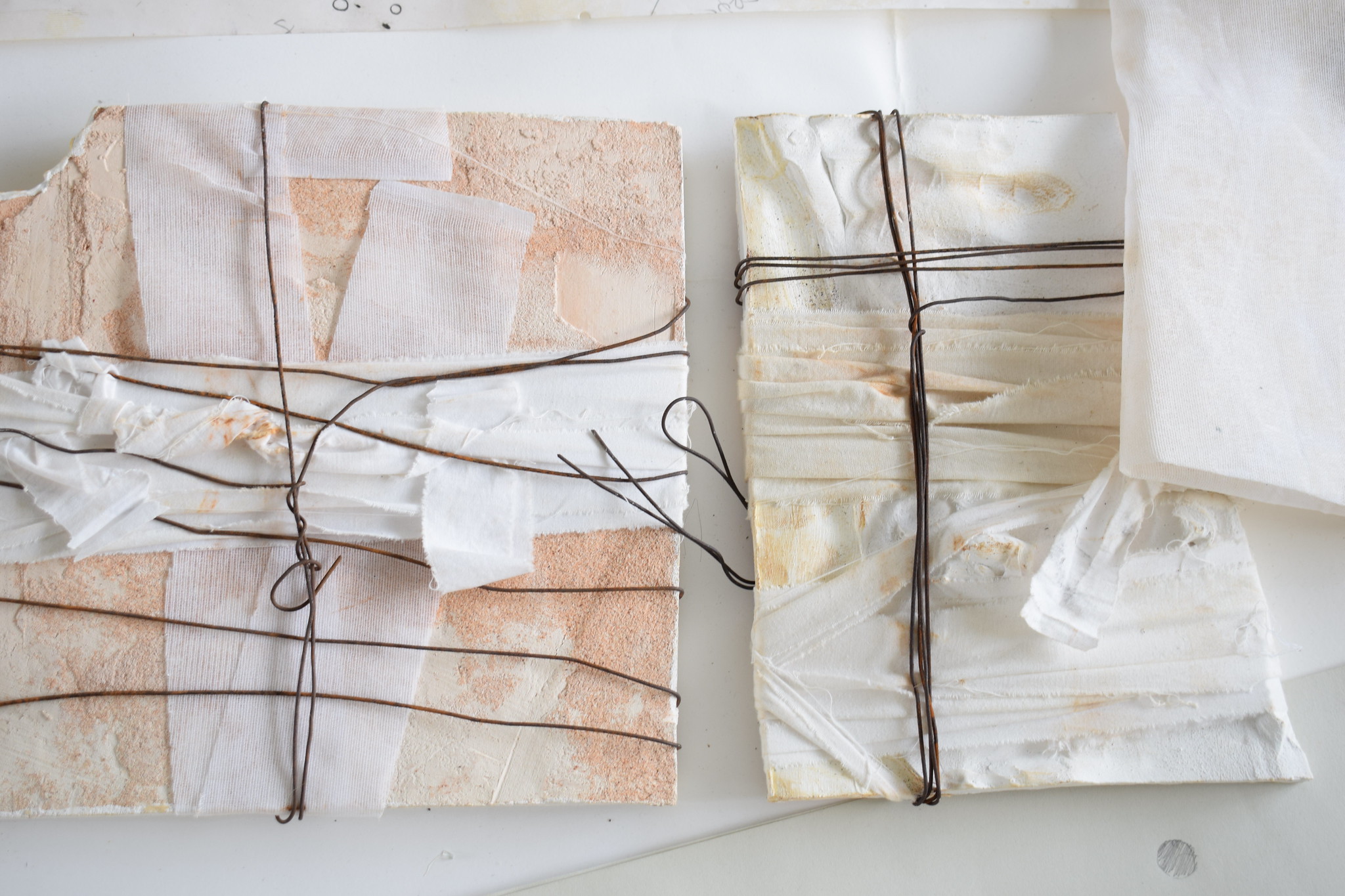
Patina, absences, gesso, textile wrappings, field chalk, exhumed oyster shells, yellow ochre,

A philosophy of Reading/Matter/Rooms, 
The Lake of The Mind
Stochastic Thinking, Steven Holl
Solitude/Libraries : Cell/Court/Domain
Capacitance, relationships between intensities and movements
Clay, Waxed Surface, Liquid Rust, Calico,

Sensate Bandages/Windings/Armatures : Corporeal Landscapes/Assemblages/Things
Flesh, elementary pre-communicative, subject and object develop.
Making as Growth : Tim Ingold

Social Architectures/Anthropologies/Imaginary Projects/Interfaces/Screens

Timothy Morton : Realist Magic
The elasticity of sensation, affective and wonderous

Sally Mann : Matter Lent/Collodion wetplate negatives
Corpus, liquid light, flesh, spirit, trace, outline, human body, performative,

Paintings/Enactments : Canvas as a spatial verb


Espace-Milieu, painting as environment/entanglements and situations

Ceramic/Process and its theoretical objects 
As a series of practices, making reality by bringing things together or separating them into their singularities, or making machines/desiring machines

Desire can be seen as an Actualization
Gathering Notations : Bernard Tuchumi  

Both presence and absence are coupled in this framework
Deleuze/Guattari

Glass/GLAS : Resistivity/Inclusions, A Field in England.
Translucent aesthetics, beyond the opacities of the sensible the rational.

An image that adequately expresses both the efficacy and the temporariness of the phenomena ( joining a diffused/invisible flow of energy, a breadth that wends its way ceaselessly through the world). Animating it as it goes.
Vital Nourishment, Departing from happiness, Francois Jullian.


What is a body capable of -  
Spinoza

Building/Making, into the theoretical performative object (that does theory)

Albers/Clarke : Interactions, Counterpoints, Intervals between colour/forms, 
Membrane, Discursive, Diffractive, Sensory, Layered and Filtered Light,
Body, Movement, Mind, Assemblages, Exploratory, Speculative, Choreographic,

Deleuze/Guattari, understand the body more in terms of what AFFECTS it is capable of, instead of the consequences of having a body.


Peter Zumthor : Thermal Baths
Human Agency/Temporal transitions between matter and movement.
Immaterial/Concrete/Water : Bodies in contact/the corporeal social human body


Manifolds/Theory of Temporality/3 Synthesis of Time

Memory     Past Preserved                    Condition
Present       Habit Instants                     Agent
New           Future, actual/virtual          Creation of The New
 
Multiplicity, purality of contemplating souls.

Asymmetries between particular past and general future.

Temporality involves multiple interacting processes.


Architecture becomes Spatial Agency
We all make space : Jeremy Till
Paintings, space, volume, surface, passages, actualizations, claddings/camouflage 

One conceives and reads a building in terms of sequences, both phenomenological and filmic, reading a space by its depth of field, its thickness.
Turbulence House, New Mexico, Steven Holl.

Aesthetics/Asperities : Resultants that incorporate the friction (asperity) of their trajectories through a medium. Tilt-up concrete construction, Chapel of St, Ignatius, Seattle. Steven Holl.

Navigations and Vectors/conduits/intervals and traces between discursive practices.

Wrapped Silences : Assembled Sectional Elements/Thresholds

Surfaces on Mourning/Samsara, a beauty fed on emptiness

Social sites of space/situatedness/matter : Explorations in developing spatial intelligence

Discursive and practical apparatuses, both drawing on the other in the act of agency.

The defining point of agency is namely its potential to transform the given.  

Spinoza : Practical Philosophy by Gilles Deleuze

Bento's Sketchbook : John Berger


Beams and Netting: Negotiations in the chamber, Hyde Abbey Gatehouse, Winchester.

Clay, hessian, drawings and transparencies, drawing frame, antique glass, lead and nylon lines.

‘Leylines’ has been appropriated and employed as both a practical and as a conceptual strategy to inquiry into places and localities. Site visits and sensitive dialogues with the other artists at a number of locations have further brought materials and processes into the creative realm. The spatial practice of setting-up this work has produced a social narrative of its own invention.

This intervention into a listed building has become a temporary refuge for a work in progress. The work attempts to show a creative agency as it encounters a host of installed hierarchies and conditions. The architectural motif on the drawings has been derived directly from the open apertures of the chamber.

Artist’s Book: white and coloured pages

A hand-bound book comprising of five signatures each with four folios. This book contains a collection of postcards made from contact prints and photograms from Tidbury Ring using the cyanotype process.


Monday, 27 March 2023

Juhani Pallasmaa : The Thinking Hand/Spatial Representation/Working Drawings,Collages and Cyanotypes.

“In my view, the task of architecture is to maintain the differentiation and hierarchical and qualitative articulation of existential space. Instead of participating in the process of further speeding up the experience of the world, architecture has to slow down experience, halt time, and defend the natural slowness and diversity of experience. Architecture must defend us against excessive exposure, noise and communication. Finally, the task of architecture is to maintain and defend silence.”
Juhani Pallasmaa : The Thinking Hand.
Existential and Embodied Wisdom in Architecture. 2009


Tuesday, 21 March 2023

From Naked to Nude : Drawing from Life/Luminosity/Movement/Corporeality.


From Naked to Nude.

Life Drawing.


https://www.flickr.com/photos/russellmoreton/


Drawing as an inquiry of seeing/being/feeling

Bodies in an abstracted atmosphere of absence


Luminosity/Movement/Corporeality.


The blurring/dissolution of the conventional distinction/relationships between the figure and the ground.


The luminescent dematerialization of the subject. 


The nude, mediated by the mechanical effects of photography/blurring/fragmentation and the distance/blindness of drawing/memory.

Monday, 20 March 2023

Littoral Zones/Making Processes : Affect, an ecology of experience/Clay Work : Visceral Practices.

 Momentum Wheel : Lucie Rie Installation.

Clay/Ceramics as a concept to a way of thinking.

Speculative Tectonics : A Poetic of Construction.


The Clay can take to the mould and mould the clay.

Simondon, took the essence of matter or the material to lie in form-taking-activity.

Brian Massumi. 2009.


Clay Works --- In and Out of material : Clay plays the stone, the stone plays the clay

Tony Cragg


IN AND OUT OF MATERIAL


Demonstration


Tony Cragg : I basically mean the effectiveness of the object, of the material. But because the metaphysical and physical association are already occupied, I'm interested in somehow establishing some relationship with the materials and the things around me without using any preconceived notions of an already occupied language. It is a bit like taking away a Christian name and depersonalising something. What I mean is that it's an attempt on my side to restart the relationship with the material, which I think sculptors have to do anyway.


Jon Wood : Thinking of the increased awareness that this side of your work tries to capture and harness in the viewer, can you say a bit about the kind of sensitivities that you would like to be heightened? What would you see your work as demonstrations of and for? Your sculptures are triggers for what kind of thinking?


Tony Cragg : Well there is an attitude to looking at things and to looking at objects and materials which is based on a meditative tradition of contemplation : the universe in a grain of sand idea, or maybe even religious ideas where you actually get in contact on some level with the material world, on a deeper level than the one you obviously are capable of reaching in an everyday situation, so on an extraordinary level, outside of your own experiences.


I am not saying that that's not interesting or important. But I also think that this leaves the battleground for the everyday life to be governed by non-contemplative thought and non-meditative thought. And this may sound like a mixture of terms, but I think that there is a job to be done even on an everyday, “second for second” level of life—on the experiential level of life. I think there is a job to be done here improving the quality of contemplation about an awareness of the material world—the material world seen as an immediate extension of the communal social effort, the cultural effort that you are part of.


Jon Wood : How does it move from being an individual contemplative experience to being one that has a communal relevance?


Tony Cragg : In the main part it only has communal relevance. All you can do for yourself is formulate your sentences, cook yourself a meal that suits you, get dressed in a fashion that suits you, and everything else you have to put up with as having been made by other people for you. But obviously, even if they didn't ask your permission, there's something consensual about that, isn't there? Even though you don't like it, it doesn't look like you're making an effort to change it. And maybe there's some active thing there. My idea is that even if I don't like it, I wouldn't be able to change a great deal of it, but I could sow the seed for some change in the direction that I would feel would be important. It's a measure of how much responsibility one takes for the change. Looking for more in the visual world around me and looking for more language, in a sense, is one way of heightening sensibilities and expanding a vocabulary and then expanding the responses to a vocabulary is a way of heightening sensibilities. I'm not a politician, but I think we still live in a world that is greatly dominated by mesmerism and mystical models, which are very distracting because they actually stop us from really trying to face reality.


Realist Magic

Objects, Ontology,

Causality

Timothy Morton


Clay Work : Visceral Practices


https://www.flickr.com/photos/russellmoreton/

Pastoral Space: Material, Inquiry and Craft.

Longshore drift is a geographical process that consists of the transportation of sediments (clay, silt, sand and shingle) along a coast at an angle to the shoreline, which is dependent on prevailing wind direction, swash and backwash. 

This process occurs in the littoral zone, and in or close to the surf zone.


Material Agency : Carl Knappett, Lambros Malafouris

Visualising Environmental Agency.


"Agents are defined as persons or things, which have the ability and intention to "cause" something "in the vicinity" or "in the mileau" to happen ( Gell 1998)"

"These latter artefacts are described with the term "index", to remove the appellation "art" and to imply that they are indexes of agency."

Some Stimulating Solutions, Andrew Cochrane.


Tectonics in architecture is defined as "the science or art of construction, both in relation to use and artistic design." It refers not just to the "activity of making the materially requisite construction that answers certain needs, but rather to the activity that raises this construction to an art form." It is concerned with the modeling of material to bring the material into presence: from the physical into the meta-physical world.

http://dspace.mit.edu/handle/1721.1/78804


Situate them in such a way that useful space for life may form itself amidst them.

Kazimar Malevich 1924

Zaha Hadid on Malevich • BBC CH/4


Template and Form 2010.The Yard,Winchester.


Modern information theory claims that both the clay and the mould are engaged with matter and form. The clay is in a metastable state that possesses potential energy, unevenly distributed, but capable of effecting a metamorphosis. This quality of the clay is the source of its form. The mould places a limit on the expanding form of the molecular organisation of the clay as it fills the mould. The mould does not form the clay passively, but communicates a resonating action throughout the clay that alters the clay's molecular organisation.