Possible Worlds (2001)
Reviewed by Jason Korsner
Updated 11 July 2001
The fourth film by the French Canadian theatre director Robert Lepage - his first in English - cements his reputation as a film maker with a unique vision.
"Possible Worlds" is a poetic study of the nature of human existence, wrapped up in a murder mystery.
George Barber (McCamus) is found dead with $1000 in his pocket but with his brain missing. Interspersed with the subsequent police investigation, we see moments of George's life as he struggles to make sense of the world - or worlds - he lived in. "Each one of us exists in an infinite number of possible worlds," he muses, as he keeps meeting the same woman, Joyce (Swinton), although each Joyce he meets has a different past, a different present, and a different personality.
Lepage employs exquisite visuals as he explores George's imagination and the role it played in his life, asking fundamental questions like do our thoughts exist before we think them? Or is there another me?
Tom McCamus displays just the right amount of vacant confusion, while Tilda Swinton gives a remarkable performance - or four performances - reprising the same character in different but simultaneous worlds.
The pace is slow and deliberate, but any faster and the audience would get lost. "Possible Worlds" is not easy to watch, and poses more questions than it could ever hope to answer, but this intelligent film will certainly achieve the director's goal of inspiring discussion.
Material absorbed in its own thoughts :
Friday, 20 October 2023
Art Works Outpost Studio 2021 : Discursive Constructions/Speculative Practices of Knowing : Possible Worlds/Robert Lepage 2001
Wednesday, 4 October 2023
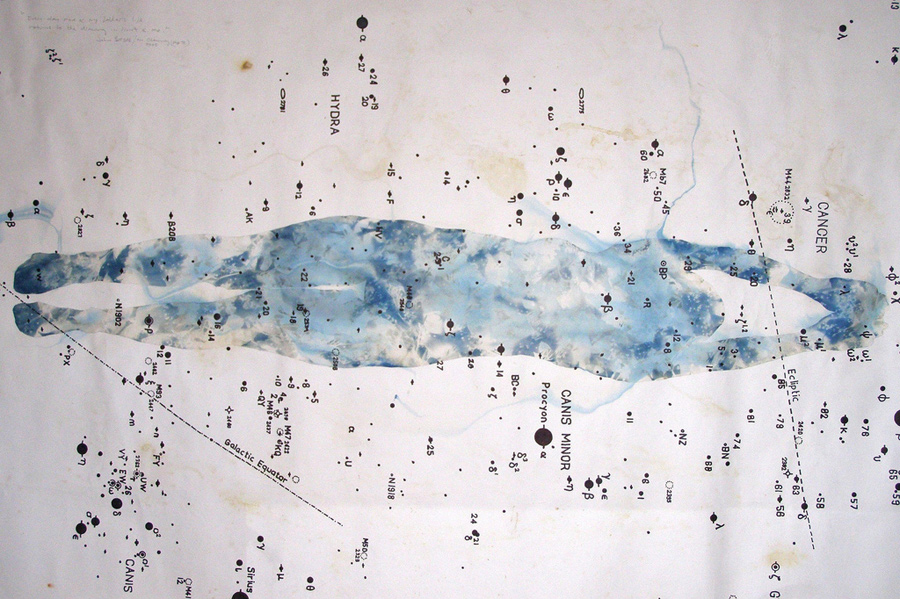
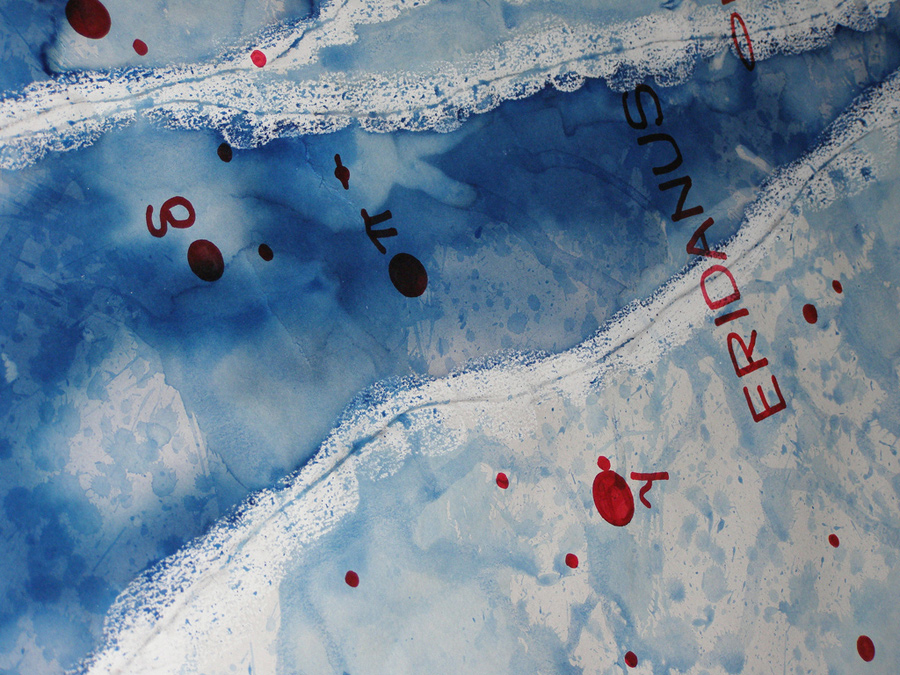
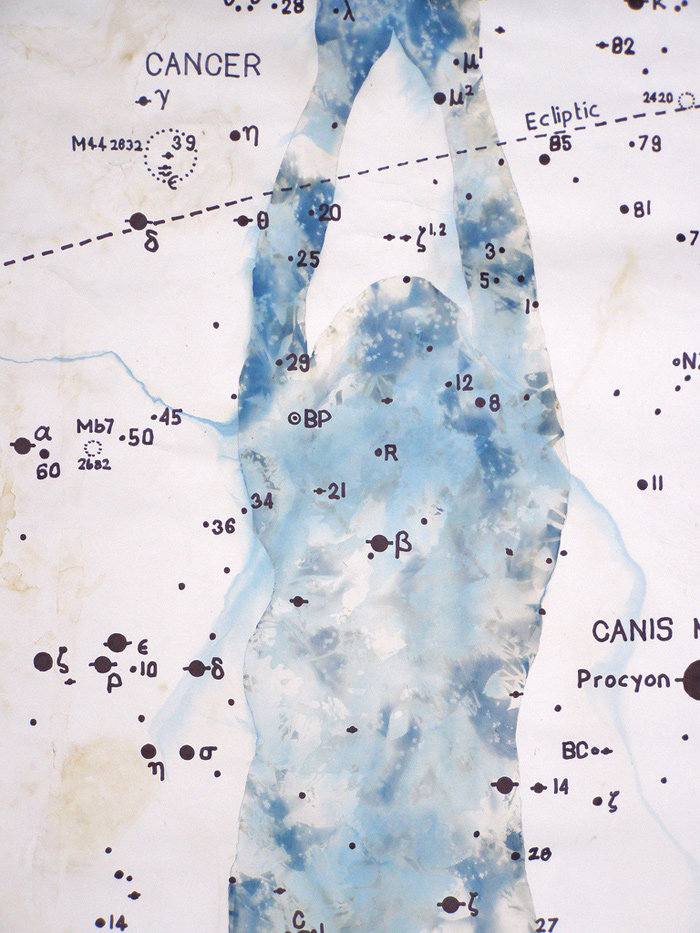
Cyanotypes : Creative Ecologies
The Drowned World, JG Ballard.
Blueprints : Anthropological Forms
Botanical traces with leper graves
DSC_0205 Archipelagic
DSC_0250 Architectural Blueprint
Biosphere (Ecology and Entropy) 2012.


Friday, 22 September 2023
Explorations around dwelling/site based ontologies : Site/Life-specific/animate installations.
Outpost 240123
Harleston 170923
Speculative/Creative /Geographies/around Moving Bodies of Thought.
Rethinking The Animate, re-animating thought, Tim Ingold.
Overlay, Contemporary Art and The Art of Prehistory, Lucy R. Lippard.
Homes and Graves and Gardens.
The Architecture Of Luis Barragan, Emilio Ambasz.
Intimately bound to Barragan's sensitivity for colour is his animistic feeling for matter. In a culture exhausted and irreparably fragmented, the walls surrounding Barragan's gardens are perhaps the last defences to preserve centuries of thought and emotion.
Explorations around dwelling/site based ontologies.
Dwelling/Person/Environment/Engagements.
The simple fluid 'flat' making ontologies of bringing/bonding clay forms together.
Worlding/Water/Performative/Intraventions.
A Practice of Transformational Modalities.
The Processual Character of Form.
Organic life, as I envisage it, is active rather than reactive, the creative unfolding of an entire field of relations within which beings emerge and take on the forms they do, each in relation to the others. Life is the very process wherein forms are generated and held in place.
Ingold.
For Ingold, there is no environment without the folding and enmeshment that is the process of life. Organisms are not folded in on themselves and surrounded by an 'environment'. Instead organisms are points of growth of environment, and whose relations are rhizoidal; and the environment is better understood as a domain of entanglement.
Making/Curriculum/Dwelling/Landscape/Place.
Re-imagining Education.
Brockwood Park School.
Understandings of place and agency.
Development/Growth/Knowledge/Skill.
Studies in Philosophy and Education.
Discussions around epistemology and ontology.
Improving Human-Environment Relations.
Dwelling.
Rethinking the animate, re-animating thought.
Tim Ingold.
Ingold insists on a flat,continuous and processual ontology of dwelling and becoming.
Curriculum Making as the Enactment of Dwelling in Places.
Empirical Research.
Participation.
Poetics of Space.
Reverberations/Dwelling.
Gaston Bachelard.
Why is everything we think we know about ecology wrong?
Being Ecological.
Timothy Morton.
Architecture has the capacity to be inspiring, engaging and life-enhancing. But why is it that architectural schemes which look good on the drawing board or the computer screen can be so disappointing 'in the flesh'?
The Eyes Of The Skin.
Architecture and the Senses.
Juhani Pallasmaa.
Marking The Line.
Ceramics and Architecture.
Formal/Monumental/Archetypal Vessels.
The giving jug/the receiving bowl.
The making by pressing clay into a mould and then manually hollowing and adjusting the form is clearly a sculptural one-off procedure as opposed to industrial repetition. However, the obsessive working of the surface- post-firing pigments, hand painted layers and final waxing- is reminiscent of the prototyping of industrial design and automotive design products in a mimesis of an envisaged perfected shell.
The Present in the Past, Eric Parry.
Site/Life-specific installations.
Building a bridge between ceramics and architecture.
Shared ground, both pursuits are primarily occupied with the use of space, scale, volume and materials.
220923
Requiem:
Drawn to that moment.
Thoughts on disappearances opposed as assemblages/John Berger.
False Hope/Short Movie/Laura Marling.
Wonderful World/Nocturama/Nick Cave and The Bad Seeds.
Atom and Cell/Snow Borne Sorrow/Nine Horses.
The Faster I Breathe The Further I Go/The Wind/P J Harvey.
Balamory Death Chant/Songs for Lonely Americans/Sir Vincent Lone.
The Temple of Love (1992)/Touched By The Hand Of Ofra Haza/The Sisters Of Mercy.
Ruins/When Shall This Bright Day Begin/Josef Van Wissem, Zola Jesus.
Fall/Some Ancient Misty Morning/Jackie Leven.
Friday, 15 September 2023
Propositions and Structures/Landing Sites/Event Markers : Experience in the making.
Outpost 190723
Ceramic Forms/Speculative Spaces.
The ambient wholeness of the world at large is impossible to take in.
Erin Manning/Arakawa and Gins.
Demarcations/Sensations in the Landscape of Perception.
The Apparent Blindness of Little Perceptions.
White Sticks and Subsidiaries.
The Meaning of the Tactile Experience.
Curriculum Making as the Enactment of Dwelling in Places.
The Environment without Objects.
Bringing Things To Life.
Creative Entanglements In A World Of Materials.
Tim Ingold.
Subsidiaries exist, as such by bearing down on the focus to which we are attending from them, and are integrated one to the other by the act of a person, and last only as long as a person, the knower, sustains this integration by indwelling (living in) them.
The proof of the existence of two kinds of awareness comes when we try to observe how we do all this. If our blind man shifts his attention from the tip of his cane to his hand, the meaning on the end of the cane disappears (or becomes something else). Deprived of the meaning of its actions, any description of the process is merely a description of the 'mechanics' and not perception at all.
Robert Irwin.
Relationscapes : Erin Manning.
For Arakawa and Gins.
Fielding Microperceptibility.
Suddenly we are no longer simply watching things moving, we are feeling movement moving. We are moving with our watching fielding the finding form of microperceptions. This finding form of microperceptibility that gives rise, to a quasi registering of an affective tonality rather than a particular emotion.
We move-with the movement even as we are moved by it,
The more ambiguous the surroundings, the greater number of Imaging Landing Sites.
Imaging Landing Sites are virtual events in the making, they foreground the kinaesthetic flickering that propels the taking form of an event.
Landing Sites are event markers in and of the event fabric that is organism-person-environment.
Landing Sites corner the experience in the making.
Imaging Landing Sites give affective resonance to the relation between experience and feeling, they give force to the taking form of the experience.
Arakawa and Gins.
Hungate Glass Abstracts
Raveningham Site Drawing on Architectural Paper.
White Sticks/Visual Feeling/Drawing on Blindness/Feeling through Subsidiaries.
Feeling Drawing/Drawing with Trace and Inscription.
Breathing/Perceiving in the landscape through the phenomenal sensations of subsidiaries/white sticks integrating an awareness of both an indwelling (living in) and a visual demarcation of that movement of gathering sensations.
Drawing into the phenomenal by using media/tools and sensations/experiences through the site of the situated body of the knower.
Personal Knowledge, Michael Polanyi.
The semantic aspect of this transformation is that the information the man gets by feeling with the cane is the meaning of the tactile experience.
Picture a blind man probing his way with a cane. While he is alert to the feelings in the hand holding the cane, the crucial distinction may be defined by saying that these feelings are not watched in themselves, but he watches something else by way of them, that is by keeping aware of them.
He has a subsidiary awareness of the feelings in his hand, feelings which are merged into focal awareness at the end of the cane, constituting two kinds of awareness that are mutually exclusive-'from awareness' and 'focal awareness.' There is here a particularly interesting phenomenal transformation. The sensations of the cane on his hand (the surface of the cane as it touches the palm of his hand, etc.) are lost. Instead, he feels the end of the cane as it touches an object.
Being and Circumstance.
Notes Towards a Conditional Art.
Robert Irwin.
All perceptual knowing is knowing in action (change) and the equivalent of the phenomenal.
Change is the most basic condition (physic) of our universe. In its dynamic, change (alongside time and space) constitutes a given in all things, and is indeed what we are talking about when we are talking about when we speak of the phenomenal in perception. Most critically, change is the key physical and physiological factor in our being able to perceive at all.
For Irwin, our perceptual process is a kind of 'perpetual motion' assimilator. No change, no perceptual consciousness. So while it is perfectly understandable that the overwhelming majority of our conceptual energies are spent on organizing this myriad of perceptual data into some 'familiar picture' we can work and live with, what is not so understandable is how much of those intellectual energies have been spent on trying to avoid this fact and its effects on our lives.
LEARNING TO LEARN
On Learning
Brockwood Park School.
J. Krishnamurti.
MAKING : Anthropology, Archaeology, Art and Architecture.
Towards an Ecology of Materials.
Knowing is Movement/Knowing from the inside.
Tim Ingold.
Transvaluation Symposium 2015.
Performative Intraventions and Matters of Care.
Choreographing Values.
Thinking Things-in-Phenomena.
Diffractive Readings.
Karen Barad.
Oren Lieberman and Alberto Altes.
LiAi : Laboratory of Immediate Architectural Intervention.
The shift we propose in architectural practices and pedagogies- towards a privileging of processes and modalities of responsible making and learning- starts with an active stance that focuses on the transformational nature of interventions performed in real times and places.
Through the performative, we shift our attention from what a thing looks like to what a thing does, and from objects and artefacts to 'movements' as well as to the effects of our practices and actions in life. This transformational 'mode' echoes the proposed category of worlding- with its accompanying history of 'indefinition' and 'indetermination' as well as its clear co-responsive engagement in the making of the world-and locates us in the realm of 'situatedness', or inside phenomena.
We are within, and active parts of, specific situations that we encounter in relationship to a series of concerns, things that really matter and have to do with the ongoing becoming of the world. Becoming inside these situations requires a certain fidelity, a certain willingness to stay and to endure; a caring in duration. In this duration it is both possible and necessary to develop situated knowledges, which emerge as 'ways-of-doing-and-making' from our engagement in worlding practices, practices which are also, for that reason, learning experiences.
Thursday, 14 September 2023
From The Bookcase to The Field Table : Landing Sites of Inquiry
Tentative Building Profiles : Speculative landing sites of surface, image and texts.
Procedural Architecture
Start by thinking of architecture as a tentative constructing toward a holding in place. Architecture's holding in place occurs within and as part of a prevailing atmospheric condition that others routinely call biosphere but which we, feeling the need to stress its dynamic nature, have renamed bioscleave.
Architectural Body
Madeline Gins and Arakawa
Working Notes/Holding in Place
Wayfinding/Movements through accumulated research
Running scripts, enactments, instances, involvements
Collaborative texts, complexity, emergent, discursive
From The Bookcase to The Field Table : Landing Sites of Inquiry
Camouflage
Neil Leach
For Benjamin, the twentieth century is an age of alienation. Human beings are no longer 'cocooned' within their dwelling spaces. Architectural spaces are no longer reflections of the human spirit. Something has been lost.
Mimesis, 19.
New Concepts of Architecture
Existence, Space and Architecture
Christian Norberg-Schulz
A child 'concretizes' its existential space.
A Philosophy of Emptiness
Gay Watson
Artistic Emptiness
Everything flows, nothing remains.
Heraclitus
Rethinking Architecture
Neil Leach
Figure 1, Sketch by Jacques Derrida for Choral Work project. 343
Foucault, Figure 2 Bentham's Panopticon (1791). 360
Page laid in, The Atrocity Exhibition by J. G. Ballard, new revised edition,annotations, commentary, illustrations and photos.
Tracing Eisaenman
Plenum, juxtaposed to form/haptic values/body absences
Robert Mangold
Between moments of 'meaning' lie spaces or blanks of immediate experience. Such blanks are actuality. Usually the blank, the actuality, goes unnoticed because it works so efficiently to differentiate one meaningful event from another. Kubler discussed this in The Shape of Time.
Interactions of the Abstract Body
Josiah McElheny
Object Lesson/Heuristic Device
The term 'heuristic' is understood here to denote a method of addressing and solving problems that draws not on logic but on experience, learning and testing. In this regard stories and fictional narratives can be heuristic devices in acting as ideal models that are not to be emulated but which help to situate characters, actions and objects.
Space Between People
Degrees of virtualization
Mario Gerosa
Adaptive Architectural Design
Device-Apparatus
Place
Function
Adaptation
The second phase of project activity acknowledges that the proposal involves two sites; the landscape of settlement and the artifice of the factory. The design is intended to be a reflection of the conditions of each, so there was a need to work directly with the manufacturing process, at full scale, as early as possible. This would provide an immediate counterpoint to the earlier representations and a necessary part of exploring the manufacturing medium in the context of architectural design. 69
Building The Drawing
The Illegal Architect
Immaterial Architecture
Mark Cousins suggests that the discipline of architecture is weak because it involves not just objects but relations between subjects and objects. And if the discipline of architecture is weak, then so, too, is the practice of architects. Architecture must be immaterial and spatially porous, as well as solid and stable where necessary, and so should be the practice of architects.
Jonathan Hill
Index of immaterial architectures
Herzog and De Meuron
Natural History
Exhibiting Herzog and De Meuron
We are not out to fill the exhibition space in the usual manner and to adorn it with records of our architectonic work. Exhibitions of that kind just bore us, since their didactic value would be conveying false information regarding our architecture. People imagine that they can follow the process, from the sketch to the final, photographed work, but in reality nothing has really been understood, all that has happened is that records of an architectural reality have been added together.
My studio is a piece of architecture that is silent. The things of which it is made say all and at the same time nothing. Its strength lies in its demanding silence. A stern silence in order to permit works to occur. I imagine that a painting by Newman could be hung there.
The arrival of Beuys in a world that was gradually falling asleep amidst minimalism generated a kind of confusion that was truly excellent for opening up the mind. Comfort vanished, driven away by subversive complexity.
Speculative architecture
On the aesthetics of Herzog and De Meuron
Without opposition nothing is revealed,
no image appears in a clear mirror
if one side is not darkened
Jacob Bohme, De tribus principii (1619)
Reflections on a photographic medium
Memorial to the Unknown Photographer
Thomas Ruff's Newspaper Photos
Valeria Liebermann
Working Collages
Karl Blossfeldt
Anti Object
We are composed of matter and live in the midst of matter. Our objective should not be to renounce matter, but to search for a form of matter other than objects. What that form is called architecture, gardens, technology is not important.
Kengo Kuma
Corporeal Phantoms/Attendants/Skins : Alternatives/Others in Photography/Phantasy Surfaces
Working Title : Montage Samples
Historical Presence #4
Helena Eflerova, 18 minute rehearsal ,GASP 2009
Art as Spatial Practice.
Space folds : Containing "Spatialities around historicality and sociality"
"All that is solid melts into air"
Karl Marx, Friedrich Engels,
(Poetic observation concerning the constant revolutionizing of social conditions)
Perceptions now gathering at the end of the millennium. Spatiality, Robert T. Tally Jr. 2013
Do you live as Humans in the Holocene or as Earthbound in the Anthropocene? (50.37)
Dr. Bruno Latour on climate change and the "Anthropocene": Wall Exchange, Fall 2013
Camera Obscura : Physical Touch #2
Photograph (240) drawing
Sequential Photograph : Performing Photography/The Inseparable Attendant


Sunday, 10 September 2023
Molecular Sieve/Performative Apparatuses : CREATING CREATIVE ANTHROPOLOGY INTO TEMPORAL SITES/10 DAYS WINCHESTER
Winchester - Hyde Abbey Laundry
The site of approximately 1,500 sq. metres comprises redundant industrial buildings and a yard at the edge of the city centre and close to the Winchester School of Art. The site is considered to be important in townscape terms and being vacant is an underused resource. The Laundry ceased trading in 2007 and has been empty since. It is a short walk from the city centre, near car parks, leisure centre, Winchester School of Art, the Colour Factory artists’ co-operative, but in an otherwise residential neighbourhood. The site consists of a large industrial space with high ceilings, a series of different sized workshops around this main zone, and on its upper floors, office accommodation, staff canteen and a workshop. The private owner and his developer wish to demolish the old buildings and develop the site for housing; however, WCC planning officers wish to see the site or part of the site, retained as offering employment within the city.
Urban Fallow could encourage the owner to consider live-work units and studios for artists to be constructed on the site and demonstrate that there is demand for this type of activity. The Council’s Estates, Arts Development and Economic Development staff have for some years, been looking for potential sites and business models to establish affordable studios in Winchester. While demand is known, the value of assisting in the establishment of such a scheme is unproven. Urban Fallow has the potential to provide further evidence and advocacy for a permanent studio facility on this site. Winchester City Council would want to work with Winchester School of Art (arts faculty of Southampton University) and the University of Winchester, and the Hampshire Economic Partnership as partners in this scheme.
The building in its present state, although unsuitable for most purposes, is viewed by creative practitioners from a range of practice, as having great potential as studio space (in great demand in Winchester where suitable premises are hard to find - and afford). In the current market conditions, the site is likely to remain ‘fallow’ for some time to come until these issues are resolved, and the market conditions improve.
Urban Fallow will bring into sharp focus areas of vacant urban land resulting from the slowdown in construction and the halting of some major redevelopment and housing projects. It is important that these spaces, many of which are significant in both scale and location are not allowed to deteriorate and damage the public perception of a place. The project will reanimate these areas of land by offering them for use by artists, architects, performers and other professionals with an interest in engaging with the public to develop temporary events and interventions. As well as transforming the spaces and reducing urban blight, this project could also have the effect of reinvigorating interest and potential investment in the spaces, encouraging developers and local authorities to look at them again with renewed creativity and optimism.
Urban Fallow/Solentcentre for architecture and design aims to develop a pragmatic but fluid approach to public access, cultural intervention, use and temporary transformation of urban spaces.
https://www.flickr.com/photos/russellmoreton/
CREATING CREATIVE ANTHROPOLOGY INTO TEMPORAL SITES
between the concrete and the spatial
THE WORKING PRACTICE IS FUNDAMENTALLY SUPPORTED BY ANTHROPOLOGICAL NOTIONS AROUND ISSUES OF SPACES, ORIGINS, SOCIAL RITUALS AND TABOOS
Utilising processes and strategies and terminologies.
Demarcation, set the boundaries or limits.
Acculturate, assimilate to a different culture.
Ethnology, the study of the characteristics of different peoples and the differences and relationships between them.
NON- SPACES, Introduction to an anthropology of super modernity. Marc Auge.
My working practice intuitively reflects and responds to what Marc Auge considers to be the condition of Supermodemity, briefly his defining parameters on the idea of Supermodemity are.
Overabundance of events.
Spatial overabundance.
The individualization of references.
A SOCIETY IN EXCESS.
My creative practice attempts to reconstitute spaces from this condition of Supermodemity into temporal sites, places from which to solicit a sense of a mobile anthropology, a dwelling that is both intimate and public and promotes solitudes and subjectivity.
Marc Auge states the twenty-first century will be anthropological, not because the three figures of excess are just the current form of a perennial raw material which is the very ore of anthropology, but also because in situations of supermodemitiy the components pile up without destroying one another.1
Contemporary Practitioners like anthropologists will attempt to make sense, they will attempt to resolve, to make or rather remake meaning through the processes of observing the phenomena of acculturation. My practice has now entered into a process that proposes a site for research driven by condition of acculturation. This site of inquiry will attempt to set up an anthropological place of localised relations amidst the condition of Supermodemity.
This proposed temporal demarcation, a marking out of a territory which will become adaptive, reflexive and spatial. Sets out to engender the inquiry of the ethnologist, to attempt of rather to reflect on how the place is organised. This site marks a private acculturation of material sourced from the world, from a hermetic and esoteric realm of private geographies, now processed and made available, accessible to the social.
The observer in the role of the ethnologist with others is invited to formulate their own invention of place through their own curiosity of encounter. This demarcation of space into the social, anticipates an intervention which creates a common adventure for a group in movement.
An interesting comment about gendered space in classical literature examines the relationship between what might theoretically and spatially link the interior with its exterior boundary is to found Mythe et pensee chez les Grecs written by Jean-Pierre Vemant. In this account Vemant describes the spatial and social arrangements of the Hestia/Hermes couple. Marc Auge acknowledges this relation as
“Hestia symbolizes the circular hearth placed in the centre of the house, the closed space of the group withdrawn into itself (and thus in a sense of its relations with itself);
while Hermes, god of the threshold and the door, but also of crossroads and town gates, represents movement and relations with others.”2
Auge makes the critical point that in anthropology studied by both classic literature and history it is identity and relations that form spatial arrangements which are also inscribed in time. It is this time that materially renders the temporal dimension of these spaces and with it our reading of anthropology.
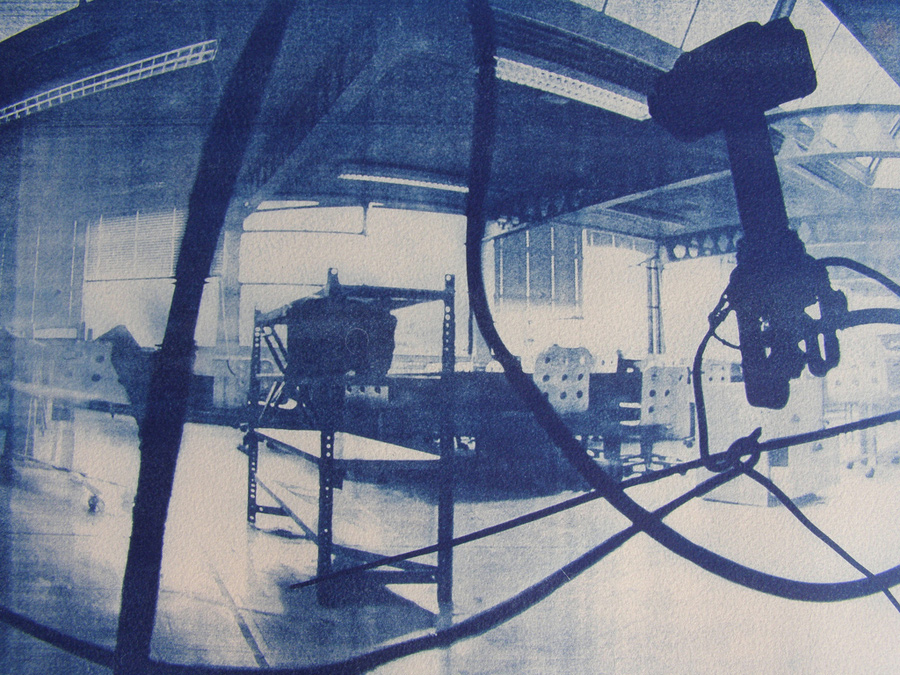
My earlier usage of long durational photographic devices (large pinhole cameras) was an attempt to realise the identity and relation of a place (its spatial activity and fixity) is totally contingent to its method of register and the particularities of fixed and temporal details. In fact these surfaces rendered from these devices are evidences of historical spaces of hidden social itineraries.
1 Marc Auge, Non-Places, introduction to an anthropology of super modernity. (London: Verso, 1992) page 41.
2 Marc Auge, Non-Places, introduction to an anthropology of supermodernity. (London: Verso, 1992) page58.
Fragment, research/Mechanisms of Seeing/The Architecture of Image
Architectural Apparatuses of Affect : Daniel Libeskind/Small Voids/Cameras
light; the darkness is a silent solid, the light etches its surface, it is simultaneously sign and cypher. The light etching itself on the dark surface is akin to a revelation, an epiphany before the building is transformed by its users and movement.
Daniel Libeskind’s building will, when finished, offer a path for the visitor, the path of history that crosses the void of commemoration. This void is the body of an absence—that of the Berlin Jews who perished in the Holocaust. The void makes us meet this absence, but we meet it by passing through it. When an absence, in the form of a void, meets the surface of daily reality, memory marks that surface. The Holocaust has created such a void, which, in projects such as the Berlin Museum with the Jewish Museum, is brought to the surface and given a place and a house. The void intersects the surface of time and creates a place of passage, of commemoration, of ritual in our daily life. The void is linear sign: lest we forget. But the incisions in the walls of the main exhibition spaces, spaces which house the historical material about the city of Berlin, create voids through which light is let in. These calligraphic empty spaces create a near biblical writing on the wall.
Cameras consist of small voids, the ‘camera’, a lens and photographic film. They are camerae obscurae that collect light and allow it to meet the surface of the film. But in fact the light comes from the larger void outside the camera. The moment the light has registered on the light-sensitive surface of the film, memories are constructed. The memory is literally conceived in this meeting and is added to life as an additional layer of being. The process through which void meets surface is therefore also about love—the love of ancestors and relatives, but also of life and its conception.
Russell Moreton, 10 Days in the Laundry
MOLECULAR SIEVE, is a performative analysis of “this place” utilising the simple properties of the pinhole camera. This appropriated apparatus makes visible the extrusive nature of time as it is deposited on the photographic surface. The extended durations required to register “place” impart a sense of dwelling as recorded by the apparatuses passive gaze. These surfaces record and register a relation constructed by the architecture of the chamber and what is beyond it. Movements when visible appear as simple abbreviated enactments caught like inclusions within this consolidated and timely consolation of place.
Time as it accumulates on a photographic surface.
This performative investigation utilizes a large pinhole chamber which is given mobility via a sack-barrow. This apparatus produces through its very inclusion into spaces a “spatial practitioner” in its own right. My aim is to utilize this device as a means of registering “worksites” both in the duration of the event and in its pre-performative state. The mobility of this research could be used to illustrate a constantly changing set of dynamics throughout the site and its event. The use of perhaps adjacent wall spaces or even a
“sandwich board” would render a tangible re-presentation of spatial information for the visitor. Darkroom facilities or conversely off-site arrangements would be organised.
Artist Statement 2009/10 Days
SITE is anti-place hovering precariously over the abyss of no-place.1
This “undoing of place” might instigate a threshold and a situation/room from which to reflect upon critical spatial, sociological and psychological conditions and perceptions.
Practitioner with earlier experience in ceramics and glass, recently completed visual arts course at Winchester, now at Canterbury studying spatial practices. Interested in drawing, photography and interventions that can explore our sense and experience of place. My work seems to harbour a need for a reflective solitude, a sense of dwelling amongst absences. The use of materials from the locality (field chalk) imply a personal geography drawn from the direct relationship to an inherited Earth. There is the suggestion that the absence recorded by the trace is an inclusion, a legacy set into a field of materiality, but it might also suggest a metaphysical field of thought. This act of drawing becomes its own experimental field of exploration, a sort of “in between reality"( Merleau-Ponty) an enmeshed experience. Perhaps all that remains is some sense of a material memory encountering the realm of the insubstantial.
Interested in collaborative projects and ventures that might facilitate issues of “site” as being the very undoing of place. Site for me is part of the rehearsal for the construction of place, site holds relations and intimacies/geographies that will be over-written by methodologies destined to be terminated to create place.


.jpg)
.jpg)