Thursday, 8 June 2023

A PAINTING IS BOTH CONCEPTUAL AND SENSATE : Towards a spatial inquiry into THE TRANSPOSITION AND ABDUCTION OF PLACE
COLLAGE and ARCHITECTURAL PRACTICES
THE TRANSPOSITION AND ABDUCTION OF PLACE


The Phenomenology of Perception, Merleau-Ponty
The Field-Fieldwork-Ethnography-Anthropology
The Body-Spatiality-Creative Practices- Arts and the Humanities
A PAINTING IS BOTH CONCEPTUAL AND SENSATE, Robert Mangold
TRANSFORMATION AND PROPHECY
JACOB’S LADDER----Robert Fludd
The Spatial Practice of Humans
The idea of the human being as both transmitter and receiver of energetic forces on spiritual, physical and emotional levels.
Beuys, Klein, Rothko “ Paintings as Presences”
The Ruin as a facilitator in the search for forms and patterns of Spatiality.


Environments, emotional states, late capitalism and its technology as it feeds into the posthuman predicament.
Materiality(creative speculative response to the found situation), the innovative presence of building processes and their subsequent spaces.
PRODUCTION COLLAGES TO ILLUMINATE DESIRES AND CONCERNS.


Colour, Space, Building and the Multiplicity of Dwelling in Place.
Contextual creative content through research material, collages and site based qualitative drawings and experiences with materials and the sense of place.
CREATIVE STRATEGIES
DEEP ECOLOGY : FINE ART, ARCHITECTURE, PLACE STUDIES
Extracting, Abstracting, Subjectivities from the experience of Place
ABBEY : INTERPRETIVE SITE FOR EXPORTING INTERIOR DESIGN THROUGH RELATIONAL AESTHETICS
ART WORKS AS IDEALIZED MODELS FOR GENERATING FORMAL STRUCTURES AND THEORIES
A UNIQUE UNIT OF PRODUCTION WITHIN A DEVELOPING DESIGN PROCESS (Mangold 1996)
SECTIONAL UNITS THAT COULD BE ADDED
THE CRITICAL DISTINCTION BETWEEN OBJECT AND UNIT.
A section is part of something concretely physical, but a unit is merely an independent entity, equal in existential status to others of its kind , perhaps nothing more than an element within a conceptual system, a digital unit (value).
Richard Shiff 2000
MEANING IS NEVER MEANT IN ANY WAY TO BE AN EXPLANATION OF THE PAINTING OR A REPLACEMENT OF THE VIEWING OF THINGS
(Mangold 1987)
Mangold uses writing to ponder the mystery of his own visual production, within the privacy of his studio, long periods of ‘looking and thinking’ about his paintings are followed by a ‘third activity’, as if it were, if not an equal, then at least an essential part (catalyst) of the complex of his creativity. (Mangold 1994 Lecture notes)
NATURALISTIC ABSTRACTIONS FROM THE BUILT ENVIRONMENT
CONCERNED WITH THE MAN MADE LANDSCAPE IN PARTICULAR THE GAPS IN THE MASS OF STRUCTURES AND THEIR RUINS THAT DOMINATE THE HORIZON.
One of the things that used to fascinate me was those architectural sections between buildings (Life between Buildings/Spatial Practices), sections of air that would glow. Sunsets or mornings … you’d see these incredible areas of light, and they were architectural shapes and yet they were nothing, because they were the voids of architecture. I used to think about them, and I used to think about a painting that would be atmospheric and architectural. (Mangold 1978)
Robert Storr, Betwixt and Between, 2000:81


VISUAL ACUITY/ACCUTANCE IS BEING REPLACED BY THE EXPLICIT RENDERING/ACCURACY OF THE SIGN/DISPLAY AND ITS IMAGE
Tensions between aesthetic appreciation and objective measurement can occur even within the realm of measurement and calculation.
The analogue slide rule and the miniaturized digital calculator ( both handheld devices) (Shiff 2000:56)
MEANING THROUGH IDEOLOGICAL VALUES OF AUTONOMY ACTUALITY AND EXPERTISE.
THE FACT PRESENTED IN THE LIGHT OF ITS PRESENCE
BEYOND APPEARANCES: ART, SCIENCE AND TECHNOLOGIES OF PERCEPTION
CONSTRUCTING ELLIPSES BY EYE
A LIBERTY DEPENDANT ON A SPACE OR MOMENT OF ACTUALITY which is in itself inhospitable to anything ’scheduled’,’ calculated’ or ‘controlled’.
THE SILENT RECEPTION OF A TRANSLATION NOT ON OFFER
THE LACK OF RECOGNIZABLE REPRESENTATIONAL IMAGERY
Krauss as critic is concerned with meaning.
Mangold as artist is concerned with experience.
Little common ground can be established, except to ask: what is the meaning of aesthetic experience itself, experience without ‘meaning’?
Can an artist strive to increase the directness or intensity of experience without also attempting to communicate ‘meaning’? (Shiff 2000:17)
Having assigned no meaning in advance, Robert Mangold presents his works to his viewers’ experience without guarantee of conceptual payback.
The paintings exist to record consciousness and underpin the subjectivities, timbre and shape of conversations through the soul into a personal knowledge./
ARCHITECTURE as becoming formal exercises in aesthetic problem-solving.
Society lacking the resources to locate the significance the work was creating.
AUTONOMY AND ACTUALITY:
TOWARDS A SPATIAL INQUIRY.
A THEORY OF MAKING LAYERED SPACES.
The painter probes into the situation of his paintings, an art of ‘answers’ that lack articulated questions, or maybe the questions have not yet been ‘realised’ enough to be asked.
Finding significance and situation in the art/activities of others
ACTUALITY
Between moments of ‘meaning’ lie spaces or blanks of immediate experience. Such blanks are actuality. Usually the blank, the actuality, goes unnoticed because it works so efficiently to differentiate one meaningful event from another.
THE SHAPE OF TIME, George Kubler 1962
Actuality is when the lighthouse is dark between flashes. It is the interchronic pause when nothing is happening. It is the void between events. Yet the instant of actuality is all we ever can know directly. The rest of time emerges only in signals relayed to us. The nature of the signal is that its message is neither here nor now, but there and then. (Kubler 1962:17)

Meaning is always differentiated, dependent on what cannot be co-presented. Meaning, distanced from the thing it purports to interpret, resemble, identify with, has the problematic structure of de Man’s realization that ‘I’ cannot say and cannot mean ‘I’.
THE VOID ALLOWS DIFFERENTIALS TO CO-EXIST
THE BODY IN SPACE AND TIME
MEMORY AND THE FATE OF PLACE
Blankness, the void, the ‘dark’ between flashes, generates meaning by distinguishing events, separating one moment from another. Or simply marking time; but it has no form or structure in itself and therefore no ‘meaning’.
STILLED SENSE OF ACTUALITY- SLOWED TIME
CULTIVATING STILLNESS
EXTENDING THE DURATION OF ACTUALITY
DEEPENING THE DENSITY OF THE VOID
CHORA
Imagine the blanks between constructs. Committed to preserving his independence and its autonomy, Mangold has achieved an art outside articulated critical discourses, neither Formalist (Greenberg) nor Minimalist (Morris), neither picture nor object- an art that moves ‘outside’ by becoming ‘between’.
The meaning of this no-reference, no-meaning art is actuality (the condition of being between) as much as it is autonomy (the capacity to move outside, unbounded).
(Shiff 2000:47)
PRACTICAL DEFINITION OF AUTONOMY
He sees perhaps the very best evidence of his own autonomy, achieved in making an object devoid of ‘meaning’, one without a fully determining discourse to enframe or fix it.
GESALT AND VARIABLES
REFERENCES TO AN ABSTRACT UNIVERSE
The painting, whatever it was, was actual?
ACTUAL, What have I done?
Rather than a relay or reference to something belonging to some other moment or situation.
CRITICAL EVALUATION :
VISUAL SYNERGIES formed from FORMAL and PERSONAL SUBJECTIVITIES
THE PAINTINGS OF BRIAN CLARKE and ROBERT MANGOLD.


Brian Clarke, On Polarities of Experience.
Decoratively speaking these amorphs introduce a sense of oxygenating randomness into the experience. (Clarke 2010:5)
Robert Mangold, The Correlative of Active Intuition is Passive Contemplation or The Assessment of Rightness.
The success of a work by Mangold must continually be reaffirmed though the artist’s prolonged encounter with it. The artist needs a great amount of time alone with each and every painting, taking in the ‘oxygen’, which becomes for him an expansive experience (as it should be for his viewers). (Shiff 2000:47)

ABBEY SITE SUBJECTIVITY BECOMES A GESALT/ORGANISATIONAL MOTIF (LEITMOTIF, small signs or shapes that constitute the basic building blocks of the design, its intervals, spaces between figure and ground)
Robert Mangold : Studio Notes (29 April 1993)
Painting and Seeing and Being.
A camera cannot see, it can only record.
A person can only see, he or she cannot record.
When you view a painting, you exist in relation to it.
The relationship is one of seeing and being, not seeing along, since it is impossible to separate seeing from being.
It is the experience of seeing and being in front of a work which affects us.
Artists are always struggling against history and the moment, to propel themselves forward, not forward as in progress, but forward as reaching for oxygen, or as a plant reaches for light. You struggle both on behalf of and against what you have already accomplished. (14 March 1994)
AN ART DERIVED FROM EMPIRICAL EXPERIENCE: OF ARRANGEMENTS AND RE-ARRANGEMENTS OF CONCRETE ELEMENTS.
‘Thrusts of the moment’ it approaches neither a limit nor a totalising conclusion. Open, it seeks its fortune rather than attaining some aim.
RECEPTIVITY IN ARCHITECTURE
Robert Mangold speaks of an architecture that is not conducive for the contemplation of art.
Mark Rothko said a picture lives by companionship, expanding and quickening in the eyes of the sensitive observer. It dies by the same token. It is therefore a risky and unfeeling act to send it out into the world.
RECEPTIVE SPACES IN ARCHITECTURE FOR PUBLIC INTIMACY
In confronting a Rothko, the viewer becomes acutely sensitised and conscious of his own receptivity on many levels. He also seems to dematerialise in response to the nature of the painting in front of him, identifying with it almost to the extent of becoming it (dwelling within it). But while the receptivity is part of it, the viewer also loses the intrusive sense of self as he feels the emotion the painting contains.
(Seymour 1987:12) Beuys, Klein, Rothko, Transformation and Prophecy.
THE ARCHITECTURE OF SCIENCE IN ART
THE ANATOMY LESSON
SPECTATORIAL ARCHITECTURES AND EXHIBITIONS DEDICATED TO CORPOREALITY.
The Anatomist is the allegory of curiosity and the invader of private spaces. He could reveal to the world not only the superficial misdemeanors of the exterior of the naked corpse that he pawed and trawled alone in his nocturnal morgue, but also its interior felonies. (Greenaway 1998:221)
THE BUILDERS: Peter Greenaway, 100 Allegories to represent the World
The Architect, the Gardener and the Greenman are a small family concerned with the building and the protection of a sense of place.
BUILDING AND CONSTRUCTING VOID SPACES
Green Tilted Ellipse/Grey Frame 1989
Acrylic and pencil on canvas
256.5x424cm
The centre space, the void, had to be large enough for a big expanse to be there. It isn’t like a hole, but an actual area of wall (Mangold 1989)
I’ve always had the desire to make the work a unity, to make all the elements-the periphery line and the internal line, the surface, colour-equal, totally locked together.
(Mangold 1990)
A beautiful thing about a quarter circle is that it is a fragment that implies a circle, but is also a complete thing in itself. (Mangold 1993)
‘Red Wall 1965’ was almost like a revelation to me. I understood the essential nature of what painting is: painting is surface, painting is edge - and painting is flat. (Mangold 1993)
In Mangold’s hands, colour and its shaped support acquired neither illusion nor allusion, nor any general theory that could explain that colour and shape. He had his own way of letting materials and forms remain mere matter-as matter-of-fact as the edge of a building or the distant horizon, no explanation necessary. (Shiff 2000:29)
Robert Irwin was concerned to preserve the direct experience of a physical form, one that would dissipate into second-hand worlds of exchangeable ‘meaning’ or ‘identity’ if distributed by photography, verbal description, or any other means of representing what the artist had already presented. Mangold shared Irwin’s concern for material specificity and physical ‘fact’, as well as his apprehensiveness regarding reproduction.
(Shiff 2000:34)
I am concerned with specifics and reject the generalities of photographs. Every element in painting has had both an identity and a physical existence-identity has always lent itself to being transferred in both photographic and literary terms. The physical existence never has. (Irwin1965:23) Artform 3 June 1965.
GORDON MATTA-CLARKE
CONICAL INTERSECT, 1975
FOUR GELATIN SILVER PRINTS
42x42x3in each, framed.
GORDON MATTA-CLARKE
SPLITTING 32, 1975
FIVE GELATIN SILVER PRINTS, CUT AND COLLAGED
41x30.5in, framed.
Surface Membrane : Painting, sensations in material agency/grisaille/landscape
Painting and Mapping/Choreutics : The Numinous
Areas of Grisaille.
Anthropology of Landscape
Christopher Tilley
Kate Cameron-Daum
Spirituality in Contemporary Art
The Idea Of The Numinous
Jingu Yoon
New Global Ecologies
Baratunde Thurston
The Rooms
To Love Is To Live
Jehnny Beth
Painting
We are not in the presence of a passively representative image, but a vector of subjectivation.
Guattari, 1995 :25


https://www.performanceparadigm.net/index.php/journal/article/view/132
Francesca Woodman : becoming-woman, becoming-imperceptible, becoming-a-subject-in-wonder
Lone Bertelsen, 2013
Studio Blackboard
ODYSSEY Aesthetic Intervals/Timbre/Traces
Immateriality/Temporal/Transitions material and movement/Human agency
A Species of Spaces
Construction/Making/Collage
Forming, slowness and repetition, elements of painting
Assemblage, sensation, surface, objects and spaces between them gathered/thresholds
Sheltering/Weathered/ Exploring a fragility of a painting in the landscape
Robert Mangold, Paintings and Architectural Forms
Fragments from sketchbooks
Ephemeral Architecture
Canvas as spatial verb
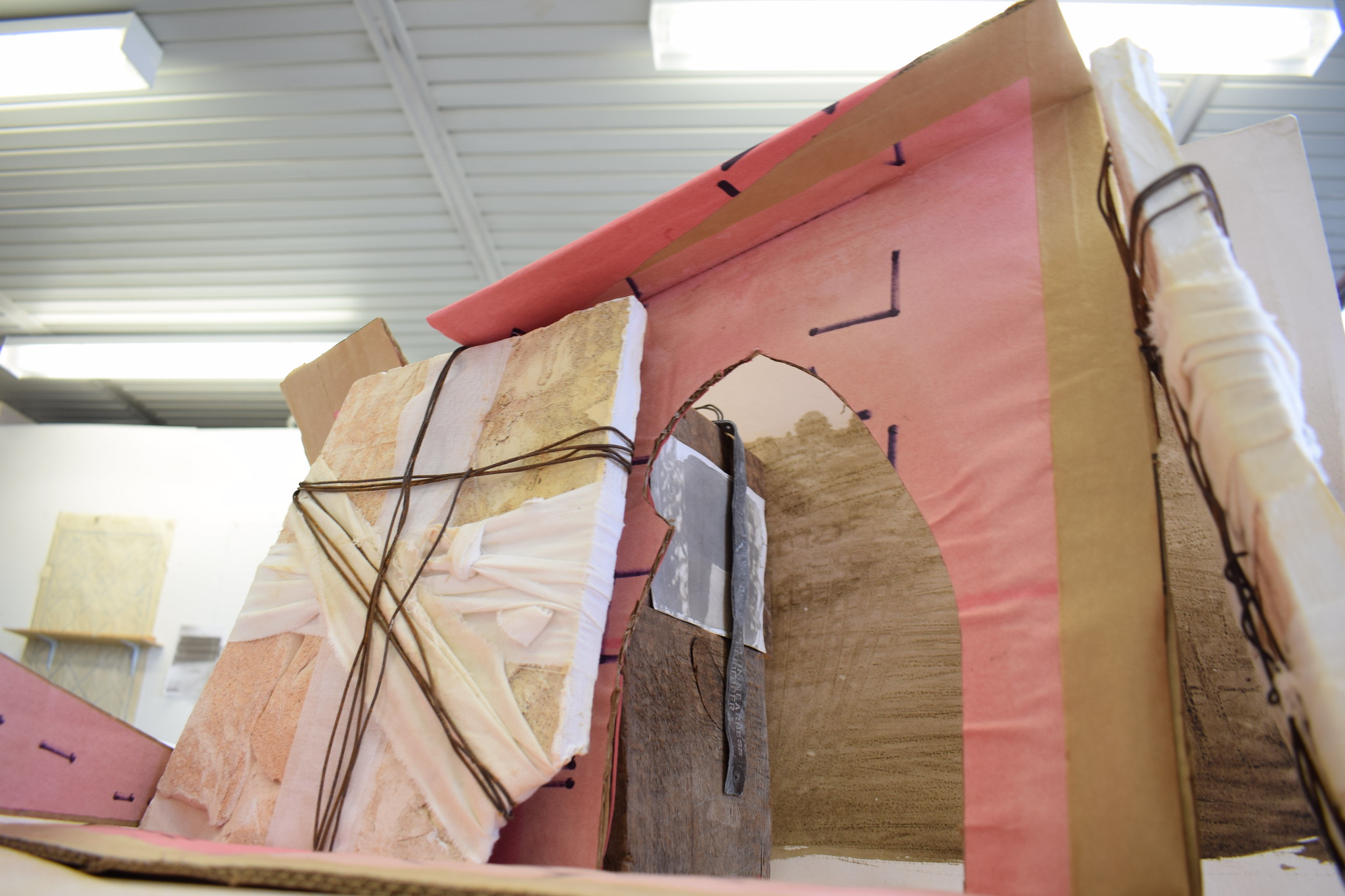
Yellow Ochre, Molochite, Gesso, Canvas, Paper, Textiles,Wood, Lead, Nails
Canvas as folded construction/shelter/place
Operative Design, A Catalogue of Spatial Verbs
Georg Simmel, text Frames, Handles, Landscapes and the aesthetic ecology of things
Monday, 5 June 2023
Transformative Drawing and Cyanotype Processes : The Drowned World, JG Ballard/Humanity an Emotional History, Stuart Walton.


Biosphere (Ecology and Entropy) 2012., a photo by Russell Moreton on Flickr.
Transformative Drawing Processes
Sun Printed Cyanotype
The Drowned World, JG Ballard.

The Custodians, Richard Cowper 1976.
russellmoreton.wordpress.com/
russellmoreton.tumblr.com/archive
Humanity : An Emotional History
Stuart Walton. 2004
Fear
Anger
Disgust
Sadness
Jealousy
Contempt
Shame
Embarrassment
Surprise
Happiness
Life Drawing : An Emotional History of The Performative/Rhizomatic Body
Stuart Walton. 2004
Fear
Anger
Disgust
Sadness
Jealousy
Contempt
Shame
Embarrassment
Surprise
Happiness
Oxford Dictionary of Geography: spatiality
The effect that space has on actions, interactions, entities, concepts, and theories. Physical spatiality can also be metaphorical. It is used to show social power—thrones are higher than the seats of commoners, and ‘high tables’ for university teachers in most Oxbridge colleges physically elevate the teachers over the taught. People use proximity to show how intimate they want to be with others (See personal space), or orientation; we may face someone or turn away from them. Institutions and governments have used large architectural spaces to invoke awe, while restaurateurs may create ‘cosiness’ in small spaces.
LIFE DRAWING : Phenomenological Reductions
The body is not an object, but the condition and context through which I am able to have relations with others. Merleau-Ponty
A study of one body in front of another body.
Our body is our connection with the world and all its phenomena, it is fundamental in our communication and interactions.
The body is a force of creative action and a site of resistance.
An exploration in various forms of physical dialogue between performing bodies.Energetic flows from others, what energy and phenomena will these relationships bring about on these bodies and the space they inhabit.
Personal and public boundaries of others, a being towards things through the intermediality of the body.
For Deleuze and Gauttari the body is rhizomatic (containing multiplicities, intensities and flows) and in active connection and interaction with its becomings, surroundings and situatedness.
What a body can do, what a body is capable of
The body without organs (BwO) is an attempt by Deleuze and Gauttari to denaturalize 'human bodies' and place the body in direct relation and connection to flows and particles of other bodies and things, creating constellations from its modes of organization of disparate substances.


"Spatial turn" The increased attention to matters of space, place and mapping in literary and cultural studies, as well as in social theory, philosophy, and other disciplinary fields.
Spatiality, Robert T. Tally Jr. Routledge 2013.
The origin of "True Humanity" : Tim Ingold
Thursday, 1 June 2023
.jpg)
.jpg)
.jpg)
.jpg)
.jpg)
Wednesday, 31 May 2023
Monday, 29 May 2023
On the property/structure of things/materials/colours : About philosophy/drawing
Outpost Studio 261021
On the property/structure of things/materials/colours
Drawings going beyond figure/ground relationships


The manifestation of weight derives from form along with substance.
I no longer wanted to make markings on a piece of paper, I wanted to make the drawing integral to its structure and properties.
About Drawing, Richard Serra.
Serra has questioned whether his 'Deadweight' series borders on the pictorial, because these drawings set two similar shapes against a common ground as if to construct a compound figure. However Serra's use of overlap protects against this possibility and preserves the material independence of the two sheets of paper.
Preface, Being and Becoming. C. Robert Mesle.
The secret of life is enjoying the passing of time. James Taylor
Process-Relational Philosophy.
An Introduction to Alfred North Whitehead. 2008
The assumption of a moving viewer, Richard Serra in a Japanese Temple Garden.
Richard Serra believes that the physical grasp of a space must occur through time in the form of movement or effort, so he temporally extends his own working of a surface.
Tempered, measured movement such as the application of layers of paintstick, narrows the conceptual gap between the space and time we imagine to experience bodily.
Serra's program (a temporal art of substance), to link bodily consciousness to material substance, to integrate vision and touch as well as space and time.
Movement/Sensation marks both space and time, it does so psychologically as well as physically.
The Interaction Of Color
Albers theorized the relation of space and time to weight.
The two basic quantities or substances question, how much and how often, distinguishes two kinds of quantities, one of size, extension in area, and one of recurrence, an extension in number. These measurements establish weight in space and weight in time.
Serra's accumulated, living movement, his layering of paintstick, collects weight in space and weight in time.
The human body (corpus humanum) is composed of many individuals (of different nature), each one of which is highly composite.
The individuals of which the human body is composed are some fluid, some soft and some hard.
The individuals composing the human body, and consequently the human body itself is affected in many ways by external bodies.
The human body needs for its preservation many other bodies from which it is, so to speak, continually regenerated.
When a fluid part of the human body is so determined by an external body that it impinges frequently on another part which is soft, it changes its surface and as it were imprints on it the traces of the external impelling body.
The human body can move external bodies in many ways, and dispose them in many ways.
The human mind is apt for perceiving many things, and more so according as its body can be disposed in more ways.
Bento de Spinoza : Ethics, Part II, Postulates I-VI, Proposition XIV
Bento,s Sketchbook : John Berger. 2011
Manuel Neri
Bodies of intensity, imprinted with a ghostly figural outline.
Sculptures and drawings showing ambivalence,hostile, intimate, relationships.
The contradictory shocks between form and substance are absorbed by the emotional resilience of the dialectic of pleasure and doubt. Neri proves this in the course of his own work, through his successive approaches to different materials, which make him oscillate between allusive figuration and the most direct realism.
Pierre Restany. 1988
How do things translate into lived experience?
Whatever the answer, it will be known only in relation to the particularity of a personal physical encounter with the work, never as a principle of order or composition.
Drawing Thick, Richard Serra.
Agencies/ways of doing, phenomena and research emerge with specific relationalities to things at hand.
A diffractive methodology is a knowledge making process, creating ongoing differences, states of being/becoming.
Diffraction as a tool for analysis, attunes us to the differences generated by our knowledge.
Opening up ways for greater sensitivity towards how we are part of the worlds continuous becoming.
Organism-Person-Environment : The Architectural Body.
Arakawa and Gins
The theoretical object/body in doing/sensate built architecture
Living Spaces : Spatial Agencies/Creative Philosophies into a world of continual process and becoming, where each person relates to every other and to all of nature.
Architectural Thinking/The Interrelated Universe : Process and Reality
Mattering : Mind-Movement-Material
Spatial Interventions in Architecture
Filtered Light and the interactions of objects
Entanglements of Materials and Substances
Asperities, opacities, reflections, textiles,
Lines Of Flight : Drawing on Mattering
Steven Holl, House,St Ignatius, Scale
Place Making/Drawing/Materials/Construction
Beach Ruins : Belgium
Rutile/Yellow Ochre washes, transparent glass/glaze, texture/textile and pierced clay/concrete.
Ceramic Slab Constructions : Facades/Massing for pacemaker utilities/living spaces
Material as drawing, drawing as construction, architectural models constructed into the assemblage of the making drawing.
Painted Clay Constructions : Gesso, Cyanotype, Cotton, Wire, Glass.
Process-Relational Philosophy : Alfred North Whitehead
Vibrant Matter : Jane Bennett
Blackness is a property, not a quality, that is to say, something fundamental, not an incidental embellishment.
About Drawing, Richard Serra.

Wednesday, 24 May 2023
Re-visiting the proposal : Making at Raveningham/Building on the lightest of things
Dwelling. Up, across and along relations in the landscape.
Giving Sensation Place.
An Education Of Attention.
Creative Curriculum Making.


%20(1).jpg)
.jpg)
.jpg)
.jpg)
.jpg)

Developing a creative inquiry and its presentation through generative art based methodologies.
Re-imagining learning through site based education, art practices and philosophy.
Installing a creative practice as a 'place driven site' for subjective experience, gathering things and personal inquiry from which to present 'findings' into the social environment.
For Tim Ingold, life is the very process wherein forms are generated and held in place.
And dwelling means that the forms people build, whether in the imagination or on the ground arise within the current of their involved activity in the specific relational contexts of their practical engagement with their surroundings.
Tim Ingold, Lines. 2007
Proposal Raveningham 2023
The Simple Presence of Things.
Peter Zumthor.
Raveningham Sculpture Trail 2023
Russell Moreton.
Making and working in drawings, diagrams and constructions that are habitable environments.
Speculative Cosmic Garden and Sculptural Array for Solargraphy.
Interested in revisiting an earlier project that I created at Kilquhanity (A Pathway Between Sunrise and Sunset), in which I mapped out transits and movements of the sun onto the landscape through demarcated pathways and intersections. I propose then to add to these ground markings an apparatus or array to hold small can cameras pointing skyward to record the movement of the sun over the duration of the Sculpture Trail.
Using the phenomena of light as both a conceptual and practical framework requires a mixture of pinhole cameras, contact photograms and shadow sticks that will demarcate lines and arcs, that will in turn create overlapping territories onto the landscape. The array construction will act in counterpoint to the landmarks, a fixed arrangement looking perpetually skyward.
Russell Moreton
Spatial practitioner employing a speculative site based practice linking visual fine art, education, architecture and philosophy.