Material absorbed in its own thoughts :
Saturday, 24 February 2024
Psychogeography : Narratives across a site plan (Waverley Abbey)
Sunday, 18 February 2024
Drawing Zones/Studios/Sites of Inquiry/Concern.
Outpost 230124
Architectural Body.
Thresholds.
Drawing.
Confronting Bodies.
Drawing : The Indexical/To Work Inside Feeling.
Inscripting Self : The Daughter of Butades.
Kairos : The movement and its moment.
Being Alive.
Tim Ingold.
There is no stage at which humankind does not demarcate, beacon or sign his space, leaving tracers that are both symbolic and practical.
Lefebvre, The Production of Space.
Drawing on the Movements of Desire and Attention.
Empirical evidence carries emotional connections, Bachelard.
The drawing itself is desperate to keep hold of an absence, it all began with a silhouette of a shadow on the wall. In the myth of Butades, the drawing is not generated by 'loss' itself but the her anticipation of loss captured in the moment of turning away, and act that unites blindness to memory.
Derrida.
Drawing is a gaze turned inward into the task at hand, it draws on the inevitable, displacement and absence of the 'thing' and its relation, its otherness.
The 'mark' and its imaginary space are encountered as a fact of existence. In drawing it is this evidence of beingness that is invested in the work, 'drawing itself' becomes a coming-into-being into the presentness of language of the image.
The image corresponds to its own unfolding pulsion, to an obsession, to a desire to expand its own flux beyond the assigned body. Material keeps desire on the inclined plane of appearances surrounding it with its gravity, the drawing materializes a surface in which desire condenses itself and infiltrates inside the oppressive operative grids/apparatuses of language.
Drawing on the holding apart instances, moments and intervals between consciousness and self consciousness. The early formative drawings of children are not guided by a visual exploration of space, but by the hand as an exploration of movement, it is only later that drawing is guided by the eye. In children graphic expression is blind, disconnected from perception, rather it is led by muscular, tonic and plastic sensations.
The 'Stage of Drawing' is at attempt to discuss what Avis Newman believes to be a crisis in art as to how an artist deals in a non-literal way with a sense of humanity, which for her is part of the essence of the artistic project. Her selection from the Tate Collection is based on a definition of drawing not as expression, but as an act of consciousness, the manifestation of which is culture, and by extension the social and political realm. In this exhibition, drawing tends and relates to the indexical as the effect of a corporealized process. In fact the aim is partly to divest drawing of the artist, so one can see this act of consciousness.
According to Newman, this indexical definition of drawing is opposed to a materialistic one, which would be about investment/authorship in the material world and would concern itself indirectly with sociological art, for Newman on the contrary we are trying to locate the area where meaning has no economy and does not have to justify itself by purpose.
Drawing even in the most fragmented of forms, there is a recognition of our sense of self and our history as we mark. It is not only the functioning of perception that interests me but also the activity of sensation.
Avis Newman.
Lefebvre acknowledges that geographical space created through the body, through routes which were inscribed by means of simple linear markings. These first markings, paths and tracks drawn into the landscape would become the pores through which without colliding would provide/produce the establishment of places, localities made special for one reason or another.
In looking at drawing, one may see not the thing itself but its possibility, its suggestion and its uncertainty as to what stage it is in its becoming.
What ever the intent, the drawing is always the artist's response to whatever, draws-the-artist's attention. To what Cezanne called the 'little sensations' and for the artist it is a question of how to rescue sensation from its subordination by representation.
Drawing as experience and experimentation, demands that the artist be susceptible to and capable of taking advantage of the uncoupling of everyday space-time and with it the expansion of the field of consciousness, to engage in what Klee once described as 'polyphonic attention.'
In the end drawing is rooted in the dematerialized space of the image, indexical or imaginative, privileging more the world of shadows than the world of appearances. The drawing surface is confirming the possibility and use of a language that albeit in a fragile way, leaves open an interstitial passage through which the imaginary may realize itself as an image.
Drawing manifests the very nature of a feeling-thinking-consciousness-of-the-body.
Drawing makes visible the synthesis, its interval and split between subject and object, between the desiring subject and the subject of language.
To draw is to protect the intensity of thought-feeling, and as such the drawing is always a formulation or elaboration of the thought itself at the very moment/instant in which it translates itself, makes itself 'visible' as an image.
The material of art, any material is that which imprisons and makes definitive desire. It is the way the material is manifested in revealing what defines the split between the imaginary and the subject. Drawing becomes the apparatus, the mechanism that tends to give order to the only dimension in which desire moves, space and time.
Drawing seeks always to reveal the gesture of the artist through the space of the surface, to capture the moment that precedes the birth of the sign. The external space becomes a specular surface, a field that captures and organizes the image. The image always corresponds/is a correspondence to a pulsion of desire, a vector that puts it in communion with tactile and visual sensations.
Drawing makes reversible the movement of desire/attention suspending it in a place understood as a place of projections and reversibility. For John Berger, the drawing shows the paths taken.
Drawing/Spatial Practice.
UCA Canterbury.
Artist Statement. 2009
Zones/Studios/Sites of Inquiry/Concern.
Within my practice drawing is used to form sites which contain visual information, evidence of temporal activities and traces of actual objects. These territories within other territories create flows formed from their permeable boundaries gathered from material, relations and differences. My drawings are about and are inside this temporality of site.
Thresholds.
Brion Cemetery by Carlo Scarpa.
Ina Macaione.
Antonello da Messina.
St. Jerome in His Study, 1474-75.
National Gallery, London.
The only figurative work in the world in which entering and crossing coincide in a unique concept of physical space, defining the specificity of the architecture by transforming the limits of solid materials into the construction of a liminal space which can be crossed by passing through thresholds.
The concept of architecture is the crossing of a space that becomes physically visible when one enters the space itself. In Brion Cemetery by Carlo Scarpa, architecture thus becomes an art form which helps us to overcome the absence of life by expanding the horizon of our minds and hearts, freeing us from our bodies, giving dignity to the void left by the loss of living presences and emotional ties.
The spatial dimension of this small building is a metaphor for the mental workings of meditation. The pavilion is the place where we can enter the mind's empty space, where we can get away from all our passing concerns.
Small cylinders of different heights and sizes, barely visible below the surface of the water. A small, inaccessible maze. A maze through the water, a maze through time, a maze of symbols and enigmas. Here, as in the poetry of Jorge Luis Borges, the maze is an allegory for the complexity of the world, which cannot be understood merely through reason. The maze itself was created to confuse those who rely on reason alone. Its winding paths lead us to a reality that lies far beyond that existential normality which hides deeper complications.
In 'The Garden of Forking Paths' Borges describes the possible outcomes of an event, each of which leads to a further multiplication of consequences, in a continuous 'branching off' of potential futures.
The Stage of Drawing.
Gesture and Act.
Catherine de Zegher.
Architectural Body.
Arie Graafland, Michael Speaks.
Drawings and Ceramic Models.
Making-Living-Environs
Hannsjorg Voth 1973-2003.
City of Orion.
Boat of Stone.
Hassi Romi.
Saturday, 17 February 2024
Re-registering Overlapping Spaces : Presentation/Ritual/Repetition.
Outpost 200423
A4 Ruled Notebook.
Blue/April 2012.
Amongst Lightness and The Reverberation of Material.
Ceramic installation in white cube space.
Open Pit Firing, Shards, Ash, Ceramic Pieces, Low Table, White Cloth, Human Outline
We maybe more sophisticated in material ways, but we have not advanced spiritually beyond the axial age, and because of our suppression of mythos, we may even have regressed.
The history of myth is the history of humanity, our stories and beliefs, our curiosity and attempts to understand the world, link us to our ancestors and each other.
A Short History of Myth.
Karen Armstrong. 2005
Rollright Stones, Oxfordshire.
Stone Circle, Storytelling, King Stone, Whispering Knights, Witch,
A Summer's Work.
Odyssey/Beauty/Struggle.
The Material Acts.
Summer 1994 : Artist's Studio.
The viewers nevertheless allow themselves to be drawn into his game, in order to 'see' as though for the first time the pure existence of things.
Presentation/Ritual/Repetition.
Art is contemplation and must act upon our consciousness.
Objects/Things are part of the artist's immediate existence.
Contemplative experiences become truly meaningful when they occur in everyday life and when nirvana or the state of superior awareness blurs into samsara or ordered time.
For Tapies, repetition is above all else a perpetual questioning or a perpetual becoming.
A working process that is additive, which incorporates changes and accidents and as such his methods are hardly erasing anything that is already present on the canvas.
A Summer's Work, Antoni Tapies.
The Embodiment of Minimal Gesture.
The Solitude and Discipline of Firing.
Heja Chong.
Drawing from the philosophy and traditions of Bizen, she has undeniably developed her own aesthetic identity, embracing the raw materials of her new world, the pots and firing responding to the evolving nature of her life and environment. Adhering to the principle of Bizen, she is conscious that her level of involvement within this tradition, may not always be recognised or understood by others.
Viewpoint/Distance/Synthesise Forms.
Framing a Figure in Space.
Drawing is not the form, it is the way of seeing the form.
Edgar Degas.
The foreignness of the intimate or the violence and charity of perception.
R. Bruce Elder.
Raveningham.
The Autonomy of The Natural Environment.
Sculpture/Playing with the existence of things.
Field Studies : Pathways around the Sun.
Drawing : Assemblage of Lightness and Weight.
Enmeshed Space : Working Drawing with Handwritten Notes.
Lawn Deliberation/Mappings of Human Agency/Space/Time.
Space projected from the body is biased towards the front and right.
The future is ahead and 'up.'
The past is behind and 'below.'
Time as a structure/place to observe things in constant motion/relation.
Drawing Site/Spiral Windings/Diagram/Spherical Markers
Terracotta, lime wash/lamp black/blackboard paint/chalk/ink
Ground Pegs/Labels/Text Markings/Archival Information
Points becoming lines, Tim Ingold.
Spatial Construct : mediated space anticipating a destination, as seen through the fragmented myths, movie locations or souvenirs that vanguard the real place, access to places through their likenesses.
The workshop proposes strategies to confront our bodies with the multiplicity, unpredictability, directness and autonomy of the natural environment. The aim is to explore and develop consciousness of the body itself being an ever evolving landscape within a greater surrounding landscape.
Body/Landscape
Frank van de Ven.
The Psychology of Time.
Temporal Perspectives.
Relative Orientations/Past/Present/Future.
Time is often referred to as 'the tacit dimension' within psychology because unlike other types of perception, it is not directly available to any sensory organ but can only be apprehended through change and the dynamic flow of environmental events. And yet despite its ephemeral nature, time is a dimension that has a significant impact upon a wide variety of psychological behaviour.
From a cognitive perspective, it can be demonstrated that the orderly nature of one's environment stems, in part, from the fact that events' spatial characteristics are structured in and over time. Music, speech, body movements and walking gaits are among the many events in which the sequence of notes, words, or actions unfold with a characteristic rhythm and tempo over a given time span. The particular arrangement of this spatial-temporal structure not only influences how an event is perceived and remembered, but also the overall accuracy with which the event's velocity and total duration are subsequently judged.
Different cultures have different conceptualizations of time which can be reflected in the types of metaphors that are used to describe time as well as the overall pace of life.
Curriculum Making.
The Enactment of Dwelling in Places.
An Ontology of Dwelling.
The dwelling ontology we want to describe rejects any possibility of living in the world through mental schemas of the world, and insists that the material-relational world is the only world in which we live, the only source of our capacities to communicate and learn, the only world in which our activities take effect, and the only world in which meaning inheres.
Greg Mannion, Hamish Ross.
Tim Ingold is an anthropologist who has looked at the interface between people and the environment. In The Perception of the Environment, he argues that ecological psychology and the philosophical writings of Heidegger and Merleau-Ponty share the view that the world becomes meaningful through active inhabitation, or 'dwelling', rather than cognitive representation.
Re-registering Overlapping Spaces #2
Public intimacies, personal dialogues in social spaces.
'Blocking In' of a private studio space of creative inquiry into the public realm as a permeable intervention.
Main reception area, UCA Canterbury 2010
Russell Moreton, Spatial Practices MA.
Saturday, 10 February 2024
Lightness/Thresholds of loss and of inside spaces constituted by darkness.
Outpost 050224
Walking with Carlo Scarpa, Brion Cemetary.
Trust in the material and its 'spiritual incitement' that comes from the world.
The spatial dimension of this small building is a metaphor for the mental workings of meditation. The Pavilion is the place where we can enter the minds' empty space/stillness, where we can get away from all our passing concerns.
Thresholds, Carlo Scarpa/Ina Macaione.
Life Affirming Sentiments.
Light-Shade
Bitter-Sweet
Vital Nourishment.
Departing from Happiness.
Feeding the Body.
Feeding the Soul.
Francois Jullien
The Flame of a Candle.
Gaston Bachelard.
On the Loss of (Dark) Inside Space.
Constanze Kreiser.
Is inside space on the verge of disappearing?
Is it being hindered by constantly improved light technology which is causing one of its fundamental qualities – darkness – to dissipate?
And for what reason?
Is it for the benefit or more outside space?
Or for the benefit of a new spatial quality?
Questioning the way increased use of artificial lighting affects interiors, architectural designer and installation artist Constanze Kreiser opens a philosophical examination of the mediating effect of light. She observes how an enclosure is gradually made lighter in the sense of weight and mass through the addition of openings that emit or filter light. Her polemic on lightness and darkness raises questions of how light measures time, space and inhabitation and the temporal rhythms of everyday existence.
Light constitutes space in that it creates bright and dim zones, enabling the physical perception of a space.
Space does not originate with the construction of a building, but exists in the act of marking a small unit from an infinite quantity. It is exactly this process which is achieved by sunlight: that which it illuminates is outside, shadowed surfaces forming inside.
Depending on whether lightness or darkness dominates, inside space is a dark space by day and a light space at night. Thus inside space is dependent on light, it is in constant contrast to the prevailing light conditions. Inside space at night has, however, existed only as of the invention of artificial means of lighting – from pine-torches to light bulbs. By day, inside space floats like a dark island in a sea of light.
Bodies and Mirrors.
Ann C. Colley discusses the correlation between physical bodies and their surrounding, particularly the space of nostalgia and recollection in Victorian literature. Working from the role memory plays in recalling our relationship to known environments. Her text through selected autobiographical accounts discusses the spaces of childhood through the invisible, aesthetic and ubiquitous body, and the proposal that the interior is not simply defined by objects within it, but by our movement and inhabitation around and among them.
Three distinct models of how the consciousness of one's physical being illuminates the interiors of home. John Ruskin text speaks of the invisible body, Walter Horatio Pater of the aesthetic body and Robert Louis Stevenson of the ubiquitous body.
They, Ruskin, Pater and Stevenson considered how their physical being had related to the walls and windows of childhood. Conscious of how this relation defines the sense of one's surroundings, they let their memories resuscitate the dialogue their bodies had once had with these interiors. They understood that it is the child's being that shapes and illuminates the interiors of home. Articles do not define interiors; bodies that move and feel their way among these objects do.
Intimus, Interior Design Theory Reader.
Their orientation anticipates those like Maurice Merleau-Ponty in The Primacy of Perception who argues that it is not through thought, absented from the body, that one knows one's surroundings, but through one's 'bodily situation' – that one is conscious through the body's position in space. This is taken further by twentieth- century architectural theorists such as Kent Bloomer, Charles Moore and Robert Yudell, who insist that one measures and orders the world from one's own body, and that the body is in 'constant dialogue' with the buildings surrounding it.
Body, Memory and Architecture.
Drawing Inscriptions/Spaces/Breaths.
Remaining in the simplicity of our origins.
A Breathturn.
A flow of energy that wends its way ceaselessly through the world, animating it as it goes.
Simple pots of simple thinkings/orderings and findings/feelings attained through the privilege/practice of the beginner's mind.
Sadhana, bearing the difficulties of existence.
Working Interiors for the making of the imagination.
Marking of a small subjective space from a infinite quality.
Ceramic Volumes/Vessels and Surfaces/Openings of Light and Dark.
On Drawing/Conversation.
Twombly/Artaud.
Corporeal Acts.
Documents and Sensation.
Images 'exist' in a domain of emotional and physical extremes.
.In drawing, acts of reading and perceiving are concurrent as a simultaneity of mental factors.
I am interested in the way the inter-connectedness between inscription and representation is 'grounded' in the primitive body. I an not speaking of the language of depiction and representation, but of what constitutes the mental energy of engagement, that is so evident in drawing. How the markers of an action translate the murmurings of the mind. For both drawer and viewer the mark and its imaginary space are encountered as a fact of existence as such it is the evidence of beingness, concerning those primitive, dark, and distant moments, etched in our psychic history that exist within the framework of the image that is now being invested in the work.
Avis Newman.
The Doctrine of Introversion.
The artist struggling to conform to the patterns of everyday existence.
I can't respond to the society I live in.
David Sylvian.
Placidity.
Condemned to the eternal silence of processes.
Zhuangzi.
INTIMUS.
Mark Taylor, Julieanna Preston.
Matrix Key/Components, clockwise.
Practical Issues
The Field of Possibilities.
The Organizing Matrix.
Date of Publication.
Time Period Discussed.
Disciplinary Orientation.
Friday, 2 February 2024
Making Statements/Making Things : Hungate/Anglian Potters.
The Enabling Constraint.
Objects become relational in conjunction with the ways in which the environment proposes its own constitutive limits . Erin Manning.
Architectural slab built pieces investigate ceramic forms as a dwelling place or a model for a building construction. Some thrown shapes on the theme of crucibles fired by the Raku process. Recent work has been exhibited in historical sites and locations, exploring contexts of ceramics and rituals. Studied Ceramics at Epsom School of Art and Design UCA, Visual Fine Art at Winchester, Teaching at Brockwood Park School.
Anglian Potters
https://www.anglianpotters.org.uk/members/russell-moreton/
Water at Hungate.
Hungate Architectural Explorations.
Air/Place/Breath/Light/Architecture/Ritual/Social Space
Cell-Court-Domain.
Russell Moreton is a visual artist interested in gathering research and responding to the historical site of St Peter, Hungate. He has explored the exhibition theme 'Water' as both a spiritual and corporeal inquiry for site-specific artworks. He has spent time developing working ideas that have an affective resonance to the architectural setting of their presentation. His use of slab built ceramics vessels echo the stillness and muted silence experienced within the medieval fabric of the Hungate. He has used a figural drawing on Chinese paper, processed by the evident passage of water to explore the representation of the human form in this particular place.
Thursday, 1 February 2024
Studios and Sites : Drawing/ Of The Body, figural and indexical.
Proposals On Studios and Sites.
Making/Reading Spaces.
Outpost Studio Sketch Books.
Discursive Contents/Drawings.
Mediating Creative Agency/Studio Works.
1, October 2018-May 2019.
2, May 2019.
3, 2020.
4, 2023.
On Drawing, haptic resonances are felt, registered via the pencil and the different asperities of the drawing body. Marks made, and their markings subsumed into the drawings unfolding causality.
Re-constructive Drawing, Drawn, Wrapped, Moved, Re-drawn, Deconstructed, Re-assembled.
Visual Membrane/Surface of Affective Matter,
Matter Painting/Gathering Materials/Relations/Sensuality.
Body/Building Plot of Affirmation, Augury Vessel 2019, Harleston.
Drawings from Hyde Abbey Gatehouse.
Paintings, proposal Cley 19.
Paper 1500x2845.
Speculative Plot 3000x3000.
Experimental Conditions and Inscriptions.
Charcoal Drawings on Translucent Materials.
Becoming Ephemeral.
Entanglements/Localities/Amalgamations
Layering of consciousness and becoming.
Something has passed through here.
Directions and process become objective readings amongst the phenomena of things.
Blueprint, building the drawing, movements and their traces of material memory.
Working drawings as architectural paintings.
The whirling and winding of affective material.
Cyanotype Process/Applied (site/plot) Archaeology (asperity/haptic movement)
Textile reinforcement, semblances, surfaces, reliefs, repairs, temporalities,
Do not arrest/explain causality, rather move with its potentialities.
Ordered, Assembly, Ritual, Fragmented, Symmetric, Equivalence, Process, Contradictions, Binary, Relations, Singularity, Re-assemble, Floating, Beyond,
Sensate, Transitive, Reflexive, Becoming, Intense, Animal,Serenity, Aftermath,
Ceramic Drawings
Claywork : The Project and Proposal.
Ceramics in the Environment.
Borderlines/Creative Boundaries and Thresholds.
The redundant stone mullion windows by the south entrance.
Exploring used and empty frames as a new setting for a constructional drawing or template both as site specific artwork and as an inclusion within a screen/surface or painting.
Developing Inquiry.
Documentation, Artist's Book, Drawings, Diagrams, Templates,
Process, Mixed Media Artworks, Prints, Alternative Photography, Ceramic Forms, Glass Work..
Other working methods, images from current art practice.
Scriptorium Space.
Architectural model for a performative reading space within a pastoral landscape or community.
Blueprints, cyanotype drawings.
Architectural concerns, cell, court, domain, layered drawing with collaged and absent objects on a historical building plan.
Assemblages.
Raku fragment, drawing, photographs, handwritten notes, field chalk, charcoal.
Concepts for making with clay.
Finishing the rim,throwing the material, the sensation of making 'outwardness' from 'innerness'.
Clay : Making for the hospitality of the body.
Throwing, form made from the solid unformed centre of the clay lump.
Making volumes/innerness from solid unformed material.
Throwing is manifested/made actual by opening up the space for the imagination previously contained/constrained by the mass of clay.
Turning, form further modified by the machining/carving into the thrown vessel.
Making volumes by the excavation, the removal of material complicit to its original form.
Turning is mastered/referenced by the rim and the internal volume of the pot/bowl/vessel.
Vessels/Crucibles
The circumference, volume and surface that correspond with/into the clay vessel.
Body, Forms, Interiors. Volumes.
The Intermingling of Material and Place.
Clay, a material of human inscriptions, volumes and surfaces, a silence worn down, abraded by time.
Windows, Building, Drawing, Pierced, Surface, Scripted, Architectural, Body, Facade, Profile, Template,
The most refined art, and the most difficult and dangerous is that of patina.
Luis Barragan.
An aesthetic nowness that stimulates a 'wondrous beauty'
The rift between and within the object/subject, between object appearance and its essence.
Object Oriented Ontology.
Earth Colours, Natural Substances, Ceramic Materials, Hand Building Processes. Weathering, Firing,
Ceramic substances/affinities and their values/phenomena/raw and fired colour.
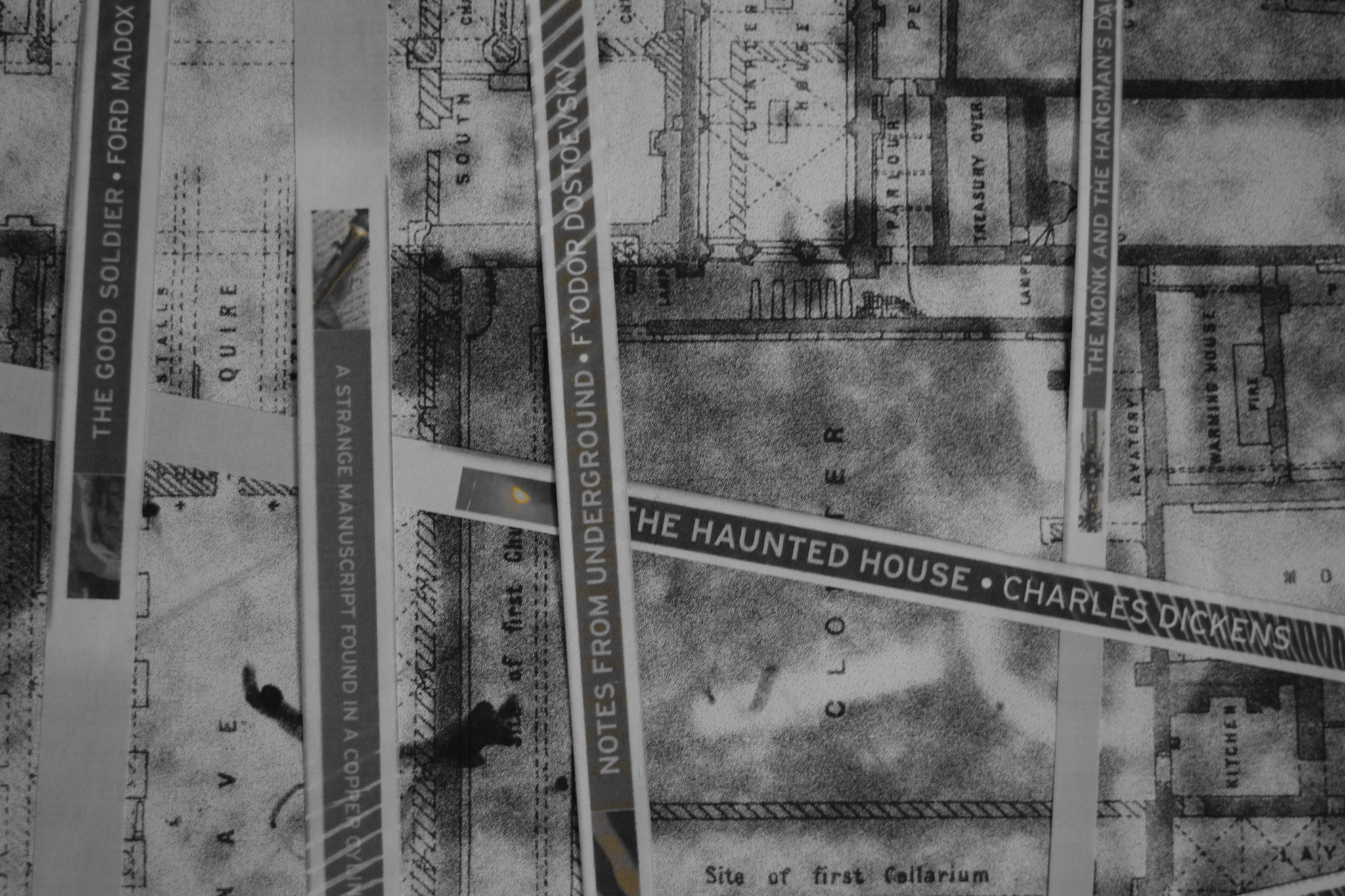
Sunday, 14 January 2024
TOWARDS A NEW INTERIOR : Photography and the temporality of territory
Spatial themes of inside/outside, negotiations between the physical, phenomenal and a metaphysical world.
TOWARDS A NEW INTERIOR
An Anthology of Interior Design Theory
Lois Weinthal
EXTREME METAPHORS
Interviews with J.G. Ballard
1967-2008
Thursday, 4 January 2024
The origins of painting and the scepticism of drawing : Architectural surface for a place of study/studio
Painting as an exploratory layered drawing for an architectural surface in a library
a shadow or an eidolen, an image without substance
Drawing Traces : Metaphysics/Atmospheric Cosmogonies
THE MYTH:
PLINY THE ELDER : NATURAL HISTORY,translation H. Rackham 1952. BOOK 35
Origins of Painting ( XXXV,5).
The question as to the origin of the art of painting is uncertain and it does not belong to the plan of this work. The Egyptians declare that it was invented among themselves six thousand years ago before it passed over into Greece-which is clearly an idle assertion. As to the Greeks, some of them say it was discovered at Sicyon, others in Corinth, but all agree that it began with tracing an outline round a man s shadow and consequently that pictures were originally done in this way, but the second stage when a more elaborate method had been invented was done in a single colour and called monochrome, a method still in use at the present day.
Plastic art. Early stages. Butades and others. (XXXV ,43 ).
Enough and more has now been said about painting. It may be suitable to append to these remarks something about the plastic art. It was through the service of that same earth that modelling portraits from clay was first invented by Butades, a potter of Sicyon, at Corinth He did this owing to his daughter, who was in love with a young man ; and she, when he was going abroad, drew in outline on the wall the shadow of his face thrown by a lamp. Her father pressed clay on this and made a relief, which he hardened by exposure to fire with the rest of his pottery ; and it is said that this likeness was preserved in the Shrine of the Nymphs until the destruction of Corinth by Mummius.
BIBLIOGRAPHY AND REFERENCES: BOOKS:
Gaston Bachelard, The Psychoanalysis of Fire (Boston :Beacon Press, 1964).
Roland Barthes, Camera Lucida (Reading: Vintage,2000).
Roland Barthes, Mythologies ( Reading: Vintage,2000).
Georges Bataille, Eroticism (London: Marion Boyars Publishers, 2006).
Eduardo Cadava, Words of Light (New Jersey: Princetown University Press, 1997).
Italo Calvino, Six Memos for the Next Millennium (London: Jonathan Cape, 1992).
Tony Cragg, In And Out of Material {Manchester: Cornerhouse Publications,2006).
Mary Douglas, Purity and Danger (London: Routledge, 1994).
Ernst Gombrich, Shadows, The Depiction of Cast Shadows in Western Art (London: National Gallery Publications, 1995).
Antony Gormley, Drawings (London: The British Museum Press, 2002).
Tania Kovats, The Drawing Book (London: Black Dog Publishing,2007).
Amelia Opie, The Father and Daughter (Peterborough: Broadview Press,2003).
Pliny, Natural History Books 33-35 trans H. Rackham, (London: Harvard University Press,2003).
Maurice Merleau-Ponty, The Visible and the Invisible (Evanston: Northwestern University Press, 1968).
Victor 1. Stoichita, A Short History of The Shadow ( London: Reaktion, 1997).
Andrey Tarkovsky, Sculpting in Time (Austin: University of Texas Press, 1986).
Rose Temkin, Thinking is Form: The Drawings of Joseph Beuys (London: Thames and Hudson, 1993).
Tracey Warr, The Artists Body ( London: Phaidon Press,2000).
OUTPOST Studio/Cyanotype Process Painting
JACQUES DERRIDA THE SCEPTICISM OF DRAWING:
Jacques Derrida in 1993 wrote an extensive text to accompany an exhibition of paintings from the Louvre. This text titled Memoirs of the Blind, The Self-Portrait and Other Ruins contains within it some particular references to “Pliny’s Origins of Painting." Together with the aid of illustrations of paintings on this theme, he examines and interrogates their philosophical and historical qualities.
Derrida makes particular mention and emphasis of the “state of blindness” in his analysis of the Butades myth. In particular the notion of “scepticism” which is at the very heart of drawing. This notion of the “difference between believing and seeing”1, and what he remarks as “believing one sees and seeing between” evokes the emergence of a “glimpse” caught in a state in which “doubt ever becomes a system“2. There is a moment of delay between the gaze with its vigilance and attention, and what one reflects upon seeing. These actions will conspire to create the moment of conclusion. So by keeping the thing in sight it is being constantly examined but not reflected on, until the point when the gaze is averted to the drawing .It is a this instant, withdrawn from the sight of the object, that a “blindness” forces the recollection (the moment of conclusion to emerge) to which the drawn mark is visual evidence of that moment Derrida makes the observation that representations substitute memory for perception and that blindness is a constant withdrawal into memory. Derrida is of the view that drawings, paintings are “representations drawn most often from an exemplary narrative." This myth of Butades with its “exemplary narrative” relates directly to the absence or invisibility of (being in) the drawing process whilst in the presence of the object, that the very act of drawing withdrawals and blinds its participant. Butades daughter is “blinded” in the acts of both love and the act of drawing. Through these conditions it can be seen that Butades daughter is blind to the vision of her lover and in drawing around his projection she is forced to recollect and reflect to produce a conclusion of that action by the simple gesture and act of an inscription drawn aided by a flickering silhouette.
Derrida uses the example of the painting by J. B. Suvee “Butades or the Origin of Drawing 1791” or as it is referred in English as “The Daughter of Butades Drawing the Shadow of Her Lover ” to illustrate that it was “as if one drew only on the condition of not seeing.” The drawing in effect becomes a “declaration of love destined for or suited to the invisibility of the other.”3 Derrida comments that the origin of drawing may have become born from the desire to create some sort of surrogate mark which originates “from seeing the other withdrawn from sight.“4 The important observation Derrida continues to make is that the daughter in “following the traits of a shadow or a silhouette” who is in effect drawing on a blindness which will through recollection, initiates a sense with which she is in effect “already loves in nostalgia.”5
Derrida dwells on the very nature of drawing moving away from “the origin of drawing” to “the thought of drawing” he comments that the thought of a drawing has a “certain pensive pose, a memory of the trait that speculates, as in a dream, about its own possibility.”6 It is as if the potency of drawings is a projected development that occurs as Derrida states “on the brink of blindness.” This notion of the “trait” (a feature to a line, stroke, or mark) a visible presence that accompanies the lines odyssey, a sense of presence that can witness something of the invisible in the visible is touched upon. ’’Merleau-Ponty’s The Visible and the Invisible is cited by Derrida as having already made “Indications” in this respect Derrida footnote from The Visible and the Invisible seems to sum up something of the invisibility and presence of the trait acting on a drawing. This extract taken from the “working notes” section of the book it reads” One has to understand that it is visibility itself that involves a non visibility.”7
Distilled from the salient points of Derrida’s extensive interrogation Memoirs of the Blind seems to acknowledge the fact that “whether Butades daughter follows the tracts of a shadow or a silhouette or even if she draws on the surface of a wall or in a veil.”8 the resultant inscription in any event “inaugurates an act of blindness.” Derrida’s revelation is that “perception belongs to recollection.” Butades daughter’s act is in blindness, as if she was drawing a declaration of love that simultaneously that also contains her anticipation of a loss, and as a result, a nostalgia that is reflected upon before it is actually perceived.
1 . Jacques Derrida, Memoirs of the Blind, The Self Portrait and Other Ruins (Chicago: Chicago Press, 1993),page 1.
2 .Ibid., page 1.
3 .Ibid., page 49.
4 .Ibid., page 49.
5 .Ibid., page 51.
6 .Ibid., page 3.
7 Maurice Merleau-Ponty, The Visible and the Invisible (Evanston: Northwestern University Press, 1968),257.
8 Jacques Derrida, Memoirs of the Blind, page 51.
VICTOR I. STOICHITA PLINY’S MYTH:
V. I. Stoichita in his book “A Short History of the Shadow" has analysed “Pliny’s Butades myth,” he makes the point in his introduction “that it is of unquestionable significance that the birth of Western artistic representation was in the negative,1” and that it emerged as such from the projection of the body marking it’s very presence by a projection, a shadow or an eidolen, an image without substance. Butades daughter therefore attempts to capture this intangible immaterial, the double of the one through whom she anticipates her impending loss.
Stoichita has noted that “Pliny” returns to the myth twice, first to discus the origins of painting and then further on to the production of sculpture. Stoichita elaborates further that Pliny claims that “the Greeks discovered painting, not by looking at Egyptian works of art but by observing the human shadow.” Pliny quotes” but all agree that it began with tracing an outline round a man’s shadow. “Stoichita connects Pliny correspondence as being a “three part theory” in which he Pliny uses early Greek painting, Egyptian painting, and the shadow.
Stoichita makes the connection that “Plinys approach can be placed at the crossroads of history and artistic mythology.2” Pliny uses a fable as a myth of origin to interpret the historical existence of early Egyptian painting The evolution of painting from this “early shadow stage” is then replaced by the advancement of a mono-chrome painting which was then later replaced by relief and shading now becomes a means of expression not just a support to give a sense of form to an outline.
1 Victor I. Stoichita, A Short History of the Shadow (London: Reaktion, 1997), page 7.
2 . Ibid., page 14.
The Daughter of Butades : Visual Art Winchester. 2008
My research centred on various situations that owe their inspiration to Pliny’s simple concise statement in his Natural History on the “origins of painting and the plastic arts.” My initial reason for selecting this particular mythical tale is its sense of performance through the simple act of drawing. It records the daughter of Butades and her lover, collaborating to produce an intimate trace of her gesture and his presence.
This performative action is at the heart of contemporary art practice. In some respects this trace is done with a form of blindness as commented upon by Derrida. This blindness of drawing and the blindness of love seem to stimulate the idea of a myth within a myth, one blind to the other. The notion that she is in the act of drawing in the anticipation of loss; and simultaneously she is sensing a nostalgic moment. This all transpires whilst her lover is still present.
Andrey Tarkovsky manages to suffuse these values into his work. These “poetics” are derived from the enduring sensibilities of mythical language. They allow things of wonder to attach themselves to the everyday. Italo Calvino’s comment “with myths, one should not be in a hurry,” seems at odds with our culture of speed and its overabundance of events and information.
But ironically this “supermodemity” with its non-places that induce a sort of solitary individuality might actually grant access to a mythical language centred by the very anonymity of these transitional sites. It is into these non-places that Butades daughter cites her act and gesture of an artist. The residue and vestige of what remains is her commenting actions, not some attempt at pictorial representation.
The inscription or mark which through an authenticity of an artist becomes captured by the place, it becomes marooned, vacated, at a standstill, time passes through somewhat stalled. This trace of authenticity of the contemporary artist becomes an absence marked, a passage and a dimension of possibilities.
The contemporary artist is already using a language of material residues, and past events from which new languages will evolve.
Myth must be the lightest historical residue there is; perhaps that is why it can survive on the barest of traces.
White Noise
Nocturnes of Silence
Wednesday, 3 January 2024
Art as Experience : Interactions of Color, Josef Albers.
Catalogue
32. Skyscaper 11
1929
Sandblasted flashed glass 36.2 x 36.2cm.
30. Skyscraper 1
1927/1929
Sandblasted opaque flashed glass 34.9 x 34.9cm.
28. City
1928
Sandblasted opaque flashed glass with black paint, 33 x 55.3cm.
Badley damaged with sections of glass missing.
Alber's numerical notations in white chalk or pencil are visible on the surface.
21. Frontal
1927
Sandblasted opaque flashed glass with black paint, 34.8 x 47.9cm.
https://ia800808.us.archive.org/9/items/glascoli00albe/glascoli00albe.pdf


.jpg)


.jpg)
.jpg)


.jpg)


