Showing posts with label flesh. Show all posts

Tuesday, 23 June 2026

Drawing : Proximities and The Sensing Self

 Outpost 221223


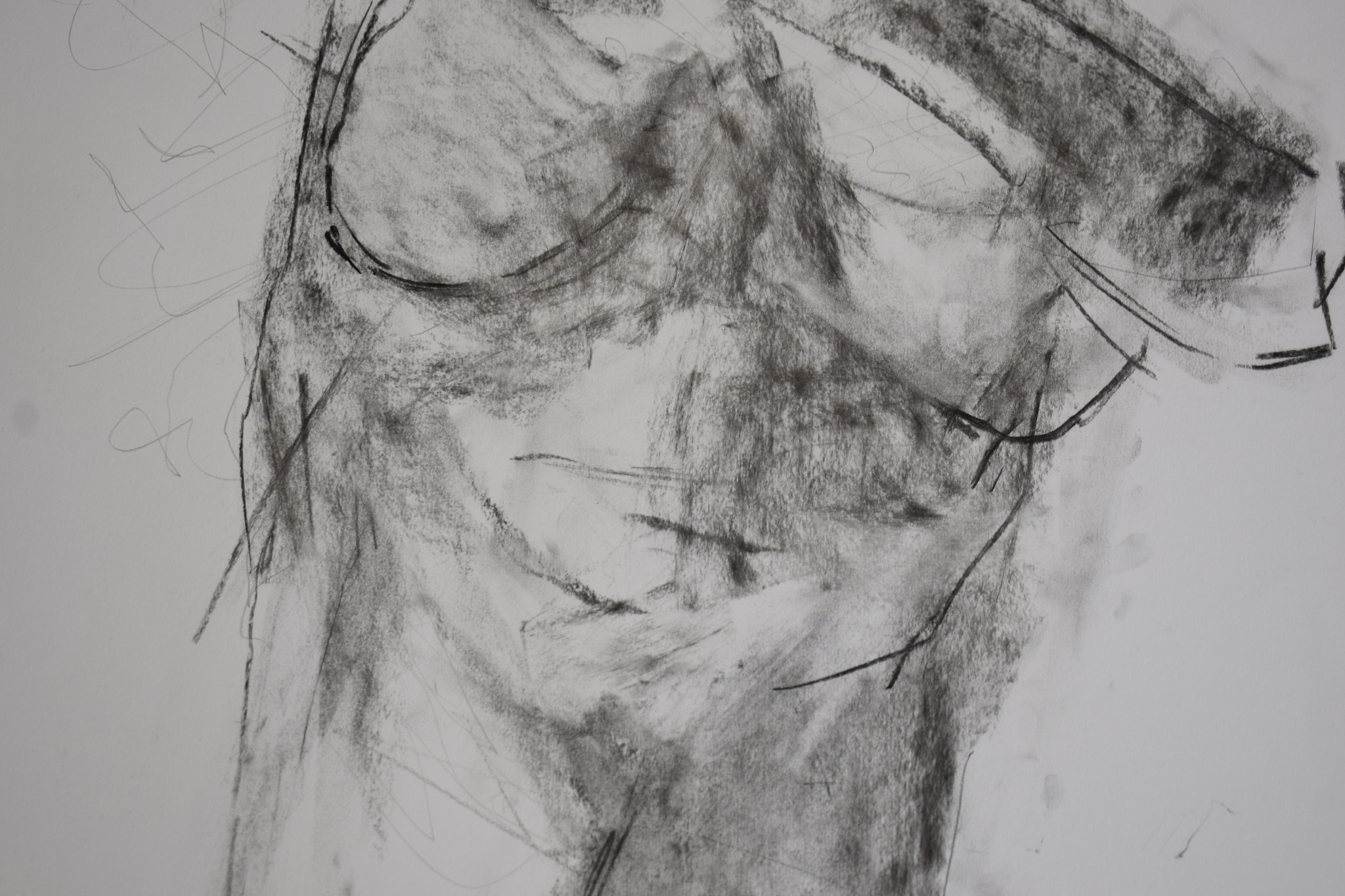
Drawings re-examine, explore the 'Body Boundary' its feelings between the world of the individual and the world. Drawings attempt to establish a common boundary condition between themselves and the outside world.


We experience architecture not by aggressively seeking it, but by dwelling in it.

Drawing is always a formulation or elaboration of the thought itself at the very moment it translates itself, makes itself as an image.


Proximities and The Sensing Self.

You see and hear things figuratively and at a distance. But you touch the actual thing. You can extend haptic perception with an instrument, in which case the 'feeling/sensing' moves out to the end of the cane. But when you extend sight or sound, telescopically or electronically you continue to see and hear figuratively and at a distance. 


Kinaesthesia a property of haptic sensing that allows one to sense the body motion (haptically) by detecting the movement of joints and muscles through your entire bodyscape. No other 'sense' deals as directly with the three dimensional world or similarly carries with it the possibility of altering the environment in the process of perceiving it. No other sense engages in feeling and doing simultaneously. This action/reaction characteristic of haptic perception separates it from all other forms of sensing, which in comparison come to seem rather abstract.

Body, Memory, and Architecture.

Bloomer, Moore.


Organism-Person-Environment

Affect Architecture : Sociological Inquiry. 

Architectural Body. 

Awakawa/Gins.


Caloricity/Corporeality.

The Dreaming Physical Body.


Poetry as a synthesis of human existence.

Novalis, Bachelard.


I've always loved encountering a Rothko, up close, they really hum through your body.

I like the spaces that a large scale offers.

I think of each mark or area as having the possibility of carrying a sensation.

Jenny Saville.


Bodily Boundaries.

Body-Image-Theory.

The 'Physical' Body is the private property of the individual, but the individual's Body Image is developed, socially and thus has a social property. The tendency to associate the body with physicality rather than image over associates the body with notions of privacy.

Bloomer, Moore.


Paint/Haptic Fleshings.

The Bodies She Paints.

Chadwick/Saville.


If Painting presents Being, the drawn line presents Becoming.

Norman Bryson.


Drawing : Bodily Transactions/Making Public.

Displaying : Showing Possession.


Possession, like a body is a feeling that calls on all the senses, but is the direct consequence of feelings that are confirmed haptically, in contrast to the more distant and figurative feeling that are experienced visually and audially.

Bloomer, Moore.


Drawing/Sensing Haptic Relations.

Situatedness through drawing produces the hapticity of the experience of seeing/sensing/feeling with the body. 


The Anatomy of The Body.

The Exposed Interior of a Painting. 

The Space between Abstraction and Figuration.


Having flesh as a central subject (what it feels) I can channel a lot of ideas.

I need my marks to construct the anatomy of the Body.

If there's a narrative I want it in the flesh, in the body of painting.

I try to find Bodies that manifest in their flesh something of our contemporary age.

I find having the framework of a body essential.

Jenny Saville.

Elpis. Gagosian Gallery. 2021

The monumental paintings explore the human body and its fascinating aesthetic potential. Saville's bold and sensuous impressions of surface, line, and mass oscillate between rational and irrational forms, capturing a unique approach to realism specific to the twenty-first century. The publication documents the twelve paintings in the exhibition alongside photographs of the artist's studio and reference materials, including snapshots taken by Saville. It also features a poem by Anna Akhmatova, whose work Saville learned about while she was in Russia, where she photographed many of the models pictured in the paintings.


Friday, 13 June 2025

Drawing as Diffractive Research : Mind/Hand/Media/Wayfaring, all in the thick of material existence.

Diffractive Research.

Tim Ingold's concept of "diffractive research" emphasizes a dynamic and iterative approach to inquiry, where researchers move between different lenses and perspectives, exploring the interplay between diverse elements. This method, rather than seeking a definitive conclusion, aims to enrich understanding by embracing the "emergent difference" and "variation in commoning" found within the research object. 

Elaboration:

"Diffractive" as a Metaphor:

Ingold's use of "diffraction" draws an analogy to the physical process of light being bent and spread when it encounters an obstacle. This process reveals the nature of the obstacle and the light itself, highlighting the complexity of their interaction. 

Iterative and Relational:

Diffractive research is not a one-time process but a continuous engagement with the research subject, moving between different perspectives and interpretations. This iterative approach emphasizes the relational nature of knowledge, recognizing that understanding emerges from the interplay between the researcher and the object of study. 

Embracing "Emergent Difference" and "Variation in Commoning":

Instead of seeking to define or reduce difference, diffractive research celebrates the "emergent difference" that arises from the interactions between diverse elements. It also emphasizes "variation in commoning," recognizing that individuals and things can contribute to a shared understanding even when they have nothing in common. 

"Wayfaring" as a Method:

Ingold's concept of "wayfaring" (a way of traversing the world, constantly engaging with its details) is closely linked to diffractive research. Wayfaring involves actively engaging with the world, paying attention to the details and nuances that emerge along the way. 

Examples in Practice:

This approach can be seen in research that explores:

Materiality and Agency: How materials shape human action and how humans, in turn, reshape materials. 

Knowledge and Memory: How knowledge is not simply transmitted but actively generated and shaped through experience and interaction. 

Social and Cultural Practices: How social and cultural practices are constantly being re-interpreted and re-created through interaction. 

Beyond Objectivity:

Diffractive research challenges traditional notions of objectivity by embracing the inherent subjectivity of research. It recognizes that knowledge is always produced within specific contexts and through particular relations. 

In essence, Tim Ingold's concept of diffractive research offers a powerful framework for understanding how knowledge is generated and how we can engage with the world in a more dynamic and nuanced way. 

AI Overview/Google


Outpost 180424

The Body of Drawing/Butades.

Thinking Matter : Cosmologies/Constellations/Assemblages/Apparatuses. 

Matter (as interlacing interplay that is dynamic and mutually defining) has its own nature.


In the thick of material existence.

Merleau-Ponty.


On The Hospitality/Intertwining of Lines


Making/Moving Matter/Theoretical Objects for Spatial Practises.

In and Out of Material/Matter/Matters of Concern/Sculpture

Tony Cragg.


Situated Practices/Architectures of Care/Concern.

Oren Lieberman.


The searching line proposes/launches visual observations/haptic responses, and conversely what is seen determines how the next line is to continue in a perpetual and recursive interaction that unfolds in ongoing time. 


Relationscapes of/with/for Drawing.

What is drawing?

What is the nature of the drawn line?


Un-Learning Drawing.

The drawn line is raw, on permanent view of its emergence into the world, an open zone that operates in real time. Corrections to the line, challenge perceptions and build intimate relationscapes with the mind, body, media and surface.

'In drawing' we are perceiving the evolving process of thought and perception.

Avis Newman.


Praesentia, being present, a presence that is close at hand to the present moment or time.

The phenomena and its nowness/nearness in the light of day. 

Drawing is driven from the outside.

The agent/agency of drawing admits that the process leads, the mind follows.

First the material signifier, marks on paper, then afterwards the signified, the depicted scene and its nominal referent. For Cozens the random application of splashes and patches of ink would at first appear a chaos, yet with a little skill, out of that chaos forms could be encouraged to appear. Blots might become clouds or the silhouette of hills. For Bryson, Cozens 'anti method' clarifies what the official ideology of drawing-as-transparency habitually mystifies. That the relation between subject matter and line is not at all a question of before or after.

Though far from being a work of philosophy Cozen's method/manual anticipates the broad outlines of Merleau-Ponty's description of the intending consciousness as always already in the world, in the thick of material existence.

Drawing the line involves an interlacing of outside and inside, a permanent cross-over between interior (the artist's mind, sensations,sensibilities) and exterior (paper, pigment,stylus).

A Walk For Walk's Sake.

Norman Bryson.


Studio Silences of  Space-Time Phenomena/Phenomenology.

Existential becomings in the thick of our material existence.

The Poetics of Space.

Gaston Bachelard.


The Primal Scene of Drawing/The Trace of Butades.

Is all about preserving loss/the blankness of paper and a hand that is about to make its first trace on the surface. Drawing enacts the very moments of trepidation when a new image is about to enter the world. 

Drawing is an art of presence and transparency of phenomena unfolding, a fusion between the artist's mind, the artist's hand, and the beholder's gaze.


On Drawing.

The work of observation is necessarily shaped by the line it leaves behind.

The drawn line conditions or models the selections from the field of observation. It launches observation along a particular direction or path.


Sunlight enters into architecture and sensations of bodily presence/perception.

Vessels unfolding through durations of light and dark.


Flesh/Sensation/Paint/Francis Bacon.

An Unconditional Body from Social Objectivity to the Extremes of Subjectivity.


Acts of both presence and transparency.

Mapping Subjectivity/Gathering Matter.


Organism-Person-Environment.

Architectural Body.

Art works and artists, all manifests themselves at the social interaction and reading/rendering of subjectivity.


The Stage of Drawing.

Gesture and Acts.

Like the drawings themselves, the exhibitions loyalty is to the immediate experience of the individual image rather than to the totalizing logic of art history complete with its grand narratives of social and cultural change. The exhibition reveals the convergence of real time operations (realities) the artist's visual idea in the time of its coming into the world, and the always ongoing work of viewing.

Pathways of difference, of the brush and pencil as they move through their respective spaces.

For The Brush.

Before it can touch the surface of the canvas, the bush has to orient itself according to the four sides of the frame, and then according to the total sum of the marks that have already appeared on the surface of the picture. It has to hover, to hesitate, to sense as though by dowsing where a channel in space may now open up, a groove in the total surface that the brush may now enter.

For The Pencil.

In drawing the presence of the 'reserve' frees the pencil from this complex calculus of the totality, reducing the scope to an area that can be taken in at once. A local area, that lies where the hand is now in praesentia. For Bryson this introduces the possibility that the drawn line, maybe closer to the immediacy of the artist's thought and perception than the line made on canvas. 


Monday, 5 May 2025

Drawing/Sociology/Art : Figuration/Flesh and the Body.

Drawing/ Being Part of Space and Time : A DISPERSION
Antony Gormley

Drawing is the most immediate way of making your ideas, sensations, and information explicit.
Euan Uglow

What do we look for from the nude today?
Drawing/Man : Oskar Schlemmer

The use of pure line compels the artist to a process of abstraction.
Energy/Tension : The Social Form of Living Flesh

To create a new intellectual image of reality

Line has an autonomous relationship with surface (a rhythmic lineation)
Rhythm is the means by which all kinds of movement are delineated.
It follows that the physiological movement of the body is rhythmically organised.

The figuration of the contemporary body through abstractions and representations.


INTERIOR : Environment, physical and psychological realms.

INTERIORITY : SELF.

The Picture Plane
Composition, elements and scale
Context-Content-Beginnings
Relationships- Figure- Ground, becomes psychological state of a figure both becoming and entropic

All pictorial representation is an intellectual and visual organisation.
Flesh follows the physiological movement of the body and is rhythmically organised/balanced.

ANTHROPOMETRICS
THE FIGURE IN SPACE
Performative, Sociological ; Structure and Agency (Klein)(Duality)
Measurement, Reach/Movement/Proportion

Making relationships between the spatial figure and the spatial arrangements of the picture plane. Bringing the spatial figures into the system of axes of the picture space.
Schlemmer's plane and spatial prospects contain architectonic motifs, which are presented orthogonally or in exaggerated perspective.

Anthropomorphic Collage
Morn Hill, chalk grave/leper hospital
Joseph Beuys/Reg Butler


Deleuze, Francis Bacon
Haptic Vision/Colour Space
Light is time, but space is colour.

Carnality/Sensation/Logic/Colour Space
Entropic/Seeing/Haptic/Violence


Sunday, 14 January 2024

TOWARDS A NEW INTERIOR : Photography and the temporality of territory

Metaphysics/Atmospheric Cosmogonies.

Blurring divisions and drawing attention to the temporality of territory, the ongoing experience of space as changing instead of space defined by the anxiety about the presence/absence of things.
Francesca Woodman, Chris Townsend. 1999


Spatial themes of inside/outside, negotiations between the physical, phenomenal and a metaphysical world.

TOWARDS A NEW INTERIOR
An Anthology of Interior Design Theory
Lois Weinthal

EXTREME METAPHORS
Interviews with J.G. Ballard
1967-2008


PHILOSOPHY IN THE FLESH
The embodied mind and its challenge to Western Thought
George Lakoff, Mark Johnson

BRITISH POLITICS
A Very Short Introduction
Tony Wright


Wednesday, 5 July 2023

Articulating Feeling Thought : The multiple sense of being brought from the earth.

Propositions for Thought in Motion.

Feeling-is affect bleeding into thought, activating complexities on the verge of expression.

Will to Power.

Activating new parameters for thought.

Feeling is power's compulsion of composition, (Whitehead, 1979/1978).

To posit a subject for feeling means, engaging with the creative from outside. Force propulses a will toward the creation of a dynamic form, opening feeling to its activation, generating expression in its passing. This taking form is less the formation of a concrete identity, than the culmination and residue of a process. 

The compulsion to compose is an aesthetic drive, a will toward sensation, a will to power-feeling.

Erin Manning.
Relationscapes/Movement/Art/Philosophy.

Anthropomorphic Form : Field Chalk with Photographic Emulsion 
150x254 cms. 2013/2018.


10 Days – Negative Capability part 1’ at The Link Gallery, University of Winchester, 2013.

‘Profiles in Transit: Anglo-Saxon
Graves’ (‘Song of a Leper Spirit’) and ‘Anthropomorphic
Vessels: Correspondence’ (‘Vacant Vessels’), Russell Moreton; 

From Behind The Frosted Glass Poems.
IIse Cornwall-Ross. 2017