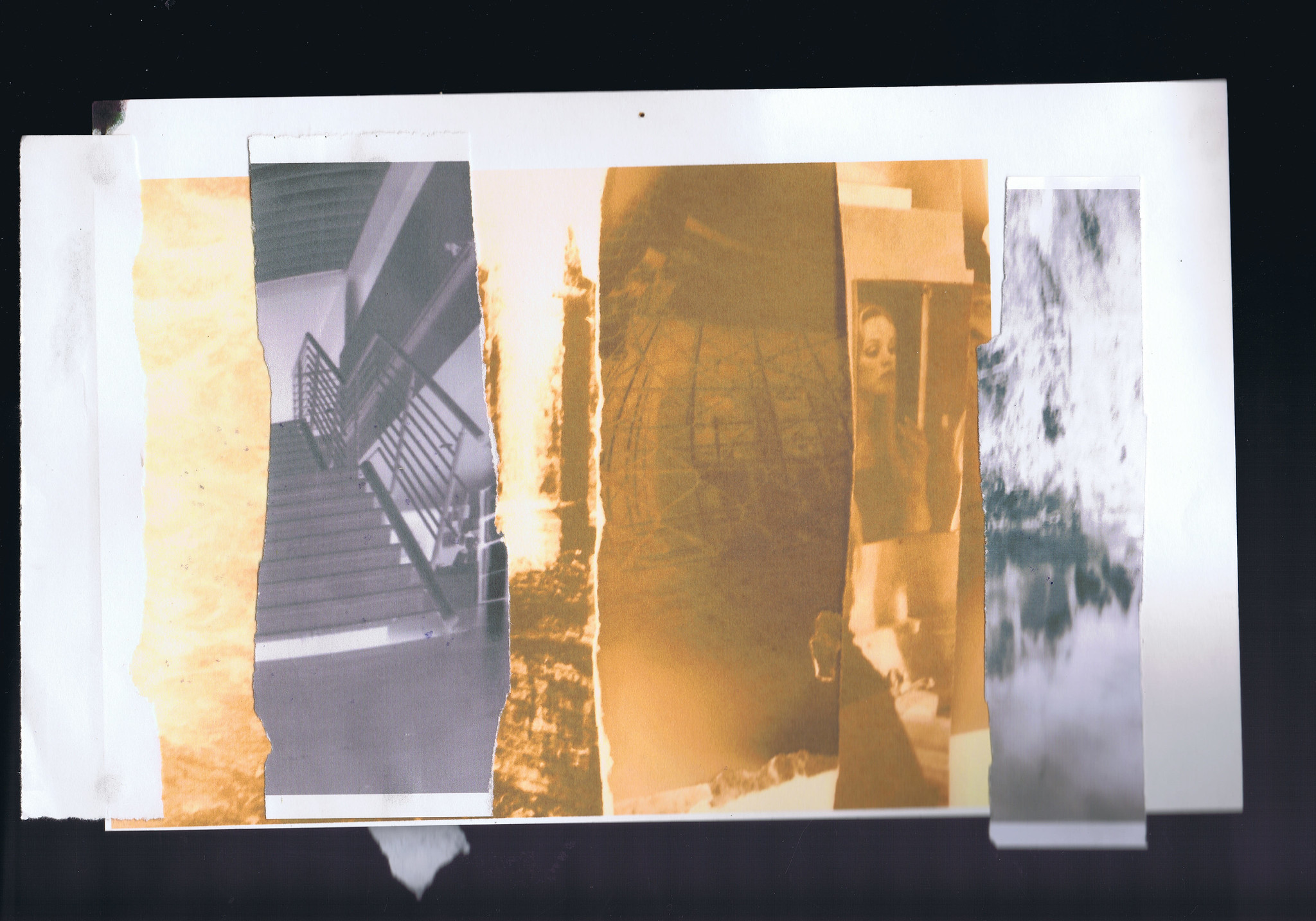
Monday, 29 July 2024

The Interval/Gap/Spacing of a poetic instant.

The Poetic Instant.

The search for the interval inherent to the Japanese culture of Ma (spacing, interval, gap)


It suggests a consciousness of time that encompasses the intermediary and the in-between, composing the present, a present in the process of becoming.


Mono-Ha, the idea of the artwork as a phenomenon of natural order with no other meaning. The artist can simply organise what already exists, and only he who dedicates himself to it – and concentrates on it – manages to maintain a privileged relationship with the world.


Outpost 040724

Beyond the formal attraction and cultural interest of the objects, the collections also translate the consistency, the tenacity even, of ending the dispersion of the fragments of the world to reach an (illusory) form of totality. Through the careful work done, the artist becomes a conservator, in the museum sense of the term: he gathers the pieces, cleans them, counts, tidies, names and exhibits them. The same applied attention is brought to collected pieces as to created ones. Of his monastic wisdom, he nurtures the kare-sensui of his art and his life, repeating identical gestures that deepen the sense of a relationship with the world.


We cannot create

what we can do is remove the dust

that has formed on the surface of things

thus rendering visible the world contained underneath.


Sekine Nobuo, 1969

Tsukuranai to iu kota (Do not create)


Roger Ackling.

The Invisible Appears. 2020

Lydia Rekow-Fond.

Translated by Derek Byrne. 


Wrapped Body : Tacit Auguries/Sacred/Secular Spaces

Speculative art objects/intermediaries on the inwardness of things.

Norwich, Sacred Spaces, 
Body Fragments/Tacit Auguries : Care and Constraint 2019
Ceramic/Textile/Wire and Wax on Gesso.

Exploratory Forms. Bandages/Rust : Tacit Collage, Drawing 2019


"All religions, nearly all philosophies, and even a part of science testify to the unwearying heroic effort of mankind desperately denying its contingency."


Jacques Monod,
The Human/Straw Dogs, John Gray.


Wednesday, 24 July 2024

Joseph Cornell : a fusion of the timeless and the everyday

Collage: Diversions, Contradictions and Anomalies.

Collage's integral methods of discordance and displacement have so insistently reflected turbulent developments in twentieth century art, science and geopolitics that our response might be to categorise the whole genre as iconoclasm or subversive fantasy.

Sally O'Reilly


23/02/2017 


Sunday, 21 July 2024

The Social Life of Making : Thoughts with materials, making good, occupation and maintenance

 A Species of Spaces 

The Social Turn 

Museum Site and Display 

Political Philosophy

We have all the choice in the world in terms of products, but very little choice in terms of the kind of economy within which those things are made, accessed and used

Whose Economy Reframing the Debate After Neoliberalism Doreen Massey

Other 'material interventions' and the revaluation of making through strategies of repair and maintenance

Making Ecological Politics

A world teeming with impulsive movements, deviations and many other lively (capacious) materialities Influences that pervade, enable, and disrupt us

Vibrant Matter, Jane Bennett

Makers work in a world that does not stand still


Iteration allows for continual correction (material conversation) in response to an ongoing perceptual monitoring of the task as it unfolds, mixing the potential for blending or combining matter that already exists into new combinations

Tim Ingold 2010

Making is central to who we are as individuals, what we make as part of everyday practice forms our identities and place in the world

The mundane experience of making, and thus of labour, is resolutely political, a geographical imperative, and a critical means of operating a meaningful relationship with this material life The Quarry as Sculpture : The Place of Making

D A Paton 2013

The making of a building does not stop when the building work is (temporarily) finished. But only really begins upon occupation, when the work commences of maintaining the buildings integrity against an onslaught of willfully destructive elements, insects, rodents, fungal infestations, corrosion, damp, harsh sun, water, wind

Evocative Thoughts on Building, Alvaro Siza 

The social life of making


Making good is about maintaining continuity with the past, in the face of efforts to rupture that continuity.

The need for repair is a remorseless and necessary process that keeps society ticking over.


Posted by Russell Moreton on 29 May 2022

Saturday, 6 July 2024

Studio : Making movements in thinking ( the way is made in the walking of it )

 Outpost Studio 24/10/2021 


Outpost Studio 221021

Material in space, working with spatial agency/thinking movements


The use of any material that helps any figure/organism exist in any given framework/environment.

Working Things/Coalitions of Material, Meaning and Form
Heuristic Discontinuities and  Materialism
Studio images, black windows, arch model,

Kounellis/Oren Lieberman
Architectural Proposal/Spatial Agencies
Marking/Demarcations/Corporeality
Drawing as an impromptu heuristic tool.

Gordon Baldwin, charcoal drawing for a vessel in a landscape. 

Drawing Materials, Blue lever arch
Exploded contents into critical/subjective analysis/displayed as assemblage around the environs of the studio

Content/First Readings/Shifting/Splitting discontinuities between organism, person, environment.

Richard Serra
Drawings Work Comes Out Of Work : Eckhard Schneider

There is no way to make a drawing - there is only drawing
Richard Serra, 1977


A sculpture grammar, based on formal reductionism, an active site-specific reference, and the central theme of gravity and balance. This results in sculptures that let the viewer experience the critical balance of different forces and whose large-scale dimensions impart a strong physical and emotional experience.


Large scale drawings and monoprints
Paintstick on paper and cloth.
Pressure is exerted on the back of the paper with a hard marking tool.
The paper treated as an active substance rather than a passive ground.
Liquid material under pressure shoots out and produces the explosive markings at the edges.

I don't see the drawing I am making until the paper is pulled off the floor and turned over or the screen is lifted.

Precisely because every illusory strategy is avoided, the forms are at the same time able to imply weight, mass, and volume.

Warming or melting the material for his drawings, he applies it either directly onto the paper with large sweeps of his arm, or he uses a window-screen as an intermediary surface through which he presses the colour.

The material and the entire work process serve to build the drawing step by step. It is an elementary process, which, carried out with intense energy, is the result of direct action. By splitting and discontinuing the flow, Richard Serra avoids the gestural and allows a dense superficial construction. Serra avoids gestural features in order to sharpen the awareness of the viewer and draw attention to one's own corporeality. He is not concerned with subjective gestures or narrative references; at the core of his drawings is the principle of marking, of the anonymous characteristic style in which the drawing seems to find its form through the density of the material and the compact work process.  

Unlike the site-specific Wall Drawings, which, rendered directly onto cloth, operate with the proportions and scales of the existing architecture, Serra's drawings on paper are not bound by content. The frame serves, instead, to separate the paper drawing from the wall.

Serra is fully aware that the weight of a drawing does not just depend on the layers of paintstick applied, but above all on its form.
I like to draw. It is an activity I rely on, a dependency of sorts. Drawing gives me an immediate return for my effort and the result is commensurate with my involvement. It is an activity that requires solitude, it is the most concentrated space in which I work.

The colour he uses is black, a dense layer of paintstick absorbs and dissipates light; what emerges is the mass, density, and volume of the drawing.

For Serra, black is a property, not a quality. In terms of weight, black is heavier, creates a large volume, holds itself in a more compressed field. It is comparable to forging. To use black is the clearest way of marking against a white field. He finds it also the clearest way of indicating something without triggering associations because black is interpreted as a material substance rather than a colour.

Convertible Facts : James Lawrence

Drawing is transformative.

Drawing is a primal, fundamental concept, an activity intimately connected with the raw terms of life as it is lived. Artists prize drawing not only for its inherent qualities, but also for its virtues as an  impromptu, heuristic tool. Rapid and agile, drawing is easy to adjust, erase, supplant, emulate, and if necessary, discard. It is a fluid means of anticipation, often prior to translation into more celebrated form.

Tony Cragg
In And Out Of Material
Interested in the coalitions of material and meaning and in the content of form.

MATERIAL IN SPACE


Working Things, Reflections on Tony Cragg's Sculptures : Robert Kudielka

Materialist

Materialism means the sculptor's experience that only through the effort of working things is thinking also able to move and change. The material assumes a new form, and the sculptor discovers new contents and meanings.

197
For Cragg, the German language in particular provides a unique possibility of distinguishing clearly 
between the thingness, objectness and objectivity. Kant.
The Rebirth of Sculpture from the Spirit of Matter : Christoph Brockhaus

Art Povera
The relationship between people and their environments and the things, materials and images in this environment, the relations among things,materials and images.

Collecting and Ordering Found Objects, Things, Materials, Images.

Formal Thinking With Matter

THINKING IS FORM
The Drawings of Joseph Beuys : Temkin, Rose

Northern accretion of detail from many sources, he explored several directions and mediums at the same time. 92 

RODIN BEUYS

Rodin's lines don't just represent carnality, they are themselves carnal, invasive, sexy. 

The Drawing Book : Tania Kovats
Drawing and Random Interference/Quantum Chance

ECSTASIS/MATTERING

QUANTUM CHANCE : Janna Levin

DRAWINGS : Antony Gormley
BODY, 2009-2011
A state of becoming, a dispersion of being part of space and time.

WRITING ON DRAWING : Essays on Drawing Practice and Research. Steve Garner.

The Erotics of Drawing : Jonathan Cooper


Sunday, 30 June 2024

Aesthetics of the Everyday : A Creative Human Praxis

Working Praxis into Creative Research
Clay, Paint, Matter/Everyday Landscapes

The Subject Matter of Lived Experience

The Potter's wheel creates cognitive enactments (materiality) through encountering clay.

The Heideggerian Roots of Everyday Aesthetics
A Hermeneutical Approach to Art
Cristian Hainic

The mere aesthetic experience of understanding one's being-in-the-world as made up by everyday phenomena, is in itself overwhelmingly sufficient to constitute a foundation for an aesthetic of everyday life. 

Textuality/Interpretations (Texts and their inherent lack of perceptual immediacy)

Everything in language belongs to the process of understanding

Human understanding/interpretation takes place not in the immediacy of representational thinking but rather in the lack of  objects and experiences available for direct confrontation. 

John Dewey
Live Creature, an aesthetic experience comes to be defined as active and alert commerce with the world. Life does not merely go on in an environment, but rather because of an environment and because we interact with it. 

Up, Across and Along
Tim Ingold

J.M.W. Turner (1775-1853)
Dunwich, Suffolk,c. 1830


THE ART OF SURVIVAL
Jacqueline Rose's catalogue essay on Therese Oulton

How to paint the earth lovingly but without false solace,a world in which love might be impotent?

But then, at the very moment you have ceded such intimacy, she manages to give you the sensation of a world hurtling to the point when there might no longer be anything, or anyone there.

The Art of Jeremy Gardiner
UNFOLDING LANDSCAPE

LANDSCAPE, MEMORY, AND PLACE
Robert Ayers

Often for these painters the experience that they concern themselves with most directly, is that of nature, which in its vast and enormously inflected range can act as a metaphor for lived experience.

They are concerned more with how nature feels than how landscape looks. They share too an awareness that it is the translation of that feeling into paint mark, the achievement of an equivalence, that is of crucial importance. It is in the consummation of paint and experience that picture-making finds experience.

Paint marks flicker as we look at them between substance and illusion.

CONTESTED SPACE
Urban/Social/Landscapes

Landscapes are contested, untidy and messy, tensioned, always in the making. Our landscapes of modernity are frequently on the move and peopled by diasporas and migrants of identity, people making homes in new places.
An Anthropology of Landscape

Christopher Tilley, Kate Cameron-Daum

ORDINARY LIVES
Studies in the Everyday
Ben Highmore

Lukács’s Literary Cartography:
Spatiality, Cognitive Mapping, and The Theory of the Novel
Robert T. Tally Jr.


https://www.flickr.com/photos/russellmoreton/26224308391


The Sleeper Awakes : Veiled Melancholy/Book Narratives : Film Collages. #3

Preface (1921) ” The great city of this story is no more than a nightmare of Capitalism triumphant, a nightmare that was dreamt a quarter of a century ago. It is a fantastic possibility no longer possible. Much evil may be in store for mankind, but to this immense, grim organization of servitude, our race will never come” H.G. Wells. Easton Glebe, Dunmow,1921.

28/01/2016

https://uk.pinterest.com/russellmoreton/art-objects-russell-moreton/

"Spatial turn" The increased attention to matters of space, place and mapping in literary and cultural studies, as well as in social theory, philosophy, and other disciplinary fields.

Spatiality, Robert T. Tally Jr. Routledge 2013.


 The Politics of Architecture : Theorizing through speculative spatial practices.

Immediate Architectural Interventions, Durations and Effects : Apparatuses, Things and People in the Making of the City and the World. Alberto Altes Arlandis, Oren Lieberman. 2013


"He rubbed his eyes. The riddle of his surroundings was confusing but his mind was quite clear - evidently his sleep had  benefited him. He was not in a bed at all as he understood the word, but lying naked on a very soft and yielding mattress, in a trough of dark glass. The mattress was partly transparent, a fact he observed with a sense of insecurity, and below it was a mirror reflecting him greyly. Above his arm- and he saw with a shock that his skin was strangely dry and yellow - was bound a curious apparatus of rubber, bound so cunningly that it seemed to pass into his skin above and below. And this bed was placed in a case of greenish-coloured glass (as it seemed to him), a bar in the white framework of which had first arrested his attention. In the corner of the case was a stand of glittering and delicately made apparatus, for the most part quite strange appliances, though a maximum  and minimum thermometer was recognizable."

H. G. Wells : The Sleeper Awakes. 1899/1910


Sunday, 23 June 2024

Interactions of Colour and Bodies : Rothko/Neri/Kundera/Schiele, subjects alone in a moment of utter immobility.

Manuel Neri

Milan Kundera

Josef Albers

Mark Rothko

Egon Schiele


The use of the word 'immobility' recalls an article that Rothko wrote in the 1947

"For me the great achievements of the centuries in which the artist accepted the probable and familiar as his subjects were the pictures of the single human figure - alone in a moment of utter immobility."

p84, Possibilities , 1, New York, 1947


The world is overloaded/the nature of things : Peter Zumthor, Jean Baudrillard


The world is overloaded of signs and information, representative of things that nobody completely understands, because they are in turn nothing but signs representative of other signs.

The real thing remains hidden. Nobody can ever see it.

Peter Zumthor


The nature of things cannot be discovered by analyzing them according to their functions, by labeling or categorizing them but by understanding their relationship to people, their behavior and emotions which caused creation of these objects.

Jean Baudrillard


Saturday, 22 June 2024

Acts of Drawing/Derrida : Becomings through immaterial, memory and blindness.

JACQUES DERRIDA THE SCEPTICISM OF DRAWING:

“perception belongs to recollection.” Butades daughter’s act is in blindness, as if she was drawing a declaration of love.

Jacques Derrida in 1993 wrote an extensive text to accompany an exhibition of paintings from the Louvre. This text titled Memoirs of the Blind, The Self-Portrait and Other Ruins contains within it some particular references to “Pliny’s Origins of Painting." Together with the aid of illustrations of paintings on this theme, he examines and interrogates their philosophical and historical qualities.

Derrida makes particular mention and emphasis of the “state of blindness” in his analysis of the Butades myth. In particular the notion of  “scepticism” which is at the very heart of drawing. This notion of the “difference between believing and seeing”1, and what he remarks as “believing one sees and seeing between” evokes the emergence of a “glimpse” caught in a state in which “doubt ever becomes a system“2. There is a moment of delay between the gaze with its vigilance and attention, and what one reflects upon seeing. These actions will conspire to create the moment of conclusion. So by keeping the thing in sight it is being constantly examined but not reflected on, until the point when the gaze is averted to the drawing .It is a this instant, withdrawn from the sight of the object, that a “blindness” forces the recollection (the moment of conclusion to emerge) to which the drawn mark is visual evidence of that moment Derrida makes the observation that representations substitute memory for perception and that blindness is a constant withdrawal into memory. Derrida is of the view that drawings, paintings are “representations drawn most often from an exemplary narrative." This myth of Butades with its “exemplary narrative” relates directly to the absence or invisibility of (being in) the drawing process whilst in the presence of the object, that the very act of drawing withdrawals and blinds its participant. Butades daughter is “blinded” in the acts of both love and the act of drawing. Through these conditions it can be seen that Butades daughter is blind to the vision of her lover and in drawing around his projection she is forced to recollect and reflect to produce a conclusion of that action by the simple gesture and act of an inscription drawn aided by a flickering silhouette.

Derrida uses the example of the painting by J. B. Suvee “Butades or the Origin of Drawing 1791” or as it is referred in English as “The Daughter of Butades Drawing the Shadow of Her Lover ” to illustrate that it was “as if one drew only on the condition of not seeing.” The drawing in effect becomes a “declaration of love destined for or suited to the invisibility of the other.”3 Derrida comments that the origin of drawing may have become born from the desire to create some sort of surrogate mark which originates “from seeing the other withdrawn from sight.“4 The important observation Derrida continues to make is that the daughter in “following the traits of a shadow or a silhouette” who is in effect drawing on a blindness which will through recollection, initiates a sense with which she is in effect “already loves in nostalgia.”5

Derrida dwells on the very nature of drawing moving away from “the origin of drawing” to “the thought of drawing” he comments that the thought of a drawing has a “certain pensive pose, a memory of the trait that speculates, as in a dream, about its own possibility.”6 It is as if the potency of drawings is a projected development that occurs as Derrida states “on the brink of blindness.” This notion of the “trait” (a feature to a line, stroke, or mark) a visible presence that accompanies the lines odyssey, a sense of presence that can witness something of the invisible in the visible is touched upon. ’’Merleau-Ponty’s The Visible and the Invisible is cited by Derrida as having already made “Indications” in this respect Derrida footnote from The Visible and the Invisible seems to sum up something of the invisibility and presence of the trait acting on a drawing. This extract taken from the “working notes” section of the book it reads” One has to understand that it is visibility itself that involves a non visibility.”7

Distilled from the salient points of Derrida’s extensive interrogation Memoirs of the Blind seems to acknowledge the fact that “whether Butades daughter follows the tracts of a shadow or a silhouette or even if she draws on the surface of a wall or in a veil.”8 the resultant inscription in any event “inaugurates an act of blindness.” Derrida’s revelation is that “perception belongs to recollection.” Butades daughter’s act is in blindness, as if she was drawing a declaration of love that simultaneously that also contains her anticipation of a loss, and as a result, a nostalgia that is reflected upon before it is actually perceived.

1  . Jacques Derrida, Memoirs of the Blind, The Self Portrait and Other Ruins (Chicago: Chicago Press, 1993),page 1.

2  .Ibid., page 1.

3  .Ibid., page 49.

4  .Ibid., page 49.

5  .Ibid., page 51.

6  .Ibid., page 3.

7   Maurice Merleau-Ponty, The Visible and the Invisible (Evanston: Northwestern University Press, 1968),257.

8   Jacques Derrida, Memoirs of the Blind, page 51.