Monday, 26 May 2025

LIVING Intensity : FRONTIERS OF ARCHITECTURE, Kirosan Observatory/Anti-Object/Anthropology/Art

040521

Anti Object

We are composed of matter and live in the midst of matter. Our objective should not be to renounce matter, but to search for a form of matter other than objects. What that form is called architecture, gardens, technology is not important. 

Kengo Kuma


Procedural Architecture

Start by thinking of architecture as a tentative constructing toward a holding in place. Architecture's holding in place occurs within and as part of a prevailing atmospheric condition that others routinely call biosphere but which we, feeling the need to stress its dynamic nature, have renamed bioscleave.

Architectural Body

Madeline Gins and Arakawa


LIVING : FRONTIERS OF ARCHITECTURE

Louisiana Museum of Modern Art.


Wang Qingsong : Dormitory, China, 2005


Key Words : Observatory, Camera Obscura, Living, Seeing, Intensity


BEHAVIOROLOGY ( the study of the combination of natural dispositions, social environment and personal experience)


Deals with the special atmosphere and character of the suburb. In film, literature and art the suburb often has an undertone of something mysterious, eerie, of events that are kept hidden.


The dual desire to see and to be seen leads to instability. An object may be made transparent, but it remains an object. And transparent, it is more thoroughly under observation and more thoroughly dominated. Conditions in the suburbs are in a sense even more wretched than those in the panopticon.

Kengo Kuma/Observatory/Anti-Object


Uchronia, Burning Man Festival, Nevada. 2006


Rouen Concert Hall and Exhibition Complex

Architectural Envelope/Heterogeneous Composite

Movement Vectors/Layers : Interior Concrete Skin/Visible Arches of the Steel Skeleton


Painting Space : Yellow ochre on white gesso over kraft paper

An Anthropology of Landscape

Christopher Tilley

Kate Cameron-Daum


Spirituality in Contemporary Art

The Idea Of The Numinous

Jingu Yoon


New Global Ecologies

Baratunde Thurston


INTENSITY : Portable Architecture as Parable. Mark Prizeman

The act of moving through mobile societies makes this transient architecture understandable.


A nomad uses what is to hand and able to be replaced or adapted.


The success of a tent depends on the exploration of an idea in the workshop by wandering through the dream and not being restricted by the finite parameters of a drawn representation of the future object.

Like explorers planning to venture into the unknown, an ability to imagine the consequences of what one takes and what one leaves behind is imperative.


ERASING :


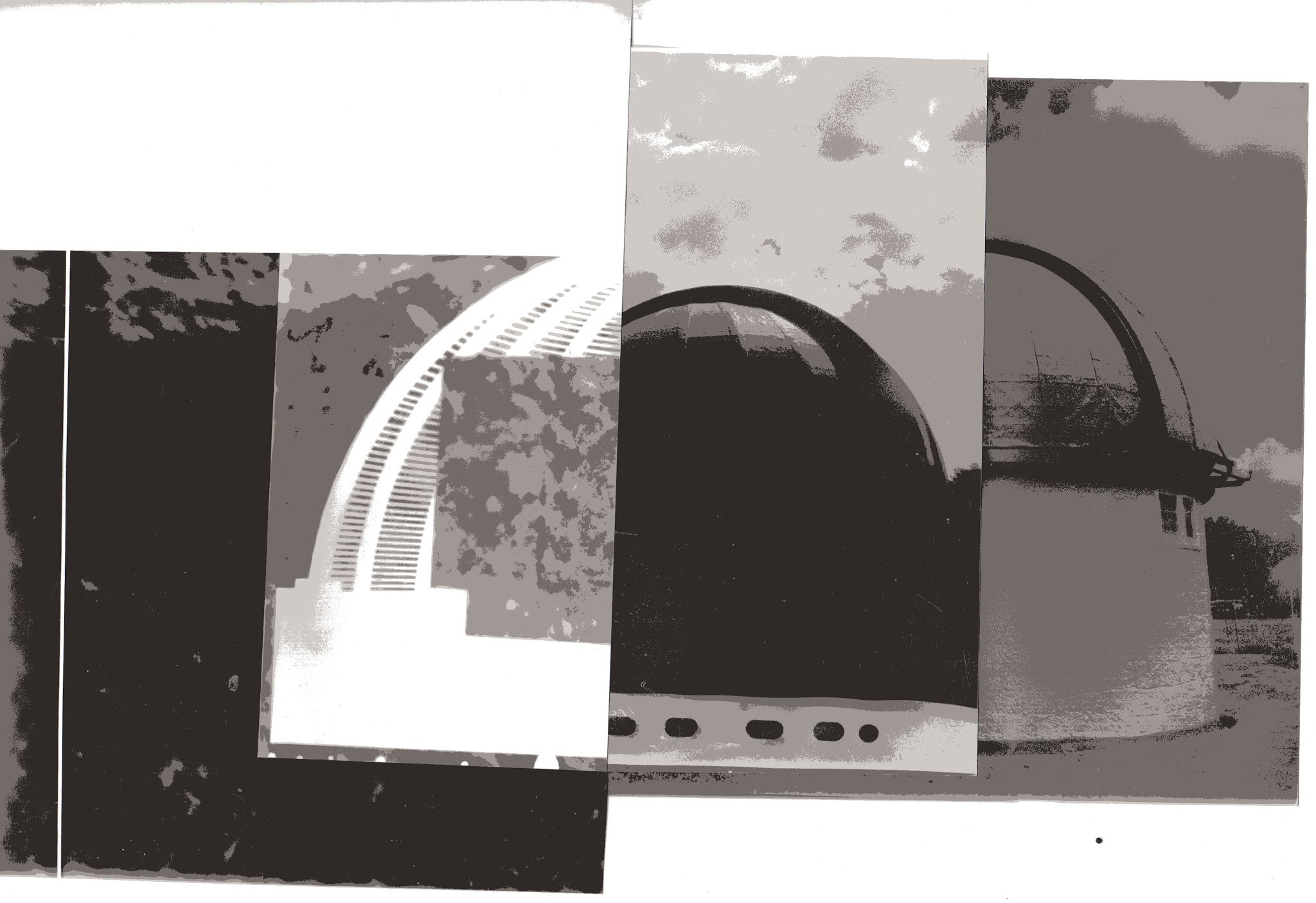
Kirosan Observatory, Kengo Kuma

Observatories demonstrate the self-centred nature of human perception. They are generally objects, that is the core of the problem. I wondered if this observatory could be made transparent, that is, effectively erased, so minimising the damage to the environment.


In terms of erasing an object, the settin is more important than the choice of material. In this case, the setting was a summit that had already been levelled and turned into a perfect pedestal. Anything that is set on a pedestal becomes an object, regardless of what it is made of or how discreetly it is placed.

Most works of contemporary art are tiresome because they rely on this particular property of the pedestal.


Observatory/Artists Outdoor Studio with astronomical 'Hortus Conclusus' /pavilion/segment built from the walled garden.


IMMATERIAL :

Layer upon layer of reality and image, the material and the immaterial, were thus overlapped. 

The Camera Obscura and Telescope, Dumfries. 1836

It is not quite clear what the real astronomical purpose of camera obscurae was, not only the Royal Observatory at Edinburgh but also the Royal Observatory at Greenwich still posses theirs, though dismantled and stored in cupboards for a century or more.


Paramatta Observatory, New South Wales, 1822

Sepia stained cyanotypes of architectural building plans


Plaster tabletop viewing screen, concave, chalk/matt surface

Lead weights on natural ropes used to control the apparatus


What I am most interested in now is inverting the structure of a culture that is centred around the city. The twentieth century was an age of industry, and an age in which everything from material goods, information and culture flowed from the cities to local towns and villages. Following the same vector, architecture, too, flowed out from the centre to the periphery.

Kengo Kuma


APPARATUS :


The Observatory is a facility for stealing looks at visitors


Electronic technology is used in these devices to expose the imperfection of vision and reverse its privileged status. Under ordinary circumstances, the seeing object is under the illusion that he/she dominates what they see. However, seeing also opens up the possibility of being seen. Anyone who dominates another through vision is always vulnerable to a brutal reversal.

High and Low, 1963. Akira Kurosawa


I therefore tried designing a transparent object. My real aim was not to create an object, but to choreograph a sequence of movements by the subject, that is, to create a device controlling his/her vision. Anti-Object, Kengo Kuma.

Your Chance Encounter, 2010. Olafur Eliasson


Messr Barr and Stroud, Optical Engineers, Glasgow, used to produce obscuras for industry, they were much cheaper to purchase and maintain in a large industrial establishment than closed-circuit television.


Friday, 23 May 2025

Drawing on Life : Bento's Sketchbook/A Hut of One's Own : John Berger/Ann Cline/Bento de Spinoza

In the backyard of where she was living, Cline once decided to build a hut inspired by Kakuzo Okakura's The Book of Tea.

As my dwelling took shape, it began to shape my life as well. And when I sat inside reading the recluse poets, the terse simplicity of their record framed my own perception, one I likened to a camera recording a world of pure experience.


The hut has a sense of immediacy that no room-filled house can achieve. The hut focuses its dweller on immediacy and meaning fulness. "I had found the commodity of my dwelling through the poetry of its use," Cline concludes.

The hut addresses the core of ritual as a part of nature versus the supposed freedom of modernist thought and the architectural contrivances it pursues. The hut represents the convergence of ritual and naturalness, at the same time addressing cultural issues and practices.

With an agility larger structures can never match, huts bring together the physical environment with such disparate aspects of culture as necessity, fantasy, faith, and "life-style." The hut, then, may be humankind's supreme experiment.

This may seem a bold conclusion given the modesty of the hut throughout history, and the modest ambitions of its makers, but this is Cline's point, that the experiment in solitude and simplicity is bolder than any social or culturally-sanctioned experiments or projects, simply because the latter are contrived and unnatural, even anti­ natural.

https://www.hermitary.com/bookreviews/cline.html


Then the days of working at home on it. The image in my head was often clearer than the one on the paper. I redrew and redrew. The paper became grey  with  alterations and  cancelations.  The drawing didn’t get better, but gradually she, about to stand up, was more insistently there.

The effort of my  corrections and  the endurance of the paper have begun  to resemble the resilience of Maria’s own body. The surface of the drawing - its skin, not its image — make me think of how there are moments when a dancer can make your hairs stand on end.

We who  draw do  so  not only  to  make something  observed visible to others, but also to accompany something invisible to its incalculable destination.


The bodies of dancers with their kind of devotion are dual. And this is visible whatever they are doing. A kind of Uncertainty Principle determines them; instead of being alternately particle and wave, their bodies are alternately giver and gift.

They know their own bodies in such a penetrating way that they can be within them, or before them and beyond them. And this alternates,  sometimes changing  every  few seconds,  some­ times every few minutes.

The duality  of each  body  is what allows them,  when  they perform,  to  merge into  a single entity.  They  lean  against,  lift, carry, roll over, separate from, co-join, buttress each other so that two or three bodies become a single dwelling, like a living cell is a dwelling for its molecules and messengers, or a forest for its animals.

The same duality  explains why  they  are as much  intrigued by falling as by leaping, and why the ground challenges them as much as the air.


Shadows Gathering around Objects, Causality, Art Ontologies : Correspondences in Drawing/Watching/Walking/Reading.


Outpost 071022


The Quadruple Object.

There are two kinds of objects and two kinds of qualities, real and sensual in both cases.

Real objects and qualities exist in their own right, while sensual objects and qualities exist only as the correlate of some real object, whether human or otherwise.


I am not saying that a work of Art reveals the secret of life and being to us.

A work of Art affords the peculiar pleasure, an aesthetic performance in which the inwardness of things, their executant reality is opened to us.

Ortega.


Giacometti.

Created a visual lexicon of nothingness and being, of community and isolation.

Making fleeting visions, interactions between the modelling object and the space within which it exists. Concentrating, extracting a female nude from the atmosphere of a city, creating a space that oscillated with their shared community and isolation.


There is no direct knowledge of anything only relations-on-knowledge.


The real object withdraws inaccessible from the scene, as the new object generated by metaphor takes over the situation.


The real objects at stake in aesthetics are ourselves.


It would be more accurate to say that in Art the part of the image which looks towards the object is always subordinated to our efforts, because as basically Thespian beings we become the new object generated by metaphor.


Object-Oriented Ontology.

A New Theory of Everything.

Graham Harman. 2018


Aesthetics Is The Root Of All Philosophy.


Robert Mangold.


Creating a new mysterious real object with new sensual qualities.


Compound Objects

Assemblages

The Quadruple Object.


Since objects cannot exist without qualities and vice versa, there are only four possible combinations.


In Object-Oriented Ontology real-sensual objects and qualities always come together.


Object Relations

Potentiality/Receptivity

The Theatricality of Metaphor.


Art makes explicit the tension between qualities that are experienced in the real/sensual object.


I myself am the sole real object in all experience, encountering any number of sensual things.


Every objective image, on entering or leaving our consciousness produces a subjective reaction.


Art is primarily theatrical in nature, since the spectator becomes a sort of 'method actor' a theatrical actor acting out the structure of metaphor. 


Ortega, An Essay in Esthetics By Way of a Preface. 


Ontology is the branch of philosophy that deals with ultimate questions of what reality and real things are.


Bruno Latour, defines modernism as the view that there are two permanently distinct kingdoms, known as nature and culture and that it is the task of modernity, to purify these two domains from each other.


Metaphor is not knowledge about a pre-existing object, rather it  brings about the production of a new object.


All we are saying is that the real object at stake in metaphor is neither the absent cypress-object to which we never gain direct access, nor the human being who takes note of it. But rather the new amalgamated reality formed from the reader who poses as a cypress-object and the qualities of the flame.


The successful metaphor much like the successful joke, will occur only when the reader or auditor is sincerely deployed in living it.


The metaphor is theatrical, in the same sense as one is living one's role on stage.


Wednesday, 21 May 2025

Making/Building Utility and Relevance : Works are rooted in the physical world.


Outpost 241122

https://www.flickr.com/photos/russellmoreton/


Elective Affinities.

Tate, Liverpool.

Penelope Curtis.


The Liveliness of Materials.


The nature of our involvement is crucial as we begin to select our meanings, as we have to also begin to exercise personal choice. 


The starting point for this exhibition was to find art which involved the spectator, an spectator immediately and which makes the body the bridge between the art and the spectator.


Using works that elicit a reaction from us based on physical recognition.


Engendering affinities both psychological and philosophical, much of the meaning in our world relates either actually or metaphorically to the body.


Creating art works that set up a network of psychological allusion.


Drawings, maps, lists, doodles, photographs, paintings, collages,scribblings and drafts, which are the secret and unformed property of the artist. These are not to be seen as artworks so much as the wild-eyed and compulsive superstructure that bears the song or book or script along. They are a support system of manic tangential information. 


What you see in this book lives in the intricate world constructed around the songs, and which the songs inhabit. To me these pieces have a different creative energy to the formed works, they are raw and immediate, but no less compelling.


Stranger Than Kindness.

Nick Cave.


Properties do not reside in objects, they are between objects.

Objects are such only with respect to other objects, they are nodes where bridges meet.


Intimate Everyday Notations.

A Book Of Days.

Patti Smith.


The 'works' evoke a physical affinity that sets up a complicity in which the viewer is implicated in the work.


The possibility of identification with the 'works' is frequently assured by their liveliness.


Fundamental to this art is the fact that its viewers stand in front of it and physical experience is highlighted or becomes part of its conceptual framework.


A photographic skin neither dead or alive, it is the blemished surface which gives the work a fragility.


Ultimately it is the ambiguity of this photographic flesh, its skin of visual tenderness that is most unsettling.


This phantasmal world of quanta is our world.


Speculative Experiential Formwork.

The Nature of Matter/Liveliness of Materials.

The Primal Level of Physical Being.


The Order Of Time.

Helgoland.

Carlo Rovelli.


Cyanotype Process and Concepts of Practice.


Technically the work is more in line with that of the photogram. It is used to record light and shadow from a specific site, through the use of intermediaries, stencils and their movements across the duration of daylight.


Conceptually the use of the cyanotype process historically references architectural blueprints and the proofing of early photographic procedures.


Outpost 241121


The Artist's Reality

Philosophies of Art

Mark Rothko, 1940-41.


Without question the work I  found as incomplete and in places, frustratingly obscure, but it was a book, and a substantial one. It was clearly written as a volume, its contents speaking to a public rather than constituting an artist's private musings

Christopher Rothko, 2004.


The Artist's Dilemma

Art as a Natural Biological Function

Art as a Form of Action

The Integrity of the Plastic Process

Art, Reality, and Sensuality

Particularization and Generalization

Genalization since the Renaissance

Emotional and Dramatic Impressionism

Objective Impressionism

Plasticity

Space

Beauty

Naturalism

Subject and Subject Matter

The Myth

The Attempted Myth of Today

Primitive Civilizations Influence on Modern Art

Modern Art

Primitivism

Indigenous Art


Rembrandt discovered that his patrons were not interested in his plastic preoccupations with light when he painted The Night Watch, and that they preferred the obvious illustrative gifts of his contemporaries and followers. Monet and Cezanne discovered the same, watching Sargent and the exhibitors at the academy sell far inferior goods, succeeding because they adopted the French masters' method in its superficial aspects, while including enough familiarity so that the spectator revelled in the familiar while he was talking about the unfamiliar.


Things and Bodies/Shifting Signs

The haptic image/indexical/involuntary markings and the present instant, a body at the limit of its moment when it is most definitely intensely alive and in the present.


Beyond the body's blurred contours and indexical markers, to see through, to see sense challenged.


Time is persistently liminal, a suspended, extended present.

Mattering/Mutability,Accident, Flux

Experience/Existence/Presence 

Life Drawing/Staging Oneself/Others

Body in Space/Resilience,Endures

Organism-Person-Environment


Haptic slippages/propositions between subject and object, human and non human, between what is alive and what is animate.

Drawing/Anamorphic Perceptions, apprehended and felt, more than seen.


Drawing is not the form; it is the way of seeing the form.

Edgar Degas.


The human figure, like any animated object is alive. Even when in a seemingly static position- whether sitting or lying- it is actually in constant motion. To capture this fundamental fact, which makes the body profoundly different from a statue or a mannequin, one must learn to see both its physical structure and its actions in space.

Daniela Brambilla.


Between seeing and drawing, what is felt, hidden, made rendering visible.

Blindness, searching, instants marking the barely known phenomena between organism, person and environment.

The searching and reflexive nature of drawing, a questioning through the performative social body, and its perceptual spatial agency and with materials, environments and others.


Human Figure Drawing

Drawing Gestures, Postures and Movements.

Daniela Brambilla, 2014.

With a series of curved lines drawn quickly, without lifting the pencil from the paper, in a loose way and almost without looking away from the subject, identify the lines that make up not the outside, the external contour or the details, but the morphological whole of the figure at that precise moment- in a certain sense the internal engine, a synthesis between intentions and actions, between mind and body.

To achieve this result draw around the form's centre and at the same time beyond it, without defining volumes with closed lines.

Gesture

Seeing Contours

Superposition

Interior and Exterior

Proportions

Modelling


What It Isn't

Memory

Balance

Techniques

Light and Shadow

Chiaroscuro

Viewpoint

What to Say?


Movements of the Soul

The Forms of Age

The Sketchbook

Imagination

If you have learnt to write, you will also learn how to draw. The manual skill is the same; you are just changing your way of seeing and feeling. To understand the meaning of this statement, ask yourself:

 “Where am I when I am drawing?”


Thinking Bodies : Deleuze and Guattari's becoming-woman

Nicole Dawson, 2008.


Deleuze and Guattari have argued that we cannot reach outside of a dualistic conceptualization of human bodies simply by seeking to transcend or bypass it. They contend: “The only way to get outside the dualism is to be-between, to pass between, the intermezzo”. We  do not get past or move beyond the dualism. This is not a successive stage of progression. The dualism is a conceptual event whose historical and contemporary activity gives rise to consequences that cannot be invalidated or ignored, thus, the situation is not such that we put the dualism behind us, move on or forward as if unaffected. The only place to go, to move, if we are to get outside the dualism is between: “one must pass ...through binaries, not in order to reproduce them but to find terms and modes that befuddle their operations, connections that demonstrate the impossibility of their binarization, terms, relations, and practices that link the binarily opposed terms”.


A Thousand Plateaus : Capitalism and Schizophrenia, Deleuze and Guattari.


Volatile Bodies : Towards a Corporeal Feminism, Elizabeth Grosz.


Being Alive~Creating physical origins/entities : Correlations of Utility and Relevance.

 Outpost 111122


https://www.flickr.com/photos/russellmoreton/

Creating physical origins.


Biology of Cognition.


We become observers through recursively generating representations of our interactions, and by interacting with several representations simultaneously we generate relations with the representations of which we can then interact and repeat this process recursively, thus remaining in a domain of interactions always larger than that of the representations.


We become self-conscious through self-observation; by making descriptions of ourselves (representations), and by interacting with our descriptions we can describe ourselves describing ourselves, in an endless recursive process.


Autopoiesis and Cognition.

The Realization of The Living. 1970.

Humberto R. Maturana.

Francisco J. Varela.


For Niels Bohr,


Nature is richer than our metaphysical prejudices, it has more imagination than we do.


The well defined and solid picture of the world given by the old physics is an illusion.


Meaningful Information : Utility and Relevance.

Natural systems rooted in the physical world.


Correlations that care both physical but also intentional.

Relative information is generated by the interactions that weave the world.


The organism cares about its relevant relative information, it connects between something internal and something else generally external, 


Helgoland.

Carlo Rovelli.


The Minds Eye

Bridget Riley.


POETICS/ARCHITECTURE.

Effective Correlations : Architectural Body.

Recasting/Reconfiguring Life.

Madeline Gins and Arakawa. 2002. 


Drawing Apparatuses: OUTPOST 2022.

Daylight observed, spatial exposures and tracked blueprints.


Intermediaries induce space between (relations) object and process, they create, set in motion diffractive phenomena.


Deconstruction, removal and revealing of objects by taking away, an archaeological process of context sheets to reference a layered and exploratory removal of material.


SPAB Shotesham Working Party.

An attitude to historical buildings.

Well-being within the preservation and social agency of what remains of the building.

Working with lime, soft capping, clay lump, flintwork.


The ruin, its tower and the early church in the landscape.


Wayfinding/Shelters/Involuntary Remains/Sculptural Outcrops. Exposed Architectural Fragments.


Lime/Flint a plastic architecture, a fabric made up of instances of building gathered from the locality.


The 'lift-line' and the shuttering and infilling of flint-work, prior to the whitewash render finish.


Undifferentiated Landscapes.

A Field of Earth.

Jean Dubuffer.


Dubuffer used a plasterer's technique, in which walls are coated using shaken branches instead of loaded trowels. He applied many layers, scattered substances such as sand and other materials, the mortar was scratched, poked and prodded until it gave the impressions of teeming matter, alive and sparkling, he could then use it to evoke all kinds of indeterminate textures, even galaxies and nebula.


Earth Colours.

CHROMAPHILIA.


A mortar of mixed material, of added soil, ash, gravels and other earth elements added to this viscous paste.

Anthropology, a study of what remains from  human societies, rituals and artefacts.

A contemporary art/architecture that takes on anthropological and sociological concerns.

The sensorial realm of practical making, learning and well-being through the hapticity of craft.

Mobility-Movement-Being Alive.

Tim Ingold.


Red Kiln 

Hebden Bridge, 2007.

Refurbish, new fibre lining, ceramic fibre adhesive, fire cement, gas burners.

Re-locate and re-assemble for larger architectural ceramics.


Outpost Members

Submit archive material. 


Anglian Potters.

Demo day with Rebecca Appleby.

Creative explorations of concept, media and scale.


An Artist Who Uses Clay As Her Medium.


In 2019 Rebecca started a new body of work titled 'Graces' which was of great significance and helped her to re-ground her practice in sculptural exploration of symbolic relationship between architecture, industrial and bodily transfiguration. 


In 2021 Rebecca was awarded a grant from the Arts Council to take risks and connect with a broader network and audiences, enriching and invigorating her career.


Interested in Order-Chaos-Impermanence, philosophical concepts addressing change.


Influenced by ceramists Gordon Baldwin, David Roberts.


Work/Making/Exhibition Titles


Urban Traces/Fragments/Translations.

Ceramics and The City.

Palimpsest. 

Fractures/Personal Trauma.

Concrete Cancer.


Ceramic sculptural works derived from Painting, Collage and Drawing.

Research material around abstract painting and architectural de-construction.


Ashraf Hanna, clay body, 55% mixed molochites.

Handbuilt slab forms fired to 1180 degrees centrigrade.

Monoprinting with slips on newsprint, underglazing, body oxide washes,  paper stencils, scratched, sprayed, and incised mark making. 


Monday, 12 May 2025

Diffracted Bodies~Matter(s) in Movement : Speculative~Performative Space~Time Drawings

Evidencing Atmospheres/A Calling To Think.

Reading diffractively through reimagined patterns/atmospheres that penetrate the body-text-space-time compositions. 

Spatial blueprints/propositional and emergent diagrams on speculative readings from The Order of Time by Carlo Rovelli.


Apparatuses and Intermediaries.

Everyday Practices, Harleston. 2022