
Mute utterences, air within the photographic experience


AWKWARDNESS.
I work from awkwardness, by that I mean I don’t arrange things.
If I stand in front of something instead of arranging it.
I arrange myself.
Rem Koolhaas, S,M,L,XL.


Working Practice
Possible Strategies/Tools/Agents/Abstractions for "working sites" that occur within a site/field of practice. Interested in the abstraction of information, its collection/registering, its wrapping/framing, and un-wrapping/transmission to inform others, and its relation to embodied knowledge.
A spatial practice that unavoidably inserts the role of the observer into the language and function of "working situations" and to participate in the analysis of "the objective statement" and its subjectivity around "sites activities".
INFORMATION, THE NEW LANGUAGE OF SCIENCE. Baeyer.


Ockham's Razor,(economy of expression) Briefer is better. "The philosophical principle that values simpler, briefer explanations over more complex ones."1 Interesting notion that this could be used a device to "prune the proliferating set of primitive entities, and reduce the number of a priori assumptions that must be fed into a theory." 2
Fechner's law, on the magnitude of a sensation being proportional to the intensity of the stimulus. Today regarded as a historical curiosity after serious departures from it in the 1950s, but it is still emblematic of a profound relation. "If the intensity of the material world is plotted along the horizontal axis, and the response of the human mind is on the vertical, the relation between the two is represented by the logarithmic curve."3After this illustrative definition Hans Christian von Baeyer posits a speculation and retires with this rather enchanting question to his reader.
Could this rule provide a clue to the relationship between the objective measure of information, and our subjective perception of it?
Boltzmann interpretation of entropy. The term entropy invented by the German physicist Rudolf Clausius as a theoretical counterpoint to energy, defined mathematically, entropy is heat divided by temperature. It does however have a peculiar quality not shared with energy. When entropy (heat from a cup of tea) is left out in the ambient and open condition of the surrounding air, the two entropies combine to give an entropic state that will always remain constant or increases, what it cannot do is to become diminished. It displays a one-way set of relational coordinates.
Entropy can be used as a simple additive quantity as in "combining two identical volumes of gas , and you get twice the mass, twice the energy and twice the entropy of one vessel".4 What Boltzmanns interpretation of entropy was able to supply was firstly a mechanical model which supports the traditional values of entropy, with something that was entirely new to physics. Entropy now gained a strange subjective quality imparted by the number of ways in which a system or more "specifically the number of rearrangements consistent with the known properties of the system."5
Entropy by this interpretation is not an absolute property of a system, but rather it displays a relational component with is wholly subjective to the amount of "information" that is available.
Boltzmann goes further with these connections, he makes them specific. By "pointing out that since the value of entropy rises from zero , when we know all about a system, to its maximum value when we know least."6 Hans Christian von Baeyer interprets and theorises this as illustrating that entropy was actually measuring "our ignorance about the details of the motions of the molecules of a system,"7 Which can be interpreted and appropriated to mean that entropy can register our lack of information about a system through the possibility and probability of what occurs and what might not occur in that system.
This intersection of the "relational" both empirical and subjective is an interesting site in which to stage a per formative element with empirical phenomena. This offers up to the "work site" a duality and a paradoxical sense of resonance.
In much the same way in which Democritus understood that all empirical evidence found in science is "collected" through and "mediated" by the senses, “working sites” could help to usher-in this gesture of analysis. This gesture of "sense experiments" creates and affirms and gives insights into our relational reality.
“We are all observers, equipped with both senses and intellects and whilst trying to understand the universe we are trying to understand man. We work from a theoretical objective (not absolute) reality from which we proceed to an understanding of the human senses and its consciousness."7 The work is in-effect using the notion of the "logarithmic curve" of Fechners law as the route of experiences encountered by interlocutory aspects of the "guest" as they are registered by the "axis's" of the architectural installation and its laboratory like situation.

Strangely and with some irony as in all scientific theories and break-throughs we inevitable end up learning more and simultaneously knowing less. This duality which contains, a theoretical state of reflection with its exactitudes and phenomena's held captive on one hand; whilst reflecting our own "un-captiveness" (or perhaps we are captive through un-captiveness) our being constantly temporal and momentary with all relations having to be applied/registered through a human subjectivity.


This interrogative compound of the theoretical and the temporal sensuality of being, of becoming relational to self/other/others and its/their placement in worlds forms the main-spring of my practice.
We live in worlds that are in effect part of a "participatory universe" according to John Wheeler(dean of American theoretical physicists).In worlds in which "the observer cannot be redacted out of the picture".8As such the observer must therefore set-up some sort of apparatus were the subjectivity of its information also quantifies the effect of the observers presence and perspective. Unfortunately the choice of apparatus, even if freely made will partially determine the possible answers to the question at hand. The apparatus fundamentally makes things "knowable" through its ability to formulate a measurement (in the world of things) in the context/inquiry of a particular question.
What if this apparatus which gives measurement was situated not to give evidence to a context of questioning criteria, but was allowed to record/register without relevance to any specific question or questions, but just to record a empirical condition or occurrences, perhaps a sensor more than an actual apparatus, something that doesn’t produce information, which is already already positing a value, a recognition of a question. If the abstractive data information from this sensor was "without determination" other mechanics could be "framed up" so as to allow a relational space frame to render-up a temporal subjective perspective and hence give a relational enactment of being.
Being in the atomic perspective of the universe.
1 Hans Christian von Baeyer, Information, The New Language of Science (London: Weidenfeld &Nicolson, 2003) page 17.
2 Ibid., Page 40.
3 Ibid., Page 85
4 Ibid., page 96
5 Ibid., page 97
6 Ibid.
7 Ibid.
8 Ibid., page 13
Working Spaces/Sites of Inquiry and Dialogue. Canterbury 2010
Mechanisms Of Seeing/Architectures and Images
Perception is in the “condition” of an interruption.
Rehearsal is the creative part of any performance.
Interested in the speculative nature of work-sites that contain a narrative intervention via a device that registers and records the documentary and its rehearsal.
Work as revealed into a final sequence of superimposures on a surface created from the collective transparency of the text.
Thresholds that reveal the interspace between the Human and its condition/environment.
MAKING SPACES PARTIAL to the material flows and currents of sensory awareness in which IMAGES and OBJECTS reciprocally take shape/meaning.
The Poetics of Space : The house, from cellar to garret.
The significance of the hut.
"He will revive the primitivity and the specificity of the fears. In our civilization, which has the same light everywhere, and puts electricity in its cellars, we no longer go to the cellar carrying a candle.
But the unconscious cannot be civilized. It takes a candle when it goes to the cellar."
Gaston Bachelard.
TRANSPARENCY AND THE DIALECTICAL IMAGE AS AN ARCHITECTURAL SURFACE.
A “PLAY” CONSOLIDATED INTO BOTH SURFACE AND PROJECTED FORM.
Temporal issues in and around activities of “SITE” and its Performativity/drama of encounter and residency.
Notes from introduction/Allegory, Montage, Dialectical Image.
Between ART and ARCHITECTURE. Jane Rendell.
A way of thinking about temporal issues of SITE/Situation and event.
VISUAL
MATERIAL
SPATIAL REGISTERS
Allegories are, in the realm of thoughts what ruins are in the realm of things. Benjamin on the origin of German Tragic Drama.
DRAMAS- sadness at the transience of life, represented as nature petrified in the form of fragments of death, and as civilization disintegrating as ruins of classical monuments and buildings.
ALLEGORIES OF THE HUMAN CONDITION RUIN its relation to TIME
FRAGMENT as RUIN and on melancholia as an attitude of retrospective contemplation.
DIALECTICS AT A STANDSTILL, a moment where the past is recognized in the present as a ruin that was once desired, allowing Allegory to be “understood” felt as a contemplative calm/equilibrium in the becoming and wrapping nowness of the self/situation.
DIALECTICAL THINKING involves the clarification of ideas through DISCUSSION/CONTRADICTION.
WHAT REMAINS AFTER THE PROCESS OF DIALECTICAL THINKING? An initial THESIS IS OPPOSED by an antithesis then RESOLVED through a SYNTHESIS of the two terms, which can in turn become a NEW THESIS.
Proposal to use pinhole camera to capture/explore threshold space of image/architecture/environment
An architectural darkness is a silent solid, but light gives texture to its stillness
The camera obscura’s darken room becomes a stage and a cinema; a drawing black boarded room for making creative reciprocal social practices.


Draft Proposal/itinerary/Layout for “Forum Presentation UCA"
Move assembled group from lecture room to studio space to start presentation as a situation in which to arrange oneself, the group, the fieldwork and research.
Work Experience/early art works and influences; note any traits that have remained faithful to ones formative years.
Closer analysis on the nature of SITE and its performative role in the Practice. Material Soundings, Drawing and Photography, Sculpture and installation in-situ work.
Dialogues and Proximities in performative of making space recorded in-situ as a surface/membrane of the architectural structure.
Photographic surface of relational gestures becoming consolidated and simultaneously projected into what is now an altered reality. The architectural “text” remains as a collaborative custodian to the light entering the building.
Transparency as a “custodian value” and interface for the interaction of encounters and farewells.
Requiem of surface inscriptions that allows light to overwrite its projection in a visionary present.
Photographic surface of events, a visual entropy resolved as a history of consolidated exactitudes/enactments.
The photographic surface shows that which no longer exists, it concretizes contingences on offer into an image of irreversibility.
Double Occupancy , Dwelling with the critique and its realization of an uncovering event, criticism collides with and into the work. Deleuze, Baroque house (65).
DRAWING INTO THE READING ROOM
FLEDGLING ARCHITECTURE IN THE MAKING ISOTROPIC SPACE
SOCIALIZED SOCIABLE
INTERIOR ARCHITECTURE through a sensitive adaptation of place studies, and using materials and built spaces to form the container/scaffold/stage for an activity not its contents. Working spaces that can be given a multiplicity of tasks that can accommodate the humanities and the life sciences.
Architecture and landscape, together with the localised weather, and the sheltering buildings all contribute to finding the mental spaces for the retreat.
APPARATUSES DURATIONS EFFECTS
THINGS-MAKING-PEOPLE-IN THE WORLD
Heightening the experiential experiences of place. Ramps, stairs and passages as devices (movable) to examine and to create immediate architectural interventions. Notion of the observatory as being part built/part still under development through drawing, (monuments as instruments/astronomical, Japor, India).


Outpost 310522
Painting is a visual experience. People can write about historical or philosophical points they want to get across using certain examples of painting, maybe work that they think might be similar.
They could make a point in so doing, but it usually has very little to do with the painting itself.
I do something with the paint, but I'm not painting a picture of anything.
I'm not manipulating the paint into an illusion of something other than what the paint does.
I make a painting.
Robert Ryman on the Origins of His Art.
David Carrier,Robert Ryman. 1997
Ferini Gallery
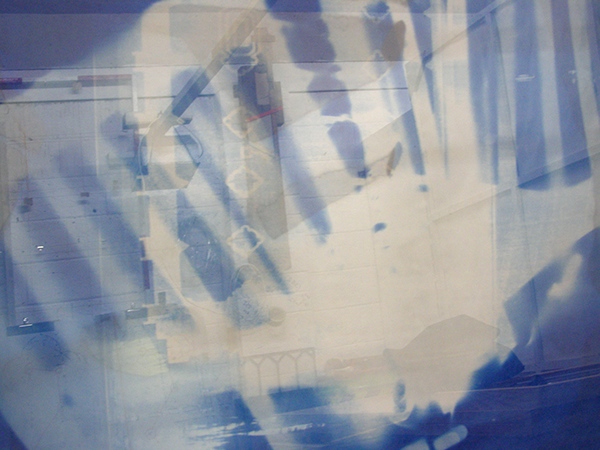
Prussian Blue
Material Immediacy
Matter and Mutability
Strange visual spatialities
A space of time and the capacitance between things
Cyanotype postcards of phenomena
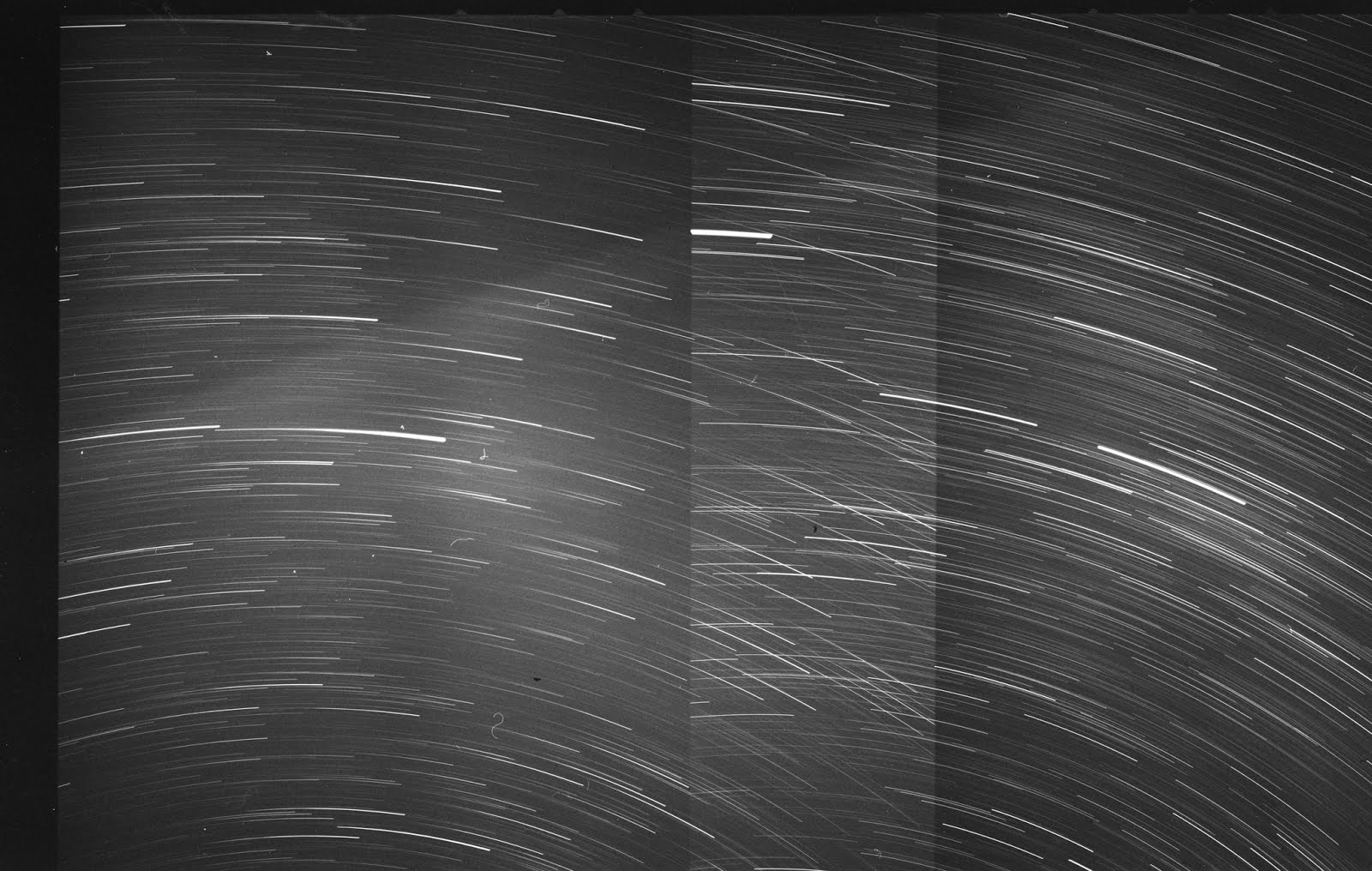
Botanical, Astronomical,
Flesh of the film
Subjectivity in forsaken spaces
Robert Ryman
USED paint, Suzanne P. Hudson. 2009
About the 'how' of the material.
Exploration on the nature of paint.
Primer
Painting
Support
Edge
Wall
Edward Thomas
Eno, vessel on a milk white sea
The clay produces an abstracted division of space, letting the material find ones boundary.
studioUS artwork submission
Listing for exhibition at PRIMEYARC, Market Gates, Great Yarmouth.
Studio 3.16 Spatial Apparatus
This large mobile pinhole camera has been used to inquire into the nature of photography and the intermingling of movements and things. The apparatus is used within my art practice which is centred around making, interior design and teaching.
Key Words, temporal agency, spatialities, environs, art practice, apparatus, photography,





.jpg)


