A provisional research ecology: material absorbed in its own thoughts. A gathering place for things being made, read, sensed and thought. Images, texts, bodies, spaces and matter(s) move through correspondence, forming tentative rooms of inquiry. Research circulates between depth and surfacing, archive and anarchive, allowing propositions to return, migrate and become otherwise.
Tuesday, 29 November 2022
Exploratory Practices : Archive/Collage/Mapping
Thursday, 17 November 2022
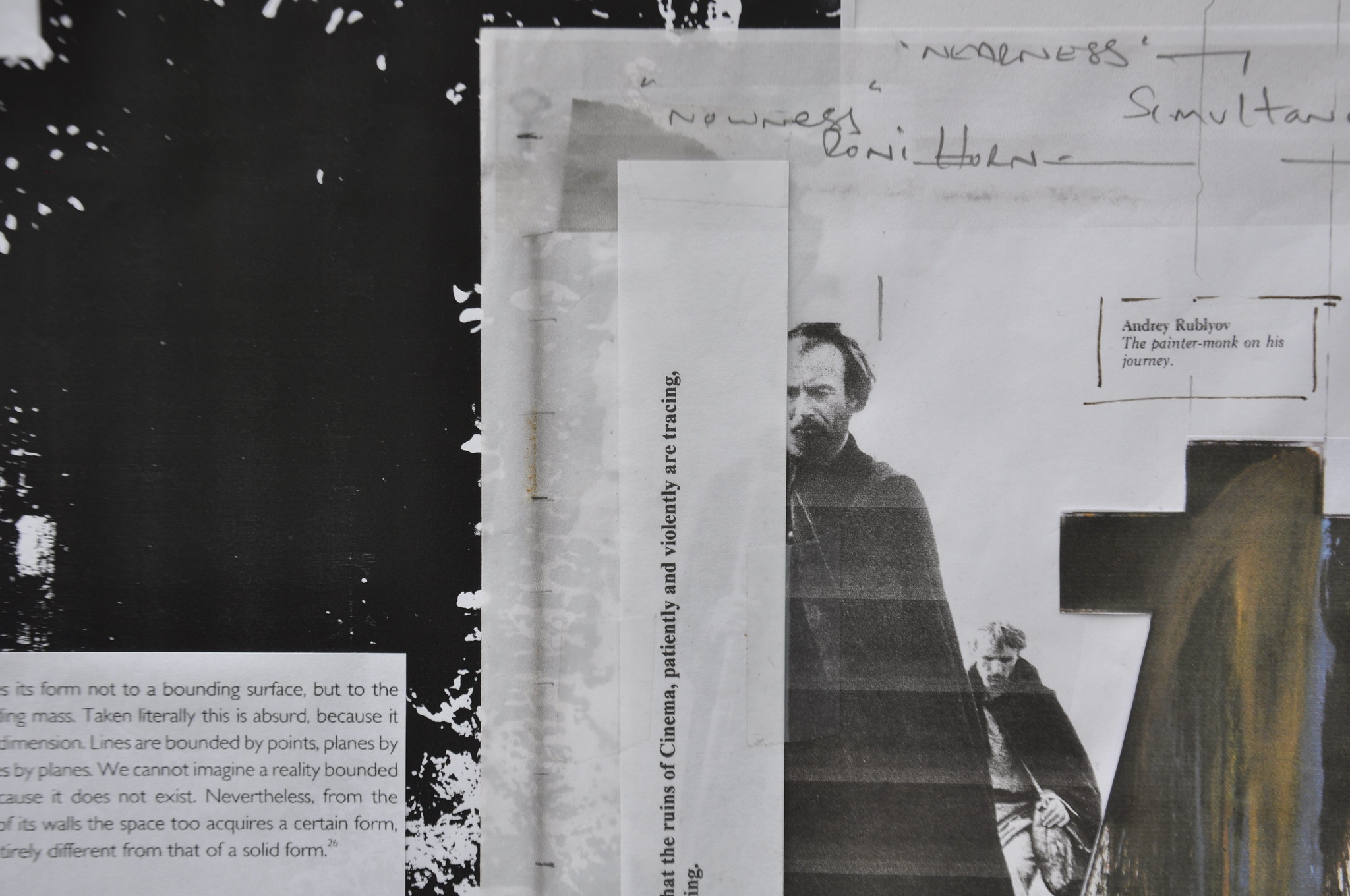
Collage Cinema : Tarkovsky : Andrey Rublev the painter-monk.
Friday, 11 November 2022
Body and Water, cyanotype process, trace drawings : Outpost 281022
Outpost 281022
Pinhole Camera
Cyanotype Postcards
Exhibition Proposal
Monoprints/Cyanotypes on Chinese paper.
Moving Diorama.
Spiritual and Corporeal Presence.
Developing installation around themes relating to the body and water.
Baptismal Fonts, sacred sites and secular spaces.
Selected Exhibitions, Hyde 900, Space for Peace, Link Galley.
Tuesday, 8 November 2022
The Re-Constituted Reality : Tacita Dean/Hamburger/Sebald
The Re-Constituted Reality of Photography
Spatiality : Space over Time
Space folds : Containing "Spatialities around historicality and sociality
All that is solid melts into air
Karl Marx, Friedrich Engels,
(Poetic observation concerning the constant revolutionizing of social conditions)
Perceptions now gathering at the end of the millennium.
After SEBALD : Essays and Illuminations
http://www.tate.org.uk/art/artworks/dean-michael-hamburger-t12880
The film Michael Hamburger was created as a result of a commission for an exhibition entitled Waterlog, held at the Norwich Castle Museum and Art Gallery and the nearby Sainsbury Centre for Visual Arts in early 2007, before it travelled to The Collection in Lincoln in autumn of the same year. Tacita Dean was one of seven British artists invited to respond to ‘the wider landscape of the east of England, with the idea of the literary journey as one its overarching themes’ (curator Steven Bode in Waterlog, p.6). This literary journey is embodied in the book The Rings of Saturn (Frankfurt am Main, 1995) by the German writer WG Sebald (1944–2001), who settled permanently in England in 1970, making Norwich his home. Part memoir, part fiction and part poetic and philosophical meditation, Sebald’s book describes a meandering circular walk that begins and ends in Norwich. Dean chose to make a portrait of the poet and translator Michael Hamburger (1924–2007), whom Sebald visits in the seventh chapter of the book. She has explained:
I had a personal connection to [Michael Hamburger] and I was told he had an orchard. When I filmed him I filmed quite a lot and I talked to him about Sebald and all sorts of other things but in the end I made my film just about apples. It was in cutting the film that I realized it was the most important thing and through apples he talked about everything else as a metaphor ... My work has become about traces and capturing things before they disappear. It’s all about the recording of an atmosphere and usually it’s transient in a sort of way.
Dean’s anamorphic film is a series of almost exclusively static shots filmed in the Suffolk garden and house of her subject. Utilising natural light and unusual points-of-view – often filming either against the light or looking through windows – the looped 28 minutes of widescreen imagery constitutes a portrait whose subject is barely visible, evoking an intensely private personality. Hamburger features in semi-darkness, as a silhouette, as a pair of hands, handling apples, or seated with his back turned to the audience; in one shot only slivers of him are visible intermittently through a chink in a curtain drawn across an internal glass-paned door. This subtle visual representation is echoed in the words he speaks – a discourse exclusively focused on his apples – the different types, their origins and characteristics. Between shots of him, the camera focuses on apples on trees in the garden, rows of apples on a wooden surface in the house, and many rows and piles of books. One shot lingers on a copy, in English, of poetry by the German writer Günter Grass (born 1927). The climax of the film is a reading of one of his own poems by Hamburger, written on the occasion of the death of his friend, the poet Ted Hughes (1930–98). For Hamburger, the link of their friendship is expressed through an apple – the Devonshire Quarenden apple growing in Hughes’s garden – from pips of one of which donated by Hughes, Hamburger grew two trees. He explains that he did this, partly because he was attracted to it by its dark colour, but also because Hughes ‘was a very good friend and it was a kind of link between us if I could have this apple in a Suffolk garden where it didn’t really belong’. His poem lingers on the apple as remembrance and the notion of the fruit’s continuity in contrast with human mortality, ending with the words: ‘hardened, mellowed the fruit to outlast our days’. Dean extends the theme of mortal transience by following Hamburger’s reading with a shot of him smoking in semi-darkness, succeeded by views of a rainbow in the sky above his house. This climax is rendered more poignant by the fact that Hamburger died in June 2007, only a few months after Dean completed her film.
Michael Hamburger is the most recent in a series of film portraits Dean has made that include Mario Merz 2003 (a portrait of the artist by chance also made shortly before his death), The Uncles 2004 (footage of two of the artist’s uncles talking about the family’s relation to Ealing Film Studios, set up by Basil Dean, her grandfather) and Presentation Sisters 2005 (featuring a group of five nuns living in Cork, Ireland). All share with Michael Hamburger an elliptical approach to portraiture which functions as a kind of poetical allegory. Dean’s work is based on networks of coincidental linkages that originate – usually invisibly – with the artist, and more visibly with a person, thing or event in the world, extending outwards into the larger macrocosm of time and space. She shares this preoccupation with Sebald; her essay on him, first printed as an artist’s book as part of a seven volume publication in 2003 (Göttingen and Paris) and reprinted in Waterlog (pp.92–109), describes her personal connection to him through a series of historical coincidences. In The Rings of Saturn, Sebald describes Hamburger’s emigration from Germany with his family to the United Kingdom in 1933, the fears and loss of emigration, his memories of his native Berlin and the ways in which they inform his dreams. He meditates on the question of why his identification with Hamburger, as a fellow German who has made his home in England, should run deeper than a question of national identity, writing, ‘how is that one perceives oneself in another human being or, if not oneself, then one’s own precursor? ... why it was that on my first visit to Michael’s house I instantly felt as if I lived or had once lived there, in every respect precisely as he does, I cannot explain.’ (The Rings of Saturn, London 2002, pp.182–3.)
In common with all Dean’s films created since 2001, Michael Hamburger contains no titles, credit sequences or additional sound, other than what is present during filming. It is projected from a booth onto a screen on the opposite wall in a darkened room, showing on a continuous loop. It was produced in an edition of four, of which Tate’s copy is the first.
Further reading:
Waterlog: Journeys Around an Exhibition, exhibition catalogue, Norwich Castle Museum and Art Gallery, 2007, pp.40–7, reproduced 42–4.
Elizabeth Manchester
July 2009
Art as Spatial Practice.
10 Days in the Laundry, Winchester.
Photograph (13) Illuminated Cathedral
Photograph (350) Anthropocene
Spliced Interior : Waverley Abbey
Pinhole Camera, exposure and movements within the ruined interior.
Russell Moreton


Sunday, 6 November 2022
Blue and Gray Paintings/Drawings on Glass : CELL COURT DOMAIN FIELDS
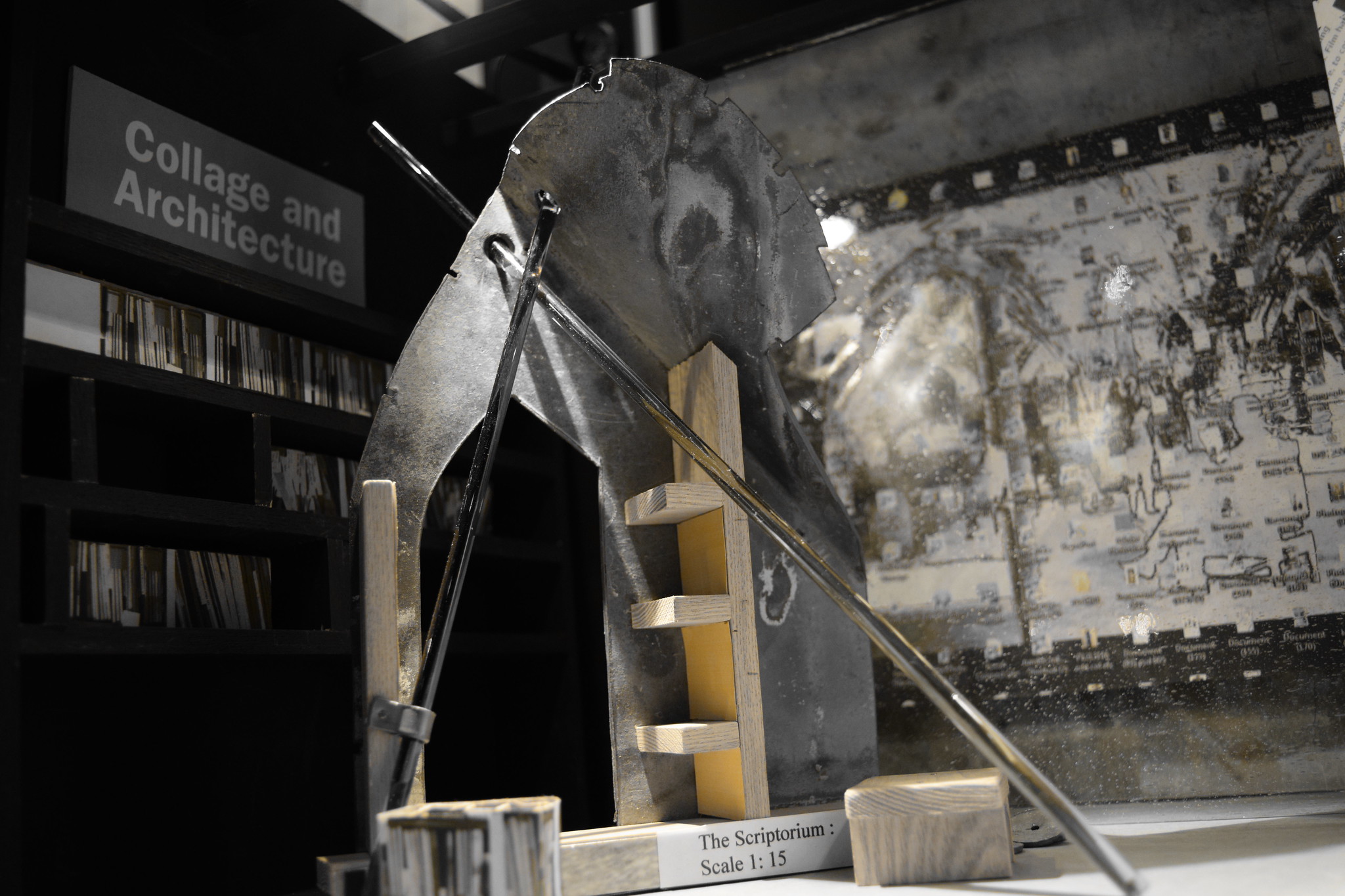
Architectural surface for a Library, raw materials, light, silence and solitude.
Subjectivity and The Instant
The Numinous
In the last decades of the twentieth Century, philosophy witnessed a marked preoccupation with the discontinuous and the disruptive.
Translator's Preface, Eileen Rizo-Patron.
Intuition of the Instant, Gaston Bachelard.
Tuesday, 25 October 2022
The phenomenal nature of the idea : Architectural Intertwining/Environs, object scripted inquiry
Lead, photographic (pinhole) and inkjet visual material from flickr stream, fixing tapes, cyanotype on tracing paper, pierced and re-positioned elements on paper.
Idea is,
the invisible of this world, which inhabits this world, sustains it, and renders it visible
Merleau Ponty
Start by thinking of architecture as a tentative constructing toward a holding in place. Architecture's holding in place occurs within and as part of a prevailing atmospheric condition that others routinely call biosphere but which we, feeling the need to stress its dynamic nature, have renamed bioscleave.
Architectural Body
Madeline Gins and Arakawa
For Steven Holl, the intertwining of idea and phenomena occurs with the realization of a building as the means for the materialization of the idea force
A methodology of connecting phenomenal properties with a conceptual strategy
Camouflage
Neil Leach
For Benjamin, the twentieth century is an age of alienation. Human beings are no longer 'cocooned' within their dwelling spaces. Architectural spaces are no longer reflections of the human spirit. Something has been lost.
Mimesis, 19.
New Concepts of Architecture
Existence, Space and Architecture
Christian Norberg-Schulz
A child 'concretizes' its existential space.
A Philosophy of Emptiness
Gay Watson
Artistic Emptiness
Everything flows, nothing remains.
Heraclitus
Rethinking Architecture
Neil Leach
Figure 1, Sketch by Jacques Derrida for Choral Work project. 343
Foucault, Figure 2 Bentham's Panopticon (1791). 360
Page laid in, The Atrocity Exhibition by J. G. Ballard, new revised edition, annotations, commentary, illustrations and photos.
Tracing Eisaenman
Plenum, juxtaposed to form/haptic values/body absences
Robert Mangold
Between moments of 'meaning' lie spaces or blanks of immediate experience. Such blanks are actuality. Usually the blank, the actuality, goes unnoticed because it works so efficiently to differentiate one meaningful event from another. Kubler discussed this in The Shape of Time.
Interactions of the Abstract Body
Josiah McElheny
Object Lesson/Heuristic Device
The term 'heuristic' is understood here to denote a method of addressing and solving problems that draws not on logic but on experience, learning and testing. In this regard stories and fictional narratives can be heuristic devices in acting as ideal models that are not to be emulated but which help to situate characters, actions and objects.
Space Between People
Degrees of virtualization
Mario Gerosa
Adaptive Architectural Design
Device-Apparatus
Place
Function
Adaptation
The second phase of project activity acknowledges that the proposal involves two sites; the landscape of settlement and the artifice of the factory. The design is intended to be a reflection of the conditions of each, so there was a need to work directly with the manufacturing process, at full scale, as early as possible. This would provide an immediate counterpoint to the earlier representations and a necessary part of exploring the manufacturing medium in the context of architectural design. 69
Building The Drawing
The Illegal Architect
Immaterial Architecture
Mark Cousins suggests that the discipline of architecture is weak because it involves not just objects but relations between subjects and objects. And if the discipline of architecture is weak, then so, too, is the practice of architects. Architecture must be immaterial and spatially porous, as well as solid and stable where necessary, and so should be the practice of architects.
Jonathan Hill
Index of immaterial architectures
Herzog and De Meuron
Natural History
Exhibiting Herzog and De Meuron
We are not out to fill the exhibition space in the usual manner and to adorn it with records of our architectonic work. Exhibitions of that kind just bore us, since their didactic value would be conveying false information regarding our architecture. People imagine that they can follow the process, from the sketch to the final, photographed work, but in reality nothing has really been understood, all that has happened is that records of an architectural reality have been added together.
My studio is a piece of architecture that is silent. The things of which it is made say all and at the same time nothing. Its strength lies in its demanding silence. A stern silence in order to permit works to occur. I imagine that a painting by Newman could be hung there.
The arrival of Beuys in a world that was gradually falling asleep amidst minimalism generated a kind of confusion that was truly excellent for opening up the mind. Comfort vanished, driven away by subversive complexity.
Thursday, 20 October 2022
The Relational Perspective : The Archive, correlated and entangled.
Outpost 201022
The Archive.
The Relational Perspective.
Correlated and Entangled.
The archive governs the said and the unsaid, the recorded and the omitted, and the aim of the knowledge archaeologist is to learn about the past via its material remainders, retrieving and reconstructing the archive to show how it can shape the construction of a historical meaning.
Foucault.
Despite a gaze that is seemingly looking back, the archive is always dominated by a sense of the future, a desire for eternity that reaches beyond death.
Derrida.
Text.
The Discursive Material.
In a book, as in all things, there are lines of articulation or segmentarity, strata and territories; but also of flight, movements of deterritorialization and destratification. Comparative rates of flow on these lines produce phenomena of relative slowness and viscosity, or on the contrary, of acceleration and rupture.
The beauty of the assemblage is that, since it lacks organisation, it can draw into its body any number of disparate elements. The book itself can be an assemblage, but its status as an assemblage does not prevent it from containing assemblages within itself or entering into new assemblages with readers, libraries, bonfires, bookstores, etc.
Assemblage.
Deleuze and Guattari.
Surprising and meticulous the archive provides an understanding of the key stages in the artist's development. The sketches, workbooks, models and photographs speak of a creative moment in the past, but form a bridge to a potential future action, underlying the intellectual and stylistic consistency that distinguishes the artist's works in the visual arts, theatre, architecture and graphic design.
The archive here is neither an accumulation nor a scientific and objective rendering of materials, but a theatre of the memory where several characters pursue one another and interweave on stage, revealing their identities past and present.
Alfredo Pirri : RWD-FWD 2016
Curated by IIaria Gianni, RWD-FWD is the first appointment of the project I pesci non portano fucili (Fish cannot carry guns), whose title is a quote devoted to Philip K. Dick's work The Devine Invasion (1981), in which the author imagines an unarmed and fluid society, comparable to the open sea.
The RWD and FWD (rewind and forward) buttons will always be remembered with nostalgia by the generation that lived through the transition from analogue to digital. Re-listening to or re-seeing what has already passed and then, at the mere press of a button, projecting oneself into the future has enabled us to feel powerful ahead of our time. By elevating this simple action to a metaphor for the unique sense of omnipotence, light-heartedness and modernity that distinguished the 1980s.
Not only does the material conserved by the artist take our thoughts back in time, it also allows us to veer towards a time yet to come, opening up a past that always hints at a potential future.
An Attitude To History.
Castelvecchio.
Carlo Scarpa
Jannis Kounellis.
Kairos, the movement and its moment.
Being Alive.
Tim Ingold.
SPAB.
Society for preservation of ancient buildings.
The First Markings/Demarcations and Localities.
Leaving traces that are both symbolic and practical.
The Production of Space.
Lefebvre.
The exhibition takes the form of an open and participatory narrative script, conducting spectators through an archaeology that records and presents personal moments, movements and stories inscribed within a more universal cosmology.
Iiaria Gianni. 2017
Each step of this extensive shared project, conceived as a journey inside Alfredo Pirri's work, thought process and research, will be independent, yet, at the same time in dialogue with others.
The choice to use the artist's studio as an exhibition space comes out of the desire to give the audience the possibility to discover the venue in which he usually meditates, collects his source materials, his documents and creates his works. For this occasion a selection of material (traces of research) produced and preserved by the artist, both physical and conceptual witnesses his thinking process.
Studio as an immersive space, a place of meditation, inhabited by forms sometime evocative of vegetable ones, and linking up to the work of the botanist Anna Atkins, a pioneer in the study of flora using cyanotype and author of Photographs of British Algae : Cyanotype Impressions.
The Archive/Exhibition.
References what remains and what is moving forward, outlining a past and prefiguring a future.
The large-format cyanotype prints record the phases of a work process and what it leaves behind.
The archive provided by Alfredo Pirri declares itself as an attempt to collect, as fully as possible, and to conserve a past, albeit in an idiosyncratic order with unexpected and fragmentary material which is an inevitable part of a life and a creative process.
Sunday, 16 October 2022
Performative Documentation : Time as both a structure and an event
DID SOMEONE SAY PARTICIPATE? AN ATLAS OF SPATIAL PRACTICE.
Edited by Markus Miessen and Shumon Basar
A few notes relating to thoughts and critical theory around which I am beginning to formulate about my practice and its application as a site from which to “stage a performative discourse of exchange”. My Spatial Practice becoming more like a curatorial trans-disciplinary producer of “on-site” exchanges and relations.
PREFACE
PARTICIPATION LASTS FOREVER Hans Ulrich Obrist
The Museum as oscillating between object and process; the “ elastic museum ” as being flexible allowing displays to be placed within an adaptable building. Alexander Dorner,
Ways Beyond Art.
Hans Ulrich Obrist notes Dorners critical remark ’’the museum as a bridge built between artists and a variety of scientific disciplines”. This observation has been taken-up by contemporary curatorial practice with the inclusion of architects, philosophers, political thinkers/theorists and visual artists into the production of exhibitions and events. The contemporary exhibition can be viewed as part of an on-going and indeed a “complex dynamic learning system” quotes Obrist.
One should renounce the closed, paralysing homogeneity of the traditional exhibition master plan. Artworks would be allowed to extend tentacles to other works- and other fields of knowledge. The curator must not stand in the way of such growth. Hans Ulrich Obrist.
Working Spaces, Sites of Inquiry and Dialogue, Spatial Practices, Canterbury 2009
OPEN TEXTS.
Allow readers to have multiple interpretations, they allow for the possibility of “determinations”.
Relationality
Gaps between connecting and disconnecting.
Notion that categories hide and weaken our perceptions of reality.
Fluctuating networks of existential events.
Emergent state of contingences that create materials for relationality.
For me this curatorial setting could be an interesting set of relations that might be rehearsed and re-presented within a “site” ( an intervention and interruption into our notion of place and placed relations).The notion that one could become an active agent and on-site translator amongst this “ trans- disciplinarily” would be worth investigating . The opportunity to be in the position to have dialogue with other practitioners and to negotiate and expand that dialogue between the different realities and fields made apparent by “site“ could produce new relational meanings.
My particular interest is with the production of ephemeral values and situations, free spaces and sites created from the interruption of place. Photography and installation have been used as an intervention into place. The artists Jane and Louise Wilson have successfully used it to present work around the psychology of architectural spaces. This value of psychology tied up with our psychological reality created by the motion of our own emotions as we project ourselves into space, could be presented by some analogy (working device) to theories, or rather theorising with the camera obscura.
Photographic Laboratory, roving camera and apparatuses during the arts event 10 Days in The Laundry, Winchester.
Performative work using the simple enchantment of the pinhole camera to question and explore the extrusive nature of time, performativity and site.
Proposed Title, Molecular Sieve/Photographic Apparatus/Theorising Object
Currently using a spatial practice to investigate issues around architectural influences on the placed self. Utilising the mobility and awkwardness of an appropriated object as an apparatus to both theorise and register spatial relations/phenomena. interested in using the values and traits of transparency and superimposures to describe the dimensionality of dwelling in place, how might these “on-site” recordings become registered into the possibility of a surface membrane of material metaphors of memory?
A performative documentation that makes visible the extrusive nature of time as it accumulates and is deposited on a photographic surface.
This performative investigation utilises a large pinhole chamber which is allowed mobility through the attachment of castors to its base and the use of a sack-barrow for undulating terrain. This apparatus produces through its very inclusion into the “space” a theoretical device centred around and relational to spatial values and influences. My aim is to utilise this device as a means of registering “worksite” both in the duration of the event and in its pre-per formative state. The mobility of this research device could be used to investigate, register and illustrate a constantly changing set of dynamics throughout the site and its event. The use of perhaps adjacent wall surfaces or even a “sandwich-board” could render a tangible re-presentation of spatial information for the visitor. Darkroom facilities could be arranged on-site to complement this work as a “working site” functioning within the orbits of both the other works and their prospective guests.
Contextual Issues. Urban Fallow-Sites.
Brief description about methodologies and goals. Urban Fallow,
Solentcentre for architecture and design.
Urban Fallow aims to develop a pragmatic but fluid approach to public access, cultural intervention, use and temporary transformation of urban spaces.
Urban Fallow is interested in using vacant urban land and spaces. The project is about reanimating these sites through the use of artists, architects, performers and other professionals, all of which have an interest in engaging with the public. This could be undertaken by the use of temporary events and per formative interventions, this would also have an effect on reducing urban blight and help to reinvigorate interest in these sites for potential investment.
Other longer term legacies might include the provision of longer term public access and cultural use even the possibility of a permanent change of use for a chosen site. To help to deliver an “improved perception and identity of the space for the public together with current user groups and prospective developers.”
Winchester, Hyde Abbey Laundry.
A site of approximately 1500 square metres made up of redundant industrial buildings together with a yard. The property is close to Winchester School of Art and the town centre. The Laundry closed in 2007 and has been vacant ever since then. The building in its current state of dis-repair is unsuitable for most purposes. However it is being viewed by creative practitioners from a broad range of practices as potential studio spaces.
Other Documents,
List re, Participating artists, actors, writers, musicians and chef.
Artist Statement/Work Statement as public handouts, made available (resting on apparatus) for visitors. 10 Days at the Laundry, on flickr site with installation images.
The Apparatus/Device/Research Collage
Time as both a structure and an event, photographic image from a moving apparatus
Brief comment around my use of “apparatuses” researched and questioned through the text “The Apparatus” Vilian Flusser.
Definitions, An Apparatus would be a thing that lies in wait or in readiness for something, and a preparatus would be a thing that waits patiently for something.
The photographic apparatus (a camera) lies in wait for photography. A camera is a tool whose intention is to produce photographs. Tools inform the materials, they “work” them.
This fact/interpretation that tools inform materials has interesting consequences. Flusser states, ’’The object( the thing the tool acts on) acquires an unnatural and improvable form, it becomes cultural. The issue is to keep the definition of “apparatus” open and refrain from referring it as a “tool in the service of photography.”
Other issues regard the “recording of something” as an image and the “registering of information” about a specific duration or experiment. Further issues of “intension” and “reading for what destination/purpose” will need to be clarified to continue. At this point I began to view the perspective of the “apparatus” as a sort of carrier and container, a sensor for some type of “isotope.” I imagined that the apparatus was just some sort of “litmus paper” something that functioned as a sort of barometer in the proximity of “site relations” the architectural. The sociological and the encountering and relational element of human curiosity. This rather spatialised concept envisaged human subjectivity as a mapping around scientific and sociological phenomena, a geography brought about by the performativity of place, time as both a structure and an event.
Francis Aly's, POLITICS OF REHEARSAL
“While everything Aly's creates has a simplicity that makes it instantly accessible, his work also offers a complexity that continues to resonate long after it has been seen”. Anne Philbin Directors Forward, Politics of Rehearsal;
Francis Aly's work has up to this point emphasized issues of place (Mexico City in particular becoming his adopted home).Aly's originally trained as an Architect and was practicing as such in Belgium. When he moved to Mexico City in the early 1990s where he began to experiment with art which reflected his own inclination to avoid definite conclusions.
In this sense he was already formulating the notion of a “rehearsal for a presentation that may or not be completed".1 The use of interventional tactics and strategies as a result of a “reaction” to Mexico City and also a way of positioning himself. It is interesting that Aly's continues to make fresh interventions into apparently completed works.
Aly's describes his work in these terms ”a sort of discursive argument composed of episodes, metaphors or parables, staging the experience of time in Latin America”.2
The Politics of Rehearsal deals with issues around the concepts of rehearsal and repetition, with its “open ended” process which allows specific details to be retained whilst also allow the possibility of others to be reviewed/worked over and possibly changed. This creates an “open site” prescribed around “key” or interlocutory relations that can then be literally presented as being a “presentation” of a process rehearsing for its re-presentation.
This sense of an evolutionary on-going situation, a working site that permit’s the interventions of other activities that pass through and beyond the register of its own narrative space.
What interests me is the notions/propositions of “the rehearsal” as a non-consecutive chronological structure, which does not have to render a specific conclusion, it only has to announce that it is over/finished or ended. It can even announce/negate that their will be “no-rehearsal” thereby paradoxically marking its proposal and place but then deigning its presence in place.
Rehearsal also offers up its space/time relation for performers to re-start, stop and begin again, it allows a multiplicity of spatial relations to be configured in segmented intervals/time slots under a durational influence which is driven by the purpose and intension of a proposal to perform. Aly"s has also utilised the use of the chronicle.
The proposal of “to Chronicle” to record occurrences, a chronicle is always in the end a record of a series of consecutive events, of which there might be no final resolution, but what a chronicle sets out unequivocally and without adjusting the flow of events is to give a precise record/witness that one thing exists prior to the recording of the next.
This particularity is mirrored in some respects by the duration and entropic nature of the photographic surface, what it has in common with the nature of being able to chronicle is that of “times arrow” a precise directional flow, mediated by the amount of light,(too little, no visible traces remain, too much, and what had been recorded is over-written to the point of total obliteration through too much information) The surface literal becomes spent, used up by agencies and proportions of the light based durations. The chronicle remains readable because it keeps-up this the unfolding of events, whilst the photographic surface is rendered un-readable unless it bracketed into individual but sequential episodes.
The notion of episodes and chronicles both require a pre-determination from the outset to create their form, they in effect act by framing segments of “what is occurring” into a prescribed duration or form.
The photographic surface renders consecutive occurrences via a transposition of transparency which produces a superimposure as a direct unequivocal evidence of something having existed before something else.
This marking out, in scripting, overlaying of occurrences as factual specific/spatial realities become relational to themselves through the negative/positive aspect of their physicality.
What the photographic surface lacks is a definitive time-line a frame of reference in proximity to the information which has become abstractively distant.
The relations of a material or form that can register consecutive occurrences and still register the totality of an event as a surface, a transparency of episodes.
1 Russell Ferguson, Politics of Rehearsal, (Los Angeles: Hammer Museum, 2008)
2 Interview with Russell Ferguson.
Friday, 14 October 2022
Refractive Phenomena : Site Circumstances, Water/Glass/Film.
Outpost 141022
Water : A Phenomenal Lens.
Refractive Phenomena.
Void Space Water Gardens.
Steven Holl.
The haptic realm of architecture is defined by the sense of touch.
When the materiality of the details forming an architectural space become evident, the haptic realm is opened up. Sensory experience is intensified; psychological dimensions are engaged.
The psychological power of reflections overcomes the science of refraction.
As rational metaphysics teaches that man becomes all things by understanding them, imaginative metaphysics shows that man becomes all things by not understanding them, for when he does not understand he, becomes them by transforming himself into them.
Vico, New Science.
One of the tragedies of modern urban life is that a complex of urban constructions often puts us out of touch with the poetry and unpredictability of the everyday change in the weather.
Patti Smith
Baptised by the New World
Site : Circumstance and Idea.
Phenomenal zones function life a manifold of parts, presenting the question of a whole more substantial than any of its components.
Each challenge in architecture is unique; each has a particular site and circumstance or program, and for each to fuse sit, circumstance, and a multiplicity of phenomena, an organizing idea .. a driving concept is required.
The unity of the whole emerges from the thread that runs through the variety of parts; whether it be one discrete idea or the interrelation of several concepts.
To find a balance between the science of water and the exhilarating qualities of experience, consider the many states and transformative properties of the substance. We might consider water a 'phenomenal lens' with powers of reflection, spatial reversal, refraction, and the transformation of rays of light.
The 'void space' water gardens and the interior ceilings of the adjacent apartments are connected by reflected light from the ponds. These 'void spaces' containing three inches of water over black smooth stones from Ise, are analogous to a sacred space within the every day world of domestic urban life.
Hungate Medieval Art.
Water, Working Title.
Exhibition, St Peter Hungate, Norwich. 2023.
Sculpture, Installation, Sonic Art, Performance and Film Screenings.
The live reflection of echo and re-echo within a stone cathedral increases our awareness of the vastness, geometry and material of its space.
Water, its use in Christian rituals, baptism, confirmation, confession, ordination, matrimony and anointing of the sick.
Responding to the physicality of stone fonts as objects to hold holy water.
Objects produced according to the doctrines of the Roman Catholic church before the Reformation.
An attention to phenomenal properties of the transformation of light through material can present poetic tools for making spaces of exhilarating perceptions. Refraction phenomena produce a particular magic in architecture that is adjacent to or incorporates water.
Of Sound.
Quieting the mind
deep in the forest
water drips down
Hosha.
The brevity of a Japanese haiku poem isolates the 'thing-in-itself' of experience and perception of material and detail.
Space brings the resonance of the acoustic near to life.
John Cage.
In some European cities, the regular sound of the church bell's community call creates a psychological space. Its perceptual associations are tied to the materiality of the bell, its resonant tower, and the adjacent square. This kind of 'sound space' cannot be accurately recreated with electronic speakers.
Sound is absorbed and perceived by the entire body. A sequence of sounds can have a mesmerizing effect on the psyche.
John Cage went into an anechoic chamber over sixty years ago in order to 'hear sounds' and found that experience gave his life direction. Cage's radical and poetic experiments with sound bridged the conventional gap between musical phenomena and the physical and psychological effects of sound.
Electronic music has increased the ranges available to composers and changes in thinking have reframed sound and time.
Scripting Aural Phenomena.
The architecture of music, the structure of aural phenomena might have a graphic parallel in architectural notations; plans sections, axonometrics, etc. Many composers have used time-space notations in order to compose with irregular rhythms. Notations which allow for accidental chromatic notes, microtones, clusters of vertical bands between marked pitches all appear different from conventional notation.
Accordingly we consider a re-framing of space, light and time in architecture.
Paul Valery suggested the closeness of music and architecture, that sculpture and painting one can turn way from, but music surrounds us as does the space of architecture.
Detail : The Haptic Realm.
Today the industrial and commercial forces at work on the 'products' for architecture tend towards the synthetic; wooden casement windows are delivered with waterproof plastic vinyl coatings, metals are 'anodized' or coated with a synthetic outer finish, tiles are glazed with coloured synthetic coatings, stone is simulated as is wood grain.
The sense of touch is dulle or canceled with these commercial industrial methods, as is the texture and essence of material and detail displaced.
The total perception of architectural spaces depends much on the material and detail found and experienced through the haptic realm.
The texture of a silk drape, the sharp corners of cut steel, the mottled shade and shadow of rough sprayed plaster or the sound of a spoon striking a concave wooden bowl, all reveal an authentic essence which stimulates the senses.
Fields.
Diagrams of Field Conditions.
All grids are fields, but not all fields are grids.
On of the potentials of the field is to redefine the relation between figure and ground. If we think of the figure not as a demarcated object read against a stable field, but as an effect emerging from the field itself- as moments of intensity, as peaks or valley within a continuous field, as the figure and field become more enmeshed.
Rather than considering photography as a means to capture an instant, some artists subverted this practice to express duration in time. Sometimes through collages, sequences and superimpositions, in some cases through a single long exposure.
Photographers are exploring different methods to synthesize the fourth dimension within the bidimensional range of the frame. The results provide a wide variety of unexpected solutions, some extremely synthetic while others very fragmented, pushing further the boundaries of the practice.